The AG-UI Protocol: Making AI Agents Truly Native to Your Application
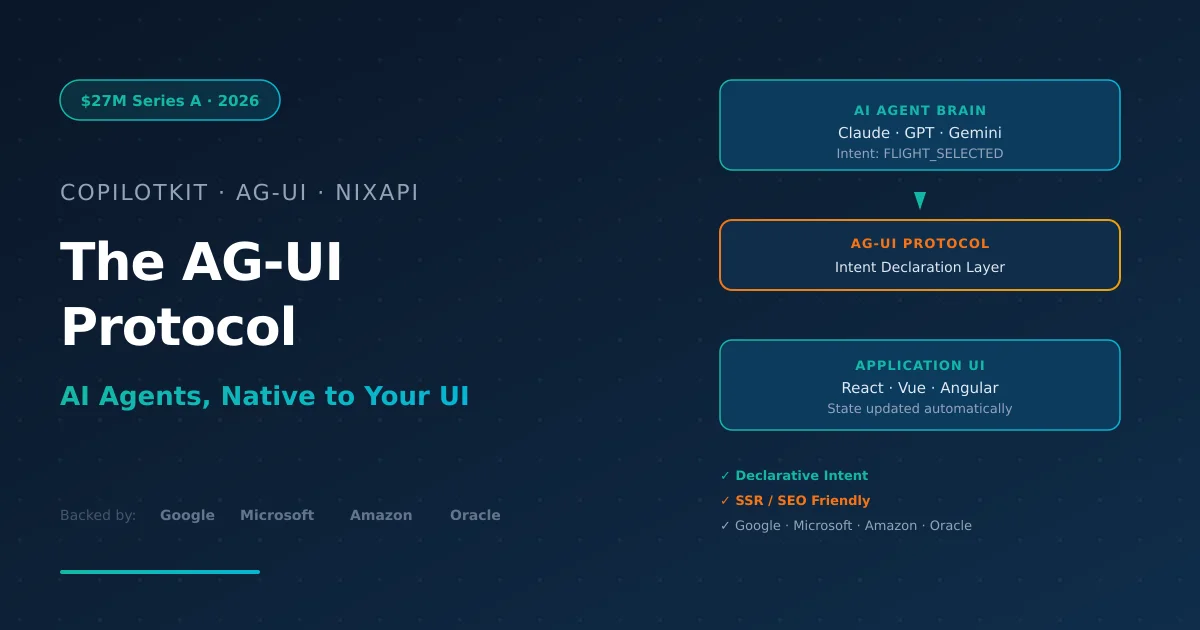
CopilotKit raised $27M Series A and its open-source AG-UI protocol is becoming the industry standard for integrating AI Agents into application UIs. This article deep-dives into AG-UI's core design philosophy, comparison with existing approaches, practical integration examples, and why this protocol may be the missing piece for AI Native applications.
Note: Facts sourced from CopilotKit’s official announcement (copilotkit.ai, May 6, 2026) and Zamin.uz tech reporting. No undisclosed information.
1. Why a Dedicated Protocol Was Needed
The Current AI Agent “Predicament”
Today, developers integrating AI Agents with applications have three main approaches:
| Approach | How It Works | Drawbacks |
|---|---|---|
| Text-only chat | Agent returns text, app renders | Users manually copy-paste; can’t interact with real UI |
| Browser Use / Playwright | Agent controls browser to operate real pages | Slow, unstable, easy to block with anti-bot |
| Function Calling | Agent calls APIs, app executes | Each operation needs hand-written function schema; high maintenance cost |
The root issue: AI Agents output “text”, while modern applications run on “interactive UI”. There’s a semantic gap between them.
AG-UI’s Core Insight
The AG-UI (Agent-Generated User Interface) protocol’s core thesis:
An Agent should directly declare its operational intent, not simulate human UI interaction behavior.
The protocol doesn’t care about “which button to click” — it cares about “what operation to complete.” The application-layer UI framework decides how to respond to that intent.
2. How AG-UI Works
Architecture
┌─────────────────────────────────────────────────────────┐
│                    Application UI                        │
│  ┌─────────────┐  ┌─────────────┐  ┌─────────────┐      │
│  │  Component A │  │  Component B │  │  Component C │      │
│  └─────────────┘  └─────────────┘  └─────────────┘      │
│                          ↑                               │
│                    AG-UI Protocol                        │
│                    (Intent Layer)                         │
└──────────────────────────┼───────────────────────────────┘
                           ↓
┌──────────────────────────────────────────────────────────┐
│                     AI Agent                              │
│  ┌──────────────────────────────────────────────────┐    │
│  │  Agent Brain (Claude / GPT / Gemini)              │    │
│  │  → Decides intent: "user wants to book flight"   │    │
│  │  → Emits: { type: "FLIGHT_BOOKED", params: {...}}│    │
│  └──────────────────────────────────────────────────┘    │
└──────────────────────────────────────────────────────────┘
Defining Intents
AG-UI doesn’t manipulate the DOM — it declares operational intents:
// Agent side: declare intent (doesn't care about specific UI implementation)
const intent = {
  type: 'FLIGHT_SELECTED',
  params: {
    flightId: 'CA1234',
    departure: 'PEK',
    arrival: 'PVG',
    price: 890,
    passengers: 2,
  },
  confidence: 0.97,
  reasoning: 'User asked for cheapest Beijing-Shanghai flight, CA1234 is ¥890',
};

// Application side: receive and process intent
function handleAgentIntent(intent: AgentIntent) {
  switch (intent.type) {
    case 'FLIGHT_SELECTED':
      return uiStore.updateBookingForm(intent.params);
    case 'PASSENGER_ADDED':
      return uiStore.addPassenger(intent.params);
    default:
      return uiStore.showSuggestion(intent);
  }
}
Bidirectional State Synchronization
Another core AG-UI capability is bidirectional state sync:
// Application → Agent: UI state changes sync in real-time
uiStore.on('change', (state) => {
  copilotKit.syncContext({
    flightSelection: state.selectedFlights,
    passengerCount: state.passengers.length,
    totalPrice: state.totalPrice,
  });
});

// Agent → Application: intents directly drive UI changes
copilotKit.on('intent', (intent) => {
  if (intent.type === 'FLIGHT_SELECTED') {
    // Directly update UI state; framework re-renders automatically
    bookingStore.setFlight(intent.params);
  }
});
3. Comparison with Existing Approaches
| Dimension | Text-only | Browser Use | Function Calling | AG-UI |
|---|---|---|---|---|
| Response speed | Fast | Slow (5–15s) | Fast | Fast |
| Stability | High | Low (DOM-structure sensitive) | High | High |
| Maintenance cost | Low | High (breaks when DOM changes) | Medium | Low (declarative) |
| Accessibility | Low | High | Medium | High |
| Framework support | Any | Playwright | Any | React/Vue/Angular |
| AI Native | ❌ | ❌ | 🟡 | ✅ |
4. CopilotKit Ecosystem Status
Supported Platforms
- Frontend frameworks: React (official), Vue (community), Angular (community)
- Backend integration: LangChain, LangGraph, AutoGen, DSPy
- Vector stores: Pinecone, Weaviate, Chroma, Atlas
Partners
Google, Microsoft, Amazon, and Oracle have all joined the CopilotKit ecosystem — signaling mainstream cloud provider backing for the AG-UI protocol.
Practical Code Example
// React app integrating AG-UI
import { CopilotKitProvider, useAgent } from '@copilotkit/react';

function BookingApp() {
  return (
    <CopilotKitProvider
      agent="flight-booking"
      guidelines={[
        'Always confirm passenger details before ticketing',
        'Require second confirmation for prices above ¥5,000',
        'Prioritize domestic flights',
      ]}
    >
      <BookingUI />
    </CopilotKitProvider>
  );
}

function BookingUI() {
  const { intent, context, suggest } = useAgent('flight-booking');

  // Listen for Agent intents to drive UI updates
  useEffect(() => {
    if (intent?.type === 'FLIGHT_SELECTED') {
      setSelectedFlight(intent.params);
    }
  }, [intent]);

  return (
    <div>
      <FlightList onSelect={(f) => suggest({ type: 'FLIGHT_SELECTED', params: f })} />
      <BookingSummary flight={selectedFlight} />
    </div>
  );
}
5. SEO Implications
Why Traditional Agent Apps Are Unfriendly to Search Engines
Most current AI Agent products (various Copilot assistants) have an overlooked problem:
- Content is rendered dynamically via JavaScript
- Search engine crawlers can’t execute JS — they can’t access the actual content
- Search rankings depend on server-side rendered (SSR) content
AG-UI’s SEO Advantage
AG-UI protocol’s declarative intent nature is naturally SEO-friendly:
- Semantic clarity: Intent types (like
PRODUCT_SELECTED,QUESTION_ASKED) are本身就是结构化数据 - SSR-friendly: Application frameworks can pre-render the Agent interaction layer server-side, without relying on JS execution
- Indexable content: Agent-generated content is injected into the page via the Intent protocol, visible to crawlers
┌──────────────────────────────────────────┐
│  Agent: "What flights are available from  │
│          Beijing to Shanghai?"            │
│  → Intent: SEARCH_FLIGHTS { from: 'PEK', to: 'PVG' } │
│  → App queries database, renders results on SSR page │
│  → Crawler can index; search-visible     │
└──────────────────────────────────────────┘
6. NixAPI Integration Value
For NixAPI multi-model API gateway users, AG-UI protocol means:
// NixAPI × AG-UI: Intent-aware multi-model routing
import { NixAPI } from '@nixapi/client';
import { CopilotKitProvider } from '@copilotkit/react';

const client = new NixAPI({
  apiKey: process.env.NIXAPI_KEY,
  routingStrategy: 'intent-aware',
});

// Route to optimal model based on Agent intent type
const response = await client.chat({
  messages,
  // Search tasks → low-cost fast models
  // Complex reasoning → Opus 4.7
  // Code generation → Claude Code
  routingHint: detectIntent(message).type,
});

export function detectIntent(message: string): Intent {
  // AG-UI intent detection
  if (message.match(/flight|hotel|book/)) return { type: 'BOOKING', model: 'fast' };
  if (message.match(/analyze|compare|report/)) return { type: 'ANALYSIS', model: 'opus' };
  return { type: 'GENERAL', model: 'balanced' };
}
7. Key Takeaways
| Dimension | Assessment |
|---|---|
| Protocol value | Upgrades AI output from “text” to “operational intent”, bridging the gap between Agents and modern UI frameworks |
| Ecosystem maturity | Backed by major cloud providers, $27M funding, major framework support ready |
| Developer adoption | Clean protocol design, low migration cost; expected to become React ecosystem standard by end of 2026 |
| SEO impact | Declarative Intents + SSR-friendly approach has positive implications for AI Native product search visibility |
For NixAPI users: Monitor CopilotKit AG-UI developments and evaluate combining multi-model routing capabilities with AG-UI intent detection — this may be the core architecture for the next generation of AI application traffic routing.
Try NixAPI Now
Reliable LLM API relay for OpenAI, Claude, Gemini, DeepSeek, Qwen, and Grok with ¥1 = $1 top-up
Sign Up Free