AI API Prices Collapse: Frontier Model Costs Drop 75-97% in Q2 2026
In May 2026, DeepSeek made its 75% V4-Pro discount permanent, locking output tokens at $0.87/M — 34.5× cheaper than GPT-5.5. This article provides a comprehensive analysis of the AI API price war, its technical drivers, and strategic implications for developers.
AI API Prices Collapse: Frontier Model Costs Drop 75-97% in Q2 2026
The fantasy of AI’s unlimited pricing power died quietly this weekend — not in a boardroom, but in a Reddit thread comparing API rate cards.
Introduction
On May 23, 2026, a Hangzhou-based startup quietly changed the floor of the AI industry.
DeepSeek made its 75% price discount on the flagship V4-Pro model permanent. What was originally framed as a promotional sale set to expire on May 31 became the new standard price. The cost of a single API round trip dropped from $1.74 per million input tokens to $0.435, and from $3.48 per million output tokens to $0.87.
This is not a promotion. It is a market floor reset.
1. The Price Map: Q2 2026 Frontier Model Costs
Per-Million-Token Pricing
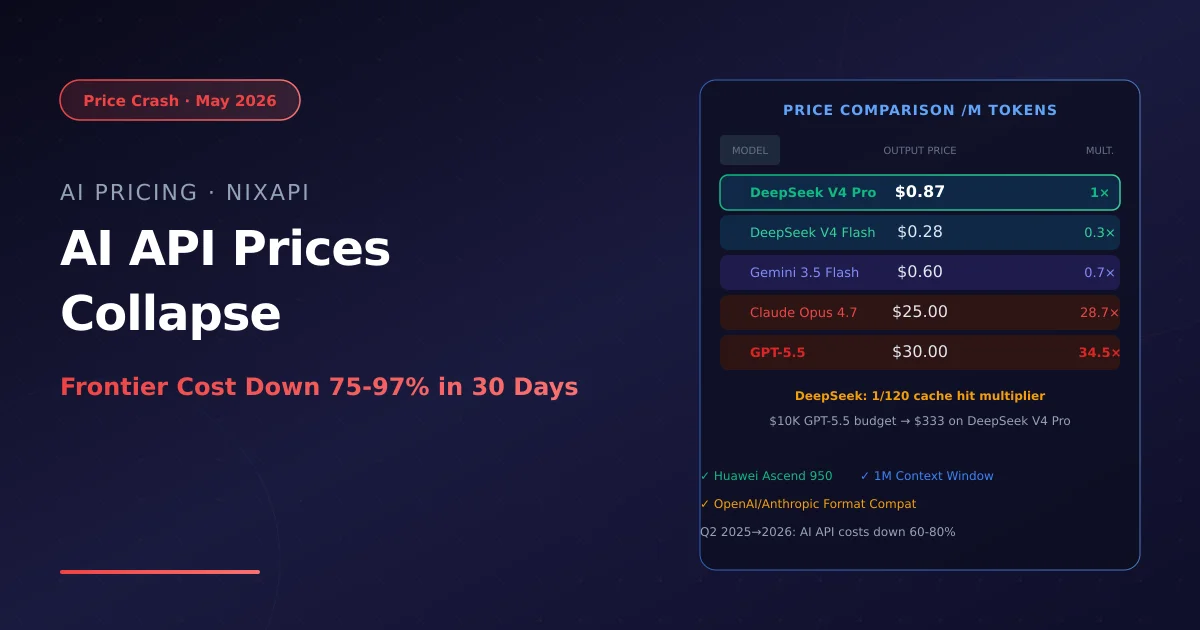
| Model | Input Price | Cache Hit | Output Price | vs DeepSeek V4 Pro (Output) |
|---|---|---|---|---|
| DeepSeek V4-Pro | $0.435 | $0.003625 | $0.87 | 1× (baseline) |
| DeepSeek V4-Flash | $0.14 | $0.0028 | $0.28 | 0.3× |
| Gemini 3.5 Flash | $0.15 | — | $0.60 | 0.7× |
| Claude Opus 4.7 | $5.00 | $0.50 | $25.00 | 28.7× |
| Claude Sonnet 4.6 | $3.00 | $0.30 | $15.00 | 17.2× |
| GPT-5.5 | $5.00 | $0.50 | $30.00 | 34.5× |
| GPT-5.5 Pro | $30.00 | — | $180.00 | 207× |
Real-World Cost Comparison
A $10,000/month GPT-5.5 budget becomes $333 on DeepSeek V4 Pro.
This isn’t just about saving money — it’s about making AI applications economically viable that were previously impossible.
Monthly cost for four realistic workloads:
| Scenario | GPT-5.5 | Claude Opus 4.7 | DeepSeek V4-Pro |
|---|---|---|---|
| Code Assistant (50M tokens/mo) | $1,600 | $1,300 | $348 |
| Document Analysis (cache-heavy) | $1,600 | $1,300 | $44 |
| Customer Support Agent (100M tokens/mo) | $3,200 | $2,600 | $696 |
| Bulk Content Generation (200M tokens/mo) | $6,400 | $5,200 | $1,392 |
Sources: TokenMix Blog and BenchLM.ai
2. Why Can DeepSeek Price This Low?
2.1 Hardware Advantage: Huawei Ascend 950
DeepSeek V4 runs on Huawei Ascend 950 accelerators rather than Nvidia GPUs. Huawei aims to ship 750,000 Ascend 950PR units in 2026. By not paying Nvidia’s margins, DeepSeek can offer structurally lower inference costs.
2.2 Architecture Efficiency: 1.6T Parameter MoE
V4-Pro is a 1.6 trillion parameter mixture-of-experts model that activates only 49 billion parameters at inference. This efficient architecture delivers roughly a quarter of the single-token compute and a tenth of the memory footprint of its predecessor at very long context — making the price cut a pass-through of efficiency gains, not a margin sacrifice.
2.3 No IPO Clock
Unlike OpenAI (valued at $852B) and Anthropic (annualized revenue surged from $9B to $30B between late 2025 and April 2026), DeepSeek is only entering its first funding round. No quarterly profit pressure — allowing them to treat inference as a commodity rather than a premium product.
2.4 Cache Architecture as a Structural Moat
DeepSeek’s cache hit price is $0.003625/M — just 1/120 of cache-miss input. Compare: Anthropic and OpenAI offer 1/10 cache hit prices, Google offers 1/4. For cache-friendly workloads (system prompts, retrieved documents, tool definitions), this creates an order-of-magnitude gap:
Same cache-friendly workload: DeepSeek V4-Pro at $44/month vs GPT-5.5 at $1,600/month — a 36× gap, driven mostly by cache hit pricing, not base rates.
3. The Western Lab Dilemma
3.1 Anthropic’s Opus 4.7 Hidden Price Hike
Claude Opus 4.7 has the same $5/$25 sticker price as Opus 4.6. But Opus 4.7 uses a new tokenizer that generates up to 35% more tokens for the same input text. A workload costing $5 on Opus 4.6 can run $6.75 on Opus 4.7 — a change Anthropic has not prominently disclosed.
3.2 GPT-5.5’s Price Increase Paradox
Contrasting DeepSeek’s cuts, GPT-5.5 doubled output token pricing compared to GPT-5.4 (from $15 to $30). OpenAI’s valuation thesis appears to depend on premium pricing — a strategy that becomes harder to defend with a 34.5× cheaper alternative available.
3.3 The Distillation Allegation
Anthropic has publicly accused DeepSeek of “distillation attacks” — improperly training on Claude’s responses to improve its own models. If substantiated, some of DeepSeek’s capability-cost advantage would be attributable to IP arbitrage rather than engineering efficiency.
4. Signals That the Price War Has Entered Phase 2
4.1 Market Bifurcation
DeepSeek’s permanent price cut signals a shift from promotional competition to structural price positioning:
A discount that expires is a marketing event. A discount that does not expire is a market floor.
4.2 The New Reality for OpenAI/Anthropic Sales
Every customer-acquisition deck written by OpenAI or Anthropic sales teams now has to assume that prospective enterprise customers know they can route a meaningful share of their workload to V4-Pro and absorb the trade-offs in exchange for a 70%+ cost reduction.
4.3 The Nvidia Side-Impact
DeepSeek’s price is enabled by non-Nvidia hardware. This complicates the assumption that “AI needs Nvidia’s most expensive GPUs.” A viable open-source alternative running on Huawei Ascend silicon puts pressure on Nvidia’s margin narrative.
5. Developer Strategy: Navigating the Price War
5.1 Workload Tiering
Smart teams are already tiering workloads rather than using one model for everything:
| Workload Type | Recommended Model |
|---|---|
| High-volume classification (<8% error tolerance) | DeepSeek V4-Flash |
| Multi-step agent with cost ceiling | DeepSeek V4-Pro |
| Multi-step agent requiring max reasoning quality | Claude Opus 4.7 |
| Long-context RAG (cache-heavy) | DeepSeek V4-Pro |
| Compliance/data residency (US, EU) | Claude Sonnet 4.6 or GPT-5.5 |
| English short-form, latency-sensitive | Claude Haiku 4.5 |
5.2 Cache Architecture Optimization
Cache hit pricing is the most underweighted factor in cross-vendor cost analysis. DeepSeek’s 1/120 cache hit multiplier means prompt architecture choices move cost by orders of magnitude.
Recommendations:
- Design system prompts and tool definitions as stable prefixes to maximize cache hits
- Prioritize DeepSeek V4-Pro for structured prompt scenarios
- Monitor cache hit rate as a key cost KPI
5.3 API Compatibility Strategy
DeepSeek supports both OpenAI and Anthropic API formats, making provider switching low-friction. Suggested approach:
- Build an API abstraction layer supporting multi-provider routing
- Configure different routing policies for different quality/cost requirements
- Maintain vendor-neutral portability as insurance
6. Q2 2025 → Q2 2026: One Year of Price Transformation
| Timeline | Lowest Frontier Price | Event |
|---|---|---|
| Q2 2025 | $10-30/M input (GPT-4 class) | No Chinese competition, model scarcity |
| Q3 2025 | $0.55/M output (DeepSeek R1) | First price shockwave |
| Q4 2025 | Claude Sonnet discounts launch | Price war officially begins |
| Q1 2026 | $1.74/M input (DeepSeek V4 preview) | 1M context era arrives |
| May 2026 | $0.435/$0.87 (V4-Pro) | All-time low → permanent |
AI API total costs declined 60-80% from Q2 2025 to Q2 2026. What cost $5 a year ago now costs under $1 at the same quality tier.
7. Summary
DeepSeek’s permanent price cut is not a marketing event — it’s a market structure redefinition. Western AI labs face a fundamental question for the first time: when the cheapest option is “good enough” at a 30-50× price gap, how long can premium pricing last?
For NixAPI’s developer audience, this price war is a pure positive:
- Lower API costs across the board
- More model choices for workload tiering
- Improved unit economics for AI products
Bottom line: If you haven’t re-benchmarked your provider mix in the last month, you’re likely paying outdated rates. The AI API market changes every 30 days — not tracking it means your product is subsidizing competitors’ infrastructure costs.
References:
- DeepSeek permanent 75% discount announcement (X/Twitter)
- the-decoder: DeepSeek makes 75% discount permanent
- TNW: DeepSeek made its 75% discount permanent. The AI price war just escalated.
- Computerworld: DeepSeek’s steep V4-Pro price cut escalates AI pricing war
- TokenMix Blog: Cheapest Frontier LLM API 2026
- Awesome Agents: AI API Pricing Q2 2026
- AOL: DeepSeek hits OpenAI, Anthropic where it really hurts
- Implicator: DeepSeek froze AI prices at a level Western labs cannot match
Try NixAPI Now
Reliable LLM API relay for OpenAI, Claude, Gemini, DeepSeek, Qwen, and Grok with ¥1 = $1 top-up
Sign Up Free