Anthropic Acquires Stainless: The New Moat for API Providers
Anthropic acquires SDK generator Stainless for $300M+, its first-ever acquisition. With clients including OpenAI, Google, and Meta, Stainless sits at the intersection of developer tooling and AI agent infrastructure. Here's what it means.
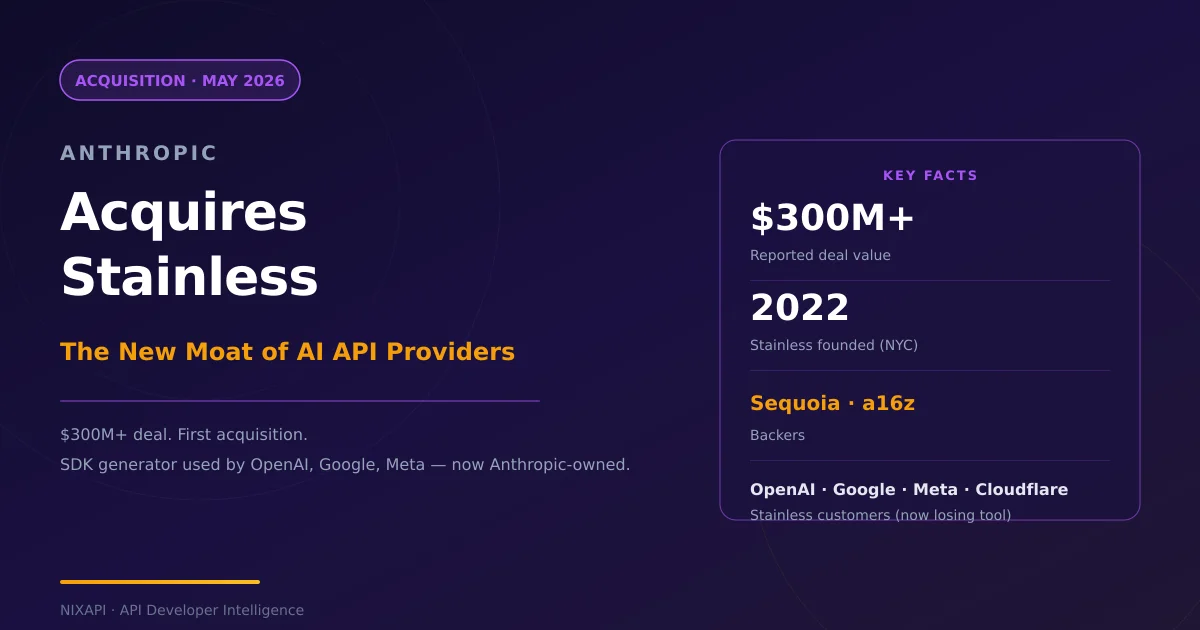
On May 18, 2026, Anthropic announced the acquisition of SDK generator Stainless. The official price tag remains undisclosed, but multiple sources confirm a valuation exceeding $300 million. This is Anthropic’s first acquisition ever—a company not yet five years old, spending significant capital on developer infrastructure rather than more model capabilities.
Stainless is not a household name, but the SDKs it generates are powering API calls across the world’s largest AI products. OpenAI, Google, Meta, Cloudflare, Replicate, and Runway are all customers. What does a company that builds “multi-language SDK generation from API specs” mean to an AI lab spending $300M+? The answer lies in a new moat logic taking shape across the AI industry.
What Stainless Does
Stainless was founded in 2022 in New York by former Stripe engineer Alex Rattray. Its core product is a platform that generates production-grade, multi-language SDKs from OpenAPI specifications.
Traditionally, when a company launches an API, it must manually maintain SDKs across multiple languages—Python, TypeScript, Go, Java, Kotlin—each with its own type definitions, error handling, and documentation examples. Maintenance costs grow linearly with the number of languages, and SDK lag during API iterations is a persistent pain point.
Stainless solves this: feed it an OpenAPI Spec, get back thoroughly tested, production-ready SDKs. It also generates corresponding CLI tools and MCP (Model Context Protocol) servers. The implication is significant—API providers maintain one spec, and all language SDKs, CLIs, and agent tools stay in sync. This fundamentally removes the multi-language SDK maintenance bottleneck.
Stainless’s technical moat is the quality of generated code and the speed of iteration. Its generation pipeline understands API semantics and outputs code that conforms to each language’s idiomatic style and best practices—not mechanical translation. This requires deep understanding of OpenAPI specs, language ecosystems, and developer workflows.
Why Anthropic Bought Stainless
Anthropic’s core product is the Claude series of models, delivered to developers via API. But the API itself is just an interface—real developer experience lives in the SDKs, tooling, and ecosystem around it.
Anthropic’s acquisition of Stainless follows several clear strategic logics:
First, insurance. If Stainless had been acquired by a competitor—especially OpenAI or Google—Anthropic’s developer ecosystem would have been directly harmed. $300M+ buys a “cannot fall into someone else’s hands” policy.
Second, tooling completeness. Anthropic has been pushing Claude as the preferred model for the Agent era. Agents need tool calling, and MCP (Model Context Protocol) is the standard protocol connecting Agents to tools. Stainless already generates MCP servers—directly aligning with Anthropic’s Agent strategy.
Third, vertical integration. Anthropic’s first acquisition targeted developer infrastructure rather than model capability or data assets. This signals a conviction that, as model capabilities converge, developer experience and tool ecosystem become the true differentiator.
Impact on the Developer Ecosystem
Stainless’s client list reads like a who’s who of the AI industry: OpenAI, Google, Meta, Cloudflare, Replicate, Runway. After the acquisition, Stainless announced it will wind down its hosted products, with existing customers retaining full SDK ownership and modification rights.
What does this mean in practice?
For OpenAI, Google, and Meta, losing the Stainless hosted platform means they need to either build SDK generation capabilities in-house or find alternatives. It’s not catastrophic, but it does require engineering resources diverted to maintaining an infrastructure layer previously outsourced. For smaller companies like Replicate and Runway, the impact is more significant—they’ve lost a key efficiency lever.
More importantly, Stainless’s MCP server generation capability now belongs to Anthropic. MCP is the Agent tool-calling standard Anthropic has been promoting. Stainless’s ability to automatically generate MCP servers for APIs means any company using Stainless is implicitly supporting Anthropic’s standard. This is an extraordinarily elegant form of ecosystem lock-in.
Long-Term Meaning for the AI Agent Ecosystem
One of the core challenges for AI Agents is tool use. Agents need to reliably call external tools—search, databases, third-party APIs—and the diversity and fragmentation of these tools is the biggest obstacle.
MCP attempts to solve this: a standard protocol enabling Agents to call various tools in a unified way. Stainless’s value lies in automating “generate an MCP server from an API spec.” When an API provider uses Stainless, they don’t just get multi-language SDKs—they get an MCP server simultaneously. Agent developers can directly use this MCP server to let Claude (or any MCP-compatible model) call that API, without writing any glue code.
Anthropic acquiring Stainless means “making third-party APIs seamlessly integrable with Claude Agents” has a near-zero barrier. This is control of an ecosystem entry point—whoever controls the SDK and MCP server generation layer controls the pipeline through which Agents call tools.
This has some similarity to Apple’s strategy with MFi (Made for iPhone): not controlling the device itself, but controlling the standards and tools through which the device connects to everything else.
Conclusion: The New Moat for API Providers
AI model capabilities are converging rapidly. The performance gap between GPT-4o, Claude 3.5, and Gemini 2.0 is no longer a decisive differentiator. Against this backdrop, the developer ecosystem and tooling chain are becoming the new competitive dimension.
Anthropic’s acquisition of Stainless reveals a forming logic: the future moat for API providers lies not in the model itself, but in the developer experience layer surrounding the API—the quality of SDKs, the completeness of tooling, and the depth of integration with other services and Agents.
Stainless went from an under-the-radar developer tool to a $300M+ ecosystem infrastructure asset. This acquisition is not an ending—it’s the opening whistle of an ecosystem war in the AI industry.
Try NixAPI Now
Reliable LLM API relay for OpenAI, Claude, Gemini, DeepSeek, Qwen, and Grok with ¥1 = $1 top-up
Sign Up Free