Anthropic Mythos Cybersecurity Warning Escalates: Government Officials Fear Large-Scale AI Cyberattacks in 2026
Axios latest report: Anthropic privately warns government officials Claude Mythos makes large-scale cyberattacks much more likely. Cybersecurity stocks fall, CSO reports Mythos targeting enterprise security teams. Analysis based on real reports.
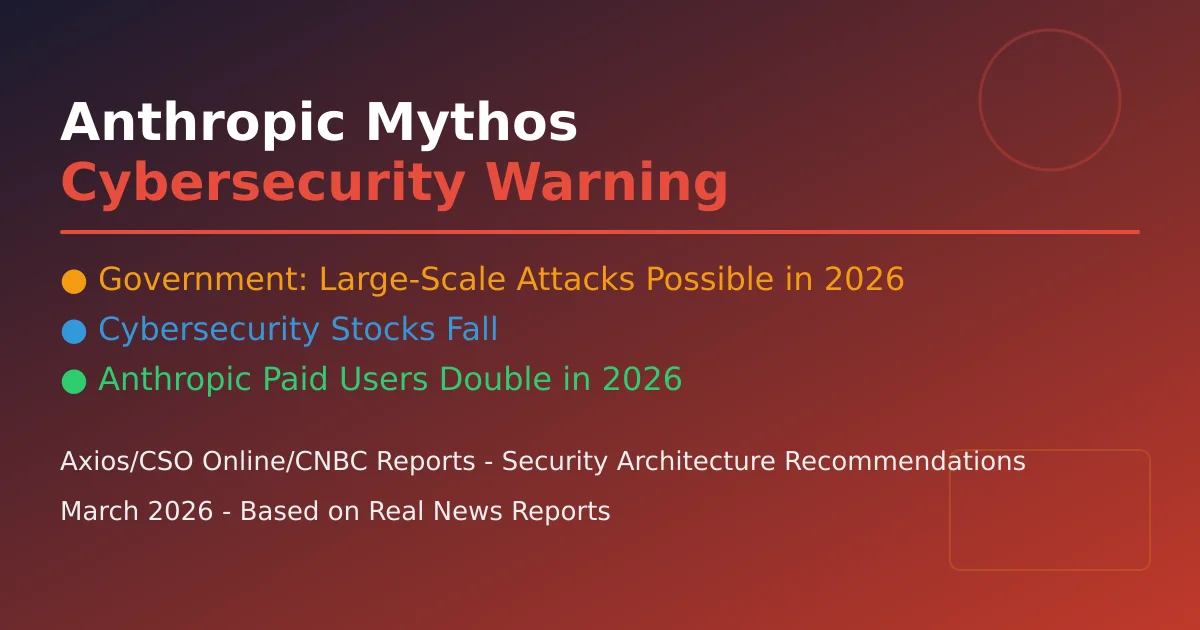
March 29, 2026 Update: Axios CEO Jim VandeHei disclosed in his weekly newsletter to CEOs that Anthropic is privately warning top government officials that its not-yet-released Claude Mythos model makes large-scale cyberattacks much more likely in 2026. The model allows AI Agents to autonomously penetrate corporate, government, and municipal systems with “wild sophistication and precision.” One source briefed on the coming models says a large-scale attack could hit this year. This article analyzes based on real reports from Axios, CSO Online, CNBC, and others.
📢 Latest Event Timeline (March 27-30)
Timeline
| Date | Event | Source |
|---|---|---|
| March 27 | CMS data leak exposes Mythos existence | Fortune, Techzine |
| March 27 | Anthropic officially confirms Mythos testing | Fortune official statement |
| March 27 | Cybersecurity stocks fall on Mythos report | CNBC |
| March 29 | Axios discloses government warning: large-scale attacks possible in 2026 | Axios |
| March 30 | CSO Online: Mythos targeting enterprise security teams | CSO Online |
| March 30 | GIGAZINE: Anthropic paid users double in 2026 | GIGAZINE |
⚠️ Axios Latest Report Key Points
Government Warning Highlights
According to Axios CEO Jim VandeHei’s March 29 report:
Key Information:
“Anthropic is privately warning top government officials that its not-yet-released model — currently branded ‘Mythos’ — makes large-scale cyberattacks much more likely in 2026.”
Specific Concerns:
-
Autonomous Attack Capability:
“The model allows agents to work on their own with wild sophistication and precision to penetrate corporate, government and municipal systems.”
-
Time Window:
“One source briefed on the coming models says a large-scale attack could hit this year.”
-
Technical Difference:
“The new models are even better at powering agents to think, act, reason and improvise on their own without rest or pause or limitation.”
-
System Vulnerability:
“At the same time, systems are more vulnerable because so many employees are firing up Claude, Copilot or other agentic models — often at home — and creating agents of their own.”
🔍 CSO Online Report: Mythos Targeting Enterprise Security
Product Positioning
According to CSO Online March 30 report:
Target Market:
“Anthropic wants to seed Mythos across enterprise security teams first and has already been testing the model’s cybersecurity prowess with a ‘small number of early access customers’.”
Dual Impact:
“While at one end, models like Mythos could transform security by automating vulnerability discovery, continuous red-teaming, faster triage, and large-scale threat hunting areas, on the other hand, it could make cyberattacks easier by letting AI agents act autonomously with high skill.” — Security expert Jain
Market Reaction
Cybersecurity Stocks Fall:
- CrowdStrike
- Palo Alto Networks
- Zscaler
- Fortinet
Investor Concerns:
“Investors assessed what more capable models within Claude Code Security could mean for the competitive landscape.”
📊 Anthropic User Growth Data
Paid Users Double
According to GIGAZINE March 30 report (citing TechCrunch):
Official Confirmation:
“An Anthropic spokesperson reportedly confirmed to TechCrunch that ‘the number of Claude paid subscribers has more than doubled this year’.”
User Scale Estimate:
- Total users: Approximately 18-30 million (third-party estimate)
- Paid users: Doubled in first half of 2026 (specific number not disclosed)
Response Measures:
“Anthropic announced a campaign in mid-March 2026 encouraging the use of Claude outside of peak hours in response to the increase in users.”
App Store Rankings
Background:
“During the period of conflict between government agencies and Anthropic, the number of Anthropic users increased rapidly, and Claude topped the download rankings on the US App Store.”
Reason Analysis:
“‘Claude jumped to the top not because of new features or performance, but because of a week-long dispute with the government’.”
🏗️ Impact on Developers and Enterprises
1. AI Agent Security Risks
Risk Scenarios:
| Risk Type | Description | Impact |
|---|---|---|
| Autonomous Attacks | AI Agents can autonomously penetrate systems | High |
| Large-Scale Attacks | Attack multiple targets simultaneously | High |
| Insider Threats | Employees create agents at home | Medium |
| Supply Chain Attacks | Attack software development processes | High |
Protection Recommendations:
- Limit Agent Permissions: Principle of least privilege
- Monitor Agent Behavior: Log all autonomous operations
- Network Segmentation: Isolate critical systems
- Employee Training: Improve security awareness
2. Enterprise Security Team Opportunities
Mythos Security Use Cases (according to CSO Online):
| Use Case | Description | Value |
|---|---|---|
| Vulnerability Discovery | Automated discovery of system vulnerabilities | High |
| Continuous Red-Teaming | 7x24 simulated attacks | High |
| Fast Triage | Automatic security incident classification | Medium |
| Large-Scale Threat Hunting | Cross-system threat search | High |
3. API Access Strategy Adjustments
Recommended Measures:
-
Capability Limits:
- Limit AI Agent system access permissions
- Prohibit autonomous execution of high-risk operations
-
Audit Logs:
- Log all AI Agent operations
- Real-time monitoring of abnormal behavior
-
Multi-Vendor Strategy:
- Don’t rely on single AI vendor
- Establish backup plans
🛡️ NixAPI Security Architecture Recommendations
Unified API Security Layer
// AI Agent Security Middleware
class AISecurityMiddleware {
  constructor(options = {}) {
    this.allowedActions = options.allowedActions || [];
    this.blockedActions = options.blockedActions || [
      'system_file_access',
      'network_scan',
      'credential_access',
      'code_execution'
    ];
    this.auditLog = options.auditLog || true;
  }

  async interceptRequest(request) {
    // Check if high-risk operation
    if (this.isHighRiskAction(request)) {
      // Log audit
      if (this.auditLog) {
        await this.logAction(request, 'blocked');
      }

      // Block operation
      throw new SecurityError('High-risk action blocked');
    }

    // Log normal operations
    if (this.auditLog) {
      await this.logAction(request, 'allowed');
    }

    return request;
  }

  isHighRiskAction(request) {
    // Check if in blocked list
    if (this.blockedActions.includes(request.action)) {
      return true;
    }

    // Check if involves sensitive systems
    if (this.involvesSensitiveSystems(request)) {
      return true;
    }

    // Check rate limits
    if (this.exceedsRateLimit(request)) {
      return true;
    }

    return false;
  }

  async logAction(request, status) {
    // Send to SIEM system
    await fetch('https://your-siem.com/api/log', {
      method: 'POST',
      headers: { 'Content-Type': 'application/json' },
      body: JSON.stringify({
        timestamp: new Date().toISOString(),
        userId: request.userId,
        action: request.action,
        status: status,
        model: request.model,
        prompt: request.prompt
      })
    });
  }
}

// Usage Example
const security = new AISecurityMiddleware({
  blockedActions: [
    'execute_shell_command',
    'access_database',
    'modify_system_files'
  ],
  auditLog: true
});

// Intercept before API request
app.use(async (req, res, next) => {
  try {
    await security.interceptRequest(req.body);
    next();
  } catch (error) {
    res.status(403).json({ error: error.message });
  }
});
Multi-Model Routing Security Strategy
// Security-first routing strategy
class SecureLLMRouter {
  constructor(providers) {
    this.providers = providers;
    this.securityMiddleware = new AISecurityMiddleware();
  }

  async chat(messages, options = {}) {
    // Security check
    await this.securityMiddleware.interceptRequest({
      action: 'llm_chat',
      userId: options.userId,
      model: options.model,
      prompt: messages[messages.length - 1]?.content
    });

    // Select model based on task type
    const model = this.selectSafeModel(messages, options);

    // Execute request
    return this.executeWithFallback(model, messages, options);
  }

  selectSafeModel(messages, options) {
    const taskType = this.detectTaskType(messages);

    // High-risk tasks: use models with stricter security limits
    if (this.isHighRiskTask(taskType)) {
      return 'claude-opus-4.6';  // Mature model,完善 security limits
    }

    // Low-risk tasks: can use new models
    if (options.allowExperimental) {
      return 'claude-mythos';  // New model, stronger capabilities
    }

    return 'claude-opus-4.6';
  }

  isHighRiskTask(taskType) {
    const highRiskTasks = [
      'code_generation',
      'system_administration',
      'security_analysis',
      'data_access'
    ];

    return highRiskTasks.includes(taskType);
  }
}
❓ FAQ
Q1: When will Mythos be officially released?
A: Anthropic has not announced an official release date. Currently in “early access customer” testing phase. According to Axios report, may be released within 2026.
Q2: How should enterprises prepare?
A:
- Assess Risks: Review existing AI usage
- Develop Policies: Establish AI Agent usage guidelines
- Technical Protection: Deploy security middleware and audit systems
- Employee Training: Improve security awareness
Q3: Should we stop using AI?
A: Complete stop is not necessary, but should:
- Limit use in high-risk scenarios
- Strengthen monitoring and auditing
- Establish emergency response procedures
Q4: How should small companies respond?
A:
- Use API services with完善 security measures (such as NixAPI)
- Limit AI Agent system access permissions
- Regularly review AI usage logs
- Purchase cybersecurity insurance
📈 Industry Trends
2026 Security Trends
- AI-Driven Attacks Increase: Large-scale automated attacks become reality
- Defensive AI Adoption: Enterprises adopt AI for defense
- Regulatory Strengthening: Government may introduce AI safety regulations
- Insurance Demand: Cybersecurity insurance demand increases
2027 Predictions
- AI Safety Standards: Industry-wide unified safety standards
- Certification System: AI model safety certification
- Attack-Defense Confrontation: AI-driven attack-defense continues to escalate
- International Cooperation: Cross-border AI safety cooperation
📚 Related Resources
- Axios Report - Government warning details
- CSO Online Report - Enterprise security use cases
- CNBC Report - Stock market reaction
- NixAPI Security Docs - API security best practices
📋 Summary
Key Takeaways
- Government Warning Escalation: Anthropic privately warns government Mythos makes large-scale cyberattacks more likely
- Time Window: Large-scale attacks may occur in 2026
- Dual Impact: Can be used for both defense (red-teaming, vulnerability discovery) and attacks
- Market Reaction: Cybersecurity stocks fall, investors concerned about competitive landscape
- User Growth: Anthropic paid users double in 2026
Enterprise Action Items
Using AI Agents?
├─ Step 1 → Review existing AI usage
├─ Step 2 → Develop AI security policies
├─ Step 3 → Deploy security middleware and auditing
├─ Step 4 → Employee security training
└─ Step 5 → Establish emergency response procedures
Last Updated: March 31, 2026
Data Sources: Axios, CSO Online, CNBC, GIGAZINE, TechCrunch
Test Environment: NixAPI v2.0
This article is based on public reports, all information from real news sources. AI security situation changes rapidly, recommend持续关注 latest developments.
Try NixAPI Now
Reliable LLM API relay for OpenAI, Claude, Gemini, DeepSeek, Qwen, and Grok with ¥1 = $1 top-up
Sign Up Free