Anthropic Buys OpenAI's SDK Pipeline: MCP Is Becoming the API Unification Protocol
Anthropic's $300M+ acquisition of SDK generator Stainless gives it leverage over OpenAI, Google, and Meta's developer access overnight. With SaaS shut down and MCP standardization accelerating—what really lies behind the SDK war?
1. Breaking: Anthropic Acquires a Competitor’s SDK Pipeline
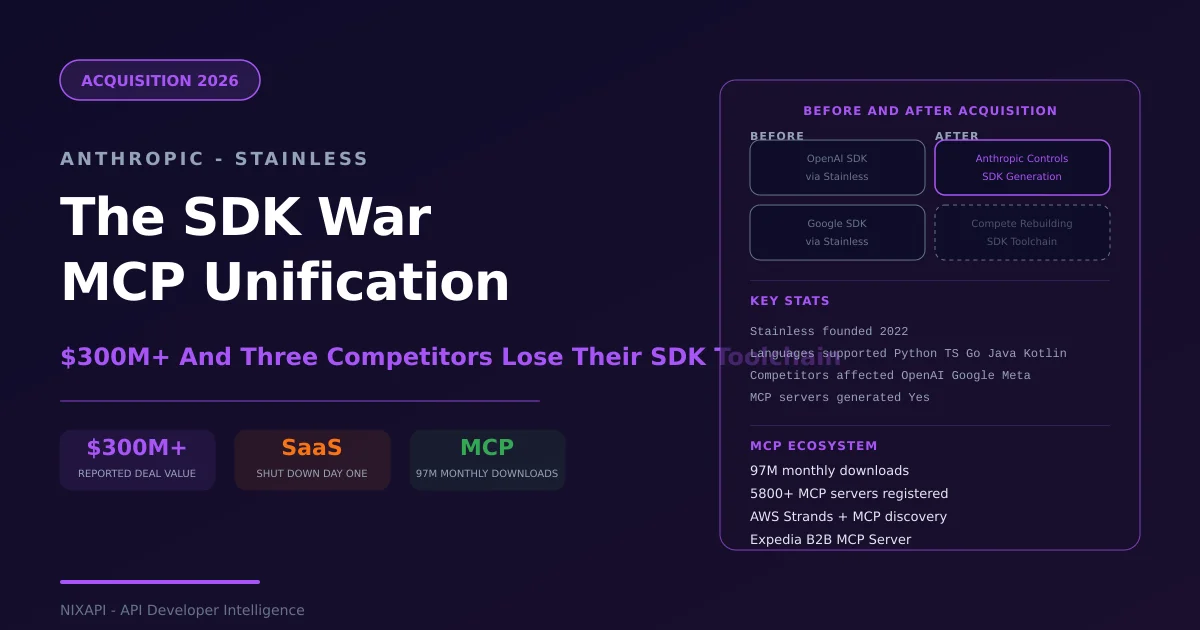
On May 18, 2026, Anthropic announced the acquisition of Stainless, an SDK generation tool, for a reported $300M+. This was Anthropic’s first-ever acquisition—but it was anything but a routine tuck-in.
Stainless is not a typical dev tool. It generates SDKs, CLIs, and MCP servers for OpenAI, Google, Meta, Cloudflare, Replicate, and Runway. In other words, it sits at the throat of every major AI competitor’s developer access layer.
On acquisition day, the Stainless SaaS was shut down. Customers retained the SDK source code they’d already generated, but control over the toolchain—ongoing updates, version cadence, and roadmap ownership—was gone overnight.
This isn’t just buying a company. It’s buying exclusive access to your competitors’ developer toolchain.
2. What Is Stainless: The Technical Value of Automated SDK Generation
Stainless was founded in 2022 by former Stripe engineer Alex Rattray. Its core product: a platform that automatically generates multi-language SDKs from OpenAPI Specification (OAS) documents.
The traditional model forces every AI company to manually maintain parallel SDKs across Python, TypeScript, Kotlin, Go, and Java—each carrying independent maintenance burdens, bug fixes, and breaking change coordination. Developer experience fragments; version consistency collapses.
Stainless’ solution is a standardized generation pipeline: one OpenAPI document in, fully idiomatic multi-language SDKs out, with version synchronization maintained automatically. Supported outputs include:
- Multi-language SDKs (Python / TypeScript / Kotlin / Go / Java)
- CLI tools
- MCP servers (Model Context Protocol implementations)
The client roster is itself the proof of concept: OpenAI, Google, Meta, Cloudflare, Replicate, Runway—companies that either depend directly on Stainless output or use it as a reference implementation baseline. Stainless is, in effect, the de facto SDK standard layer for the AI industry.
Backed by Sequoia and Andreessen Horowitz, it raised on the premise that SDK consistency at scale was a solved problem—except it wasn’t, and Stainless solved it.
3. Why Anthropic: The Strategic Logic Behind Competitor Control
Anthropic’s rationale for this acquisition can’t be explained as “expanding the product portfolio.” The logic is precise: control the upstream developer toolchain.
3.1 The “Chokepoint” Position in Competitive Dynamics
When your competitors (OpenAI, Google) rely on the same vendor to generate their SDKs, acquiring that vendor means:
- Version cadence control: whoever ships new SDK features first owns the developer migration window
- MCP server primacy: MCP server generation is where protocol behavior gets defined—who generates it shapes how agents behave
- Technical debt leverage: competitors’ SDK technical debt is now partially owned by Anthropic
3.2 Why This Was Anthropic’s First Acquisition
Anthropic had previously avoided acquisitions on principle: organic growth, singular focus. Stainless changed that calculus. This wasn’t a feature add—it was a strategic positioning move. Passing on it meant risking that OpenAI or Google would acquire Stainless instead, flipping the leverage entirely.
3.3 The Investor Seal of Approval
Sequoia and a16z backing Stainless meant it was a rare and valuable asset. The $300M+ price tag understates the strategic premium Anthropic was willing to pay to prevent a competitor from getting there first.
4. The Role of MCP: From Toolchain Standardization to Agent Interoperability
Understanding this acquisition requires understanding MCP (Model Context Protocol).
4.1 What MCP Is
MCP is an open protocol championed by Anthropic (late 2024) that standardizes how AI agents discover, invoke, and interact with external tools. Think HTTP for the web, or ODBC for databases—MCP aims to be the “common language” for AI tool interoperability.
Core capabilities:
- Dynamic tool discovery: agents query available tools in real time, no hardcoding required
- Standardized interfaces: tools from different vendors connect through a unified protocol
- Bidirectional communication: not just model→tool, but tool→model state feedback
4.2 Adoption: Becoming a De Facto Standard
The numbers tell the story:
- 97M+ monthly SDK downloads
- 5,800+ active MCP servers
- AWS Strands now supports MCP dynamic tool discovery
- Expedia building a B2B MCP Server for travel inventory
MCP is no longer experimental—it’s moving toward industry infrastructure status.
4.3 MCP Tunnels: Extending Inward
Beyond standardized MCP servers, Anthropic released MCP Tunnels—encrypted tunnels connecting Claude agents directly to enterprise private internal APIs and databases. MCP’s boundary is expanding from “public tools” to “private systems,” dramatically increasing its addressable scope.
For Anthropic, controlling Stainless’ MCP server generation capability means future enterprise AI integration “on-ramp design authority” flows through its hands.
5. Developer Impact: What OpenAI and Google Are Losing
5.1 Immediate: SaaS Shutdown and Trust Shock
The Stainless SaaS shut down on acquisition day. That decision signals something specific: Anthropic has no interest in maintaining a neutral, multi-vendor tool platform. For companies that treated Stainless as a core dependency—especially OpenAI and Google—this is a wake-up call.
They must now reassess:
- Will SDK update cadence remain reliable?
- Will MCP server implementations continue to be maintained?
- Should they build in-house or migrate to an alternative SDK generation tool?
5.2 Medium-Term: The MCP Implementation Sovereignty Question
When OpenAI and Google’s agents increasingly rely on the MCP protocol, but the MCP servers are generated by a company Anthropic owns, the “reference implementation” authority sits with Anthropic.
This isn’t about Anthropic actively sabotaging competitors—it’s about path dependency: if Anthropic’s MCP implementation is more complete and ships faster, developers will naturally use it as the baseline, shaping the entire ecosystem’s trajectory.
5.3 Long-Term: The “Android Moment” for SDKs
If we draw a parallel to mobile development, what Anthropic is doing has structural similarities to Google’s Android strategy: not directly controlling device manufacturers, but controlling the protocol and development tools underlying app distribution.
Whoever controls the SDK generation layer controls developer workflows, API exposure, and the path through which competitors reach their users.
6. Conclusion: The Eve of MCP Unification
Anthropic’s acquisition of Stainless is, at its core, a protocol-layer positioning play:
| Dimension | Impact |
|---|---|
| OpenAI / Google | Lose SDK toolchain neutrality; must accelerate self-built or alternative solutions |
| Developers | Short-term uncertainty, long-term benefit from a more unified MCP tooling ecosystem |
| MCP Protocol | Gains its strongest advocate; accelerating from “optional standard” to “industry requirement” |
| Anthropic | First acquisition is a strategic masterclass—becomes the key variable in AI developer tooling |
The “SDK War” is no longer a thesis—it’s a present reality. AI competition isn’t just about model capability anymore; it’s about developer ecosystem access. Protocol standardization, MCP unification, and toolchain control were once invisible infrastructure battles. They’re now explicit strategic battlefields.
MCP is becoming the API unification protocol. And Anthropic just made the first decisive move.
Try NixAPI Now
Reliable LLM API relay for OpenAI, Claude, Gemini, DeepSeek, Qwen, and Grok with ¥1 = $1 top-up
Sign Up Free