Claude Opus 4.7 vs GPT-5.4: The Definitive 2026 Flagship Model API Comparison
Claude Opus 4.7 (BenchLM #2, 94 pts) vs GPT-5.4 (BenchLM #4, 93 pts) is the most important model comparison of 2026. Opus 4.7 leads on coding (72.9 vs 57.7) and agentic tasks (MCP Atlas 77.3% vs 67.2%), while GPT-5.4 wins on cost (1/2 price) and knowledge workloads. This article compares both models across 7 dimensions — benchmarks, pricing, context, coding, agent workflows, multimodal, and safety — with NixAPI routing recommendations for each use case.
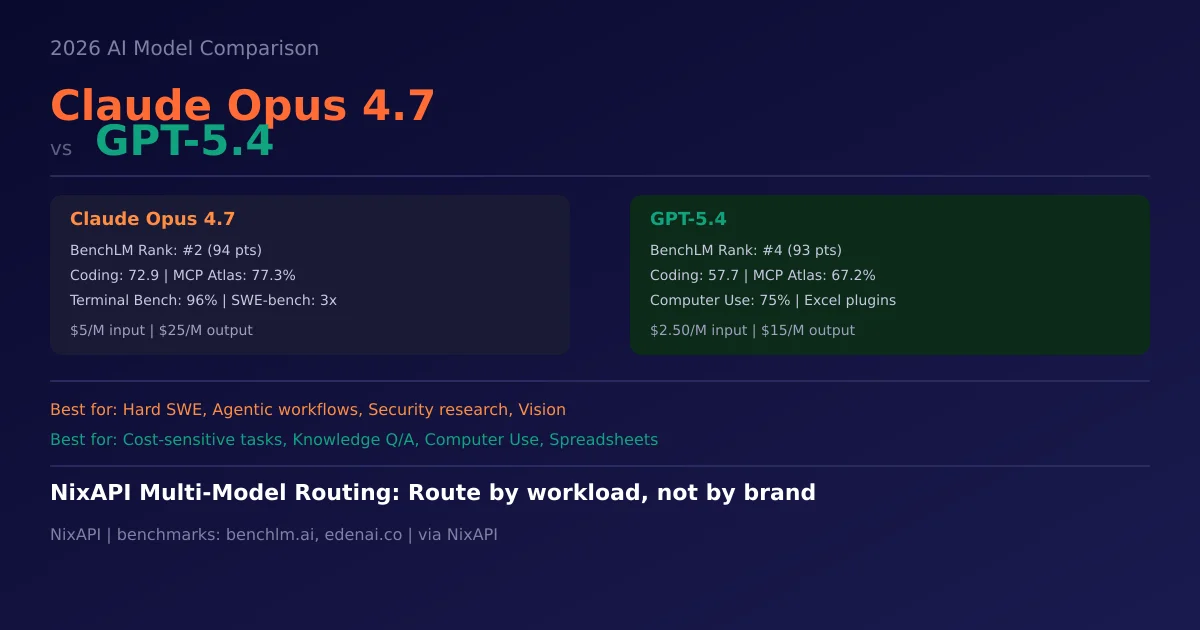
Note: Data from BenchLM (benchlm.ai), Eden AI (edenai.co), Evolink.AI, ModelsLab, GlbGPT, and official Anthropic/OpenAI release pages. Integration guidance is engineering analysis based on public information.
1. Benchmark overview: Is there a clear #1?
From BenchLM’s provisional leaderboard (April 2026):
| Metric | Claude Opus 4.7 | GPT-5.4 |
|---|---|---|
| BenchLM overall rank | #2 (94 pts) | #4 (93 pts) |
| Coding average | 72.9 | 57.7 |
| MCP Atlas (agentic core) | 77.3% | 67.2% |
| Knowledge tasks | 68.2 | slight edge |
| Agentic average | 74.9 | 42.9 |
| Visual acuity (XBOW) | 98.5% | not disclosed |
The gap is real but not dominant: Opus 4.7 wins on hard tasks and reliability; GPT-5.4 wins on cost and knowledge workloads. BenchLM’s own verdict: “Opus 4.7 finishes one point ahead — not a blowout, but enough to call.”
2. Pricing: 2–6× cost difference
| Dimension | Claude Opus 4.7 | GPT-5.4 (standard) | GPT-5.4 Pro |
|---|---|---|---|
| Input | $5 / 1M tokens | $2.50 / 1M | $30 / 1M |
| Output | $25 / 1M tokens | $15 / 1M | $75 / 1M |
| Cached input | — | $0.625 / 1M | — |
| Context window | 1M tokens | 1.05M tokens | 1.05M |
| Max output | undisclosed | 128K tokens | 128K |
GPT-5.4 is roughly half the cost of Opus 4.7 on standard tier. Its cached input pricing ($0.625/M) is a significant advantage for multi-turn agent conversations. GPT-5.4 Pro at $30/M input is 6× Opus 4.7 — premium tier reserved for the most demanding workloads.
3. Context window and token efficiency
GPT-5.4 offers 1.05M tokens context vs Opus 4.7’s 1M. GPT-5.4 also supports up to 128K max output — useful for long-form report generation. However, Opus 4.7’s tokenizer inflation (1.0–1.35×) and heavier thinking at high effort means real-world token spend in long-horizon tasks is ~1.2–1.5× higher. Use effort parameters and task budgets to control Opus 4.7 spend.
4. Coding: Opus 4.7 dominates hard tasks
| Benchmark | Claude Opus 4.7 | GPT-5.4 |
|---|---|---|
| SWE-bench (Rakuten) | 3× Opus 4.6 | not disclosed |
| Terminal Bench 2.0 | 96% (vs 54.5% on Opus 4.6) | not disclosed |
| CursorBench | 70% (vs 58% Opus 4.6) | not disclosed |
| XBOW visual acuity | 98.5% | not disclosed |
The most striking demo: Opus 4.7 autonomously built a complete Rust text-to-speech engine — neural model, SIMD kernels, browser demo — then verified its own output. No equivalent GPT-5.4 public demo exists. GPT-5.4’s advantage in coding is its native spreadsheet plugins (Excel, Google Sheets) and strong document formatting output.
5. Agent workflows and tool use
MCP Atlas (core agentic benchmark): Opus 4.7 77.3% vs GPT-5.4 67.2% — a 10-point gap.
| Dimension | Claude Opus 4.7 | GPT-5.4 |
|---|---|---|
| Tool calling style | Anthropic native Tool Use | OpenAI Function Calling |
| MCP protocol | supported (via claude-code) | supported |
| Native spreadsheet plugins | no | Excel + Google Sheets |
| Computer Use accuracy | improving (54.5%→98.5%) | 75% |
| Fine-grained effort control | xhigh tier | no equivalent |
GPT-5.4’s native Computer Use at 75% accuracy is a genuine differentiator for desktop automation and GUI operation. Opus 4.7’s xhigh effort provides superior reasoning quality control for the most difficult multi-step tasks.
6. Safety and compliance
Opus 4.7 deploys under Project Glasswing — automatic detection and blocking of high-risk cybersecurity requests, with a Cyber Verification Program whitelist for legitimate security researchers. GPT-5.4 has no comparable public safety architecture. For security research, pentesting, and red-teaming use cases, Opus 4.7 offers a clearer compliance path.
7. NixAPI routing strategy
export async function routeTask(task: Task) {
  // Hard SWE → Opus 4.7
  if (task.type === 'swe' && task.difficulty === 'hard') {
    return opus47.chat(task.messages, { effort: 'xhigh' });
  }
  // Desktop automation / Computer Use → GPT-5.4
  if (task.type === 'computer-use') {
    return gpt54.chat(task.messages, { reasoning: { effort: 'high' } });
  }
  // Long-context knowledge Q&A → GPT-5.4 (cost advantage)
  if (task.type === 'knowledge' && task.longContext) {
    return gpt54.chat(task.messages);
  }
  // General agentic workflows → Opus 4.7
  if (task.type === 'agentic') {
    return opus47.chat(task.messages, { effort: 'high' });
  }
  // Simple tasks → Sonnet 4.6 or MiniMax M2.7
  return sonnet46.chat(task.messages);
}
8. Summary: The workload determines the answer
| Use case | Recommended | Why |
|---|---|---|
| Hard SWE / complex coding | Claude Opus 4.7 | 72.9 coding, 3× SWE-bench improvement |
| High-frequency agentic workflows | Claude Opus 4.7 | MCP Atlas 77.3%, highest reliability |
| Desktop automation / Computer Use | GPT-5.4 | 75% native accuracy |
| Long-context knowledge tasks | GPT-5.4 | 1.05M context, 128K output, cached input |
| Cost-sensitive general use | GPT-5.4 | 1/2 Opus 4.7 price |
| Security research / pentesting | Claude Opus 4.7 | Project Glasswing compliance |
| Vision-intensive tasks | Claude Opus 4.7 | 98.5% XBOW, 2,576px resolution |
The core insight: Opus 4.7 is the reliability choice for hard tasks; GPT-5.4 is the flexibility choice for cost-sensitive general work. NixAPI’s multi-model routing architecture is designed exactly for this — let workloads auto-route to the right model.
Try NixAPI Now
Reliable LLM API relay for OpenAI, Claude, Gemini, DeepSeek, Qwen, and Grok with ¥1 = $1 top-up
Sign Up Free