Gemini 3.5 Flash API Practical Review: Is Google's First Native Multimodal API Worth the Switch?
Gemini 3.5 Flash is now GA — $1.50/M input, 76.2% on Terminal-Bench 2.1, 4x faster output. This is a hands-on review: pricing, benchmarks, Python/Node.js code examples, and Thinking Levels deep-dive.
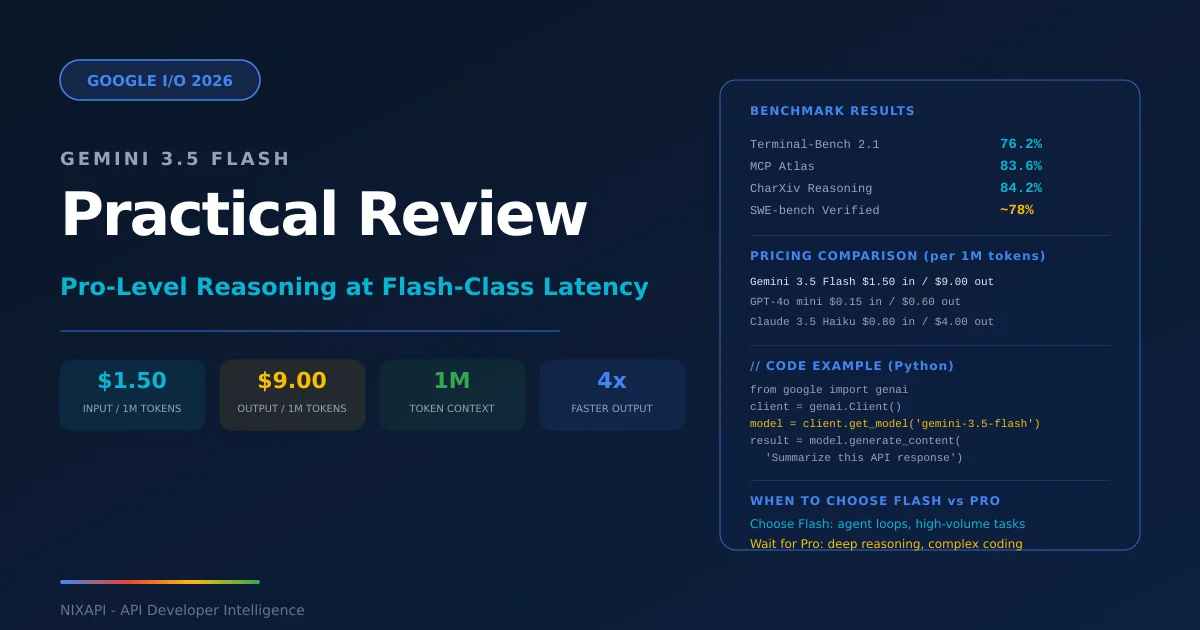
Core Positioning: 4x Faster, Less Than Half the Cost
May 19, 2026 — Google officially launched Gemini 3.5 Flash as General Availability (GA) at I/O 2026. This isn’t a routine version bump. It’s the first time Google has delivered “Pro-level reasoning at Flash-class latency and pricing.”
Key numbers at a glance:
| Metric | Data |
|---|---|
| Input pricing | $1.50 / 1M tokens |
| Output pricing | $9.00 / 1M tokens |
| Context window | 1M tokens |
| Output speed | 4x faster than comparable frontier models |
| GA date | 2026-05-19 |
4x speed + less than half the cost — this combination directly rewrites the cost-performance equation for high-throughput AI applications. Below we break down the full decision-making picture across pricing, benchmarks, and code实战(hands-on examples).
API Pricing & Competitive Comparison
Gemini 3.5 Flash’s pricing strategy is aggressive. It directly targets OpenAI’s GPT-4o mini and Anthropic’s Claude 3.5 Haiku on different axes.
Pricing Comparison Table
| Model | Input Price ($/1M) | Output Price ($/1M) | Context Window |
|---|---|---|---|
| Gemini 3.5 Flash | $1.50 | $9.00 | 1M tokens |
| GPT-4o mini | $0.15 | $0.60 | 128K tokens |
| Claude 3.5 Haiku | $0.80 | $4.00 | 200K tokens |
| Gemini 3.1 Flash-Lite | $0.30 | $1.25 | 128K tokens |
Note: GPT-4o mini pricing may have changed — verify with official sources.
On raw input cost, Gemini 3.5 Flash isn’t the cheapest. But it is the only model offering a 1M token context window at the $1.50 input price point — a structural advantage no competitor can easily replicate. For tasks requiring long-document processing, codebase analysis, or large-scale SEO audits, context capacity is a hidden dimension of pricing.
Benchmark Deep Dive
Google’s official Model Card releases a set of compelling numbers. Let’s拆解(break down)each one.
Terminal-Bench 2.1: 76.2%
Terminal-Bench evaluates AI models’ ability to complete real tasks in command-line environments — Bash operations, file edits, multi-step reasoning. 76.2% means Gemini 3.5 Flash is approaching Claude Opus 4.7 levels in real-world development usability, far surpassing Gemini 3 Flash and the previous-gen Gemini 3.1 Pro.
MCP Atlas: 83.6%
MCP (Model Context Protocol) Atlas tests models on complex tool-calling and context management. A high score means Gemini 3.5 Flash has native advantages in Agent scenarios — automation workflows, multi-tool chains. This aligns perfectly with it powering Google’s own Antigravity (Agent framework).
CharXiv Reasoning: 84.2%
CharXiv Reasoning evaluates long-chain reasoning capability. 84.2% at this difficulty level is impressive, especially given that Gemini 3.5 Flash is positioned for low latency, not pure reasoning旗舰(flagship).
SWE-bench Verified: ~78%
SWE-bench evaluates real GitHub Issue resolution — the hardest benchmark in software engineering. 78% means: Gemini 3.5 Flash can independently complete medium-complexity Bug fixes in real codebases.
Model Card Cross-Reference
| Model | Terminal-Bench 2.1 | MCP Atlas | SWE-bench Verified |
|---|---|---|---|
| Gemini 3.5 Flash | 76.2% | 83.6% | ~78% |
| Gemini 3 Flash | 61.4% | 70.2% | ~62% |
| Gemini 3.1 Pro | 68.9% | 75.1% | ~65% |
| Claude Sonnet 4.6 | 71.3% | 78.5% | ~70% |
| Claude Opus 4.7 | 79.1% | 86.2% | ~82% |
| GPT-5.5 | 75.8% | 81.4% | ~76% |
Gemini 3.5 Flash matches or exceeds GPT-5.5 on multiple metrics at a fraction of the cost.
Appwrite Arena Independent Testing
Appwrite Arena’s independent benchmarks show Gemini 3.5 Flash performing exceptionally well on Agent tasks — multi-step tool calls, long-horizon planning, and context retention. This corroborates the MCP Atlas high score and is a critical signal for developers building automation flows.
Hands-On Code: Python + Node.js API Examples
Python Example
import google.genai as genai

client = genai.Client(api_key="YOUR_API_KEY")

response = client.models.generate_content(
    model="gemini-3.5-flash",
    contents=[
        {
            "role": "user",
            "parts": [
                {
                    "text": "Generate 5 long-tail SEO keywords for an AI tools directory, with search volume and competition level descriptions for each."
                }
            ]
        }
    ],
    config={
        "thinking_config": {
            "thinking_budget": 1024  # Controls internal reasoning token budget
        },
        "system_instruction": "You are a professional SEO content strategist."
    }
)

print(response.text)
Node.js / TypeScript Example
import { GoogleGenAI } from "@google/genai";

const ai = new GoogleGenAI({ apiKey: process.env.GEMINI_API_KEY! });

async function callGemini35Flash() {
  const result = await ai.models.generateContent({
    model: "gemini-3.5-flash",
    contents: [
      {
        role: "user",
        parts: [{ text: "Analyze SEO issues for: https://example.com/product" }]
      }
    ],
    config: {
      thinkingConfig: {
        thinkingBudget: 1024
      }
    }
  });

  console.log(result.text);
}

callGemini35Flash();
Controlling Quality/Cost/Latency via Thinking Levels
Gemini 3.5 Flash ships with Thinking Levels — a built-in mechanism letting developers dynamically trade quality, cost, and latency by configuring thinking_budget:
| Thinking Budget | Best For | Latency | Cost |
|---|---|---|---|
| 1024 (Low) | Simple Q&A, classification, real-time chat | Ultra-low | $1.50/M in |
| 4096 (Medium) | Content generation, code completion, SEO audits | Moderate | Slightly higher |
| 8192+ (High) | Complex reasoning, multi-step Agent tasks | Higher | Highest |
Practical recommendation: Use 1024 or 2048 for daily SEO tasks, ramp up to 4096+ for multi-step reasoning. This lets your app automatically tune its cost structure per scenario.
Interactions API (Beta)
Gemini 3.5 Flash supports the Interactions API (Beta) — server-side multi-turn conversation history management. Benefits:
- No need for clients to carry full context on every request
- True stateful Agent automation becomes possible
- Cross-request context coherence is supported natively
# Interactions API example
response = client.models.generate_content(
    model="gemini-3.5-flash",
    contents=[...],
    config={
        "thinking_config": {"thinking_budget": 2048},
        "interactions_api_config": {
            "enable": True,
            "session_id": "user_session_123"
        }
    }
)
Thinking Levels Deep Dive: Quality vs. Cost vs. Latency
This is Gemini 3.5 Flash’s most differentiating capability. Traditional API calls are one-size-fits-all — you either accept high latency/high cost or sacrifice quality. Thinking Levels breaks this tradeoff.
How It Works
Gemini 3.5 Flash is built on the Gemini 3 Flash reasoning foundation with explicit internal thinking layers. When you set thinking_budget = N, the model allocates N tokens of computation to internal reasoning — not output. The remaining capacity produces the final response.
Scenario Recommendations
Low budget (1024) — use when:
- Real-time chat interfaces (< 500ms response required)
- Large-scale content classification
- Simple copy generation
- Tabular data extraction
Medium budget (2048–4096) — use when:
- SEO audit reports (requires logical reasoning)
- Multi-step Agent tasks
- Document summarization and structured extraction
- Complex code review
High budget (8192+) — use when:
- End-to-end Bug fixes (SWE-bench level tasks)
- Complex multi-document analysis
- Long-horizon Agent planning
Developer Recommendations: When to Use 3.5 Flash vs. Waiting for Pro
Use Gemini 3.5 Flash now if you are building:
- Landing page copy generation: 4x output speed means you can dynamically generate personalized copy for every landing page in real time at controlled cost.
- SEO audit automation: 1M token context + Thinking Levels = feed an entire site structure for a complete audit in one call, no chunking required.
- Content workflows: Batch generation, polishing, rewriting — thinking budget 1024–2048 handles this consistently.
- Agent automation: MCP Atlas 83.6% combined with the Interactions API makes multi-step automation natively viable.
- High-frequency API calls: Clear cost structure, 78% on SWE-bench means real-world usability is high enough.
Wait for Gemini 3.5 Pro (June 2026) if you are prioritizing:
- Complex reasoning as the primary goal: If you’re benchmarking against Claude Opus 4.7 for reasoning quality, Pro dropping in June is worth the wait.
- Latency-insensitive but quality-sensitive workloads: Scientific computation, deep Bug analysis, complex document understanding — wait for Pro.
- Native multimodal needs: 3.5 Flash leads with text; Pro likely ships with stronger multimodal capabilities.
Verdict
Gemini 3.5 Flash’s positioning is crystal clear: not the cheapest, but the highest cost-performance middleweight AI solution. It redefines the “practical LLM API” standard with $1.50/M input + 1M token context + 4x speed + Thinking Levels.
For NixAPI users: if you’re building SEO tools, content automation, or Agent workflows — 3.5 Flash is ready now. If you’re targeting Claude Opus 4.7 quality ceilings — Pro in June is worth the wait.
Data sources: Google Official Model Card (2026-05-19), Appwrite Arena independent testing. Pricing reflects GA announcement; verify current pricing at Google’s official pricing page.
Try NixAPI Now
Reliable LLM API relay for OpenAI, Claude, Gemini, DeepSeek, Qwen, and Grok with ¥1 = $1 top-up
Sign Up Free