Gemini 3.8 Flash Onboarding: New Interactions API Mode, 1,048,576 Context Window, and the 9-Item Migration Checklist
Google released Gemini 3.8 Flash on September 22, 2026. The model ID is gemini-3.8-flash, with native 1,048,576 token context, 65,536 token output, and tunable thinking level (low/medium/high). Google simultaneously elevated the new Interactions API as the recommended primary path (server-side state via previous_interaction_id + steps timeline), while keeping generateContent as legacy. This article covers model specs, intro pricing ($0.75/$3.75 through Dec 31, 2026), the two API shapes, the 9-item migration list (including required call_id/name fields and thought-signature preservation), code examples, and the NixAPI integration strategy.
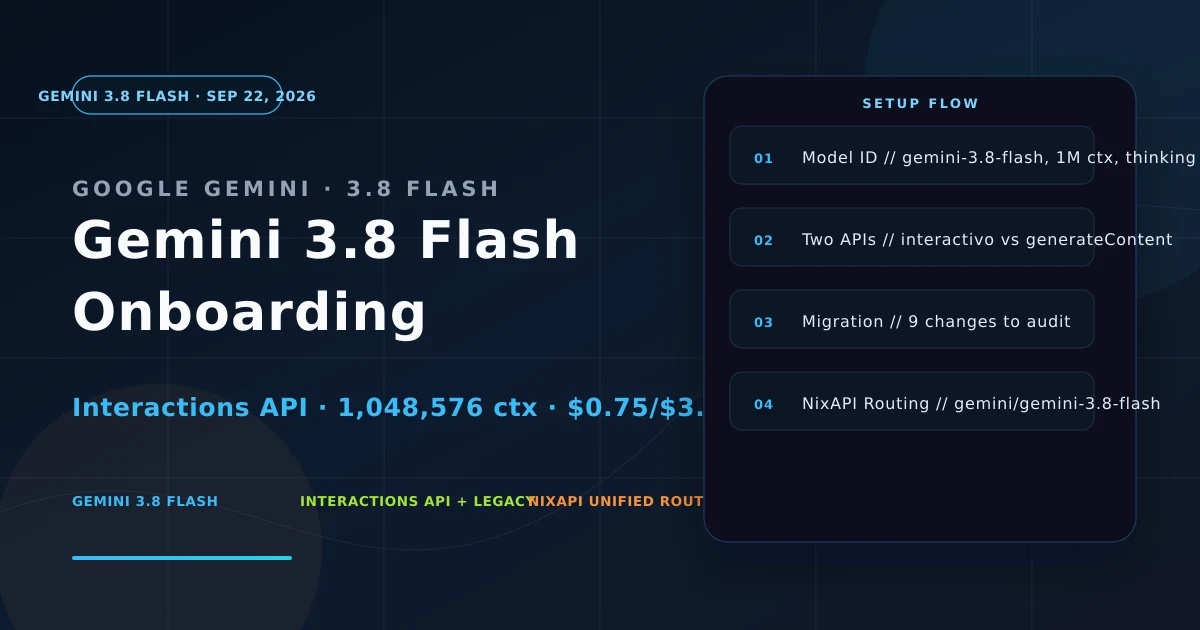
On September 22, 2026, Google released Gemini 3.8 Flash — the third update in the Flash series within six weeks. The headline isn’t a benchmark SOTA — it’s a structural shift in API shape:
- Interactions API (new recommended primary path) — server-side state via
previous_interaction_id, returns a structuredInteractionresource with astepstimeline; generateContent(kept as legacy, no sunset) — the old stateless call shape continues to work;- Model ID simplified: from
gemini-3.8-flash-previewto stablegemini-3.8-flash(no preview suffix); - Core specs:
1,048,576token input /65,536token output;thinking_levelis a string enum (low/medium/high, defaultmedium);minimalreturns a validation error; - Intro pricing: $0.75 / $3.75 per million input/output tokens through December 31, 2026; standard pricing ($1.50 / $7.50) takes effect January 1, 2027.
For teams currently using gemini-3.7-flash, this upgrade is not a one-line swap — temperature / top_p / top_k are no longer supported, thinking_budget is replaced by thinking_level, FunctionResponse must carry call_id + name, prefilled model turns are removed, and thinking signatures must be passed back verbatim.
This guide gives you the full onboarding package:
- Model specs and positioning — 1M ctx, thinking level, endpoint IDs, pricing;
- Two API shapes compared — Interactions API vs
generateContent, with structural, streaming, and state-management differences; - 9-item migration checklist — one item at a time, with before/after code;
- First-run battle code — 4 sample paths: curl, Python, Node, OpenAI-compatible;
- NixAPI integration strategy — what you can do today, what to switch tomorrow.
1. Model Specs and Positioning
1.1 The basics
| Property | Value |
|---|---|
| Model ID (stable) | gemini-3.8-flash |
| Modalities | Input: Text / Image / Audio / Video / PDF; Output: Text |
| Context window | Input 1,048,576; Output 65,536 |
| Thinking levels | LOW / MEDIUM / HIGH (default MEDIUM) |
| Watch out | minimal is not supported on 3.8 Flash — sending it returns a validation error |
| Endpoint (legacy) | POST /v1beta/models/gemini-3.8-flash:generateContent |
| Launch stage | GA (no preview suffix) |
| Latest update | September 2026 |
1.2 Pricing — intro vs standard
| Tier | Input $/MTok | Output $/MTok | Cache read $/MTok | Effective |
|---|---|---|---|---|
| Intro pricing | $0.75 | $3.75 | $0.075 | through 2026-12-31 |
| Standard pricing | $1.50 | $7.50 | $0.15 | from 2027-01-01 |
| Priority tier (high throughput) | $1.35 | $6.75 | $0.135 | intro period |
| Priority standard | $2.70 | $13.50 | $0.27 | from 2027-01-01 |
Region note: the table shows Global pricing; Non-global (specific regions like EU/UK) is roughly +10%.
Long context > 200K tokens: input and output are both billed at long-context rates — for example Priority tier long-context intro pricing is $1.485 / $7.425.
Batch / Flex: 50% of standard ($0.375 / $1.875).
1.3 Relationship with 3.7 Flash
Google positions 3.8 Flash as “based on Gemini 3.7 Flash” — same underlying architecture, but tuned for agent workflows + long context:
- 3.8 Flash defaults to
thinking_level=medium; 3 Pro defaults tohigh— don’t copy a Pro config across and assume it matches; - 3.7 Flash remains fully supported — keep a config flag for one-click rollback;
- The upgrade path is format-compatible (3.7 Flash also accepts the new format), but 3.8 Flash adds several hard validation rules — that’s where the real care is needed.
2. Two API Shapes: Interactions API vs generateContent
Google now treats Interactions API as the recommended primary path, but generateContent has no sunset date. The difference isn’t “new vs old” — it’s a “stateless call vs stateful timeline” paradigm shift.
2.1 Interactions API (recommended)
Interactions API redefines “making a call” as “creating an interaction” — each call returns a stored Interaction resource containing a steps timeline:
{
  "id": "interaction_abc123",
  "object": "interaction",
  "created_at": "2026-09-22T09:00:00Z",
  "steps": [
    { "type": "model_output", "content": [...] }
  ]
}
steps is an explicit array that records, in chronological order:
model_output(final text)thought(thinking process, as its own step)google_search_call/google_search_result(search tool call + result)function_call/function_result(user-defined function call + result)
Callers can iterate over steps directly for fine-grained handling — no more manually parsing parts / candidates / groundingSupports as in generateContent.
Multi-turn conversations use previous_interaction_id for server-side state management — the caller just passes the ID:
curl https://generativelanguage.googleapis.com/v1beta/interactions \
  -H "x-goog-api-key: ***" \
  -H "Content-Type: application/json" \
  -d '{
    "model": "gemini-3.8-flash",
    "input": "Q: What is the capital of France?",
    "previous_interaction_id": "interaction_abc123"
  }'
Streaming: Interactions API uses the same endpoint with "stream": true. The server pushes SSE events with specialized delta types for each step (including thinking delta, character-level function-call arguments delta).
2.2 generateContent (legacy)
generateContent is still stateless — it returns a candidates array, with each candidate having parts. Multi-turn conversations require the client to manage the contents array itself:
curl https://generativelanguage.googleapis.com/v1beta/models/gemini-3.8-flash:generateContent \
  -H "x-goog-api-key: ***" \
  -H "Content-Type: application/json" \
  -d '{
    "contents": [
      {"role": "user", "parts": [{"text": "Hello"}]},
      {"role": "model", "parts": [{"text": "Hi there!"}]},
      {"role": "user", "parts": [{"text": "What did I say?"}]}
    ]
  }'
The streaming endpoint requires switching to :streamGenerateContent.
2.3 When to use which?
| Scenario | Recommended API |
|---|---|
| New project, agents / multi-turn | Interactions API (recommended) |
| Simple one-shot request | generateContent is enough |
| Need exact control over thought signature | Interactions API (server-side hosted) |
| Reusing old SDK code | generateContent (keep current code) |
| NixAPI aggregation access | OpenAI-compatible → both Interactions API and generateContent are supported |
3. The 9-Item Migration Checklist
The 9 items below are the mandatory audits for upgrading from 3.7 Flash to 3.8 Flash. The first 5 will directly break your code.
3.1 Model ID
- "model": "gemini-3.7-flash"
+ "model": "gemini-3.8-flash"
3.2 thinking_level="minimal" is no longer supported — returns a validation error
- "thinking_level": "minimal"
+ "thinking_level": "low"   // 3.8 Flash: low / medium / high
3.3 Remove temperature / top_p / top_k
3.8 Flash completely removes sampling parameter support — Gemini 3.x tightens sampling uniformly.
- generation_config: {
-   temperature: 0.7,
-   top_p: 0.95,
-   top_k: 40
- }
+ generation_config: {
+   thinking_level: "medium"
+ }
3.4 thinking_budget → thinking_level (string enum)
- "thinking_config": { "thinking_budget": 1024 }
+ "thinking_config": { "thinking_level": "medium" }
3.5 Remove candidate_count
3.x no longer supports multi-candidate sampling.
- "candidate_count": 3
+ // removed
3.6 FunctionResponse must carry call_id + name
This is the second hard-break item. On 3.8 Flash, every function result you send back must carry the call’s ID and function name.
- {
-   "functionResponse": {
-     "name": "get_weather",
-     "response": {"temperature": 23}
-   }
- }
+ {
+   "functionResponse": {
+     "name": "get_weather",
+     "id": "call_xyz789",
+     "response": {"temperature": 23}
+   }
+ }
3.7 Enforce turn-validation rules
- Remove prefilled model turns;
- Ensure the last user turn has non-empty text.
- contents: [
-   { role: "user", parts: [{text: "..."}] },
-   { role: "model", parts: [{text: "(prefilled)"}] }   // ❌ no longer allowed
- ]
+ contents: [
+   { role: "user", parts: [{text: "Please answer this: ..."}] }   // ✅ final turn has non-empty text
+ ]
3.8 Audit function calling
- Place multimodal assets in the response payload;
- Format inline instructions with
\n\n; - If you see
Malformed_Function_Callerrors (tied to pre-tool text), refer to Google’s “Workarounds for pre-tool text requirements” doc.
3.9 Standard Gemini 3 requirements
- SDK update — switch to an SDK version that supports Gemini 3;
- Thought signatures must be passed back verbatim — Interactions API handles it for you server-side; if you go stateless with
store: falseor stick withgenerateContent, you must keep the thought block + signature and pass them back yourself, otherwise you’ll seefunction_callerrors.
Rollback strategy: 3.7 Flash fully supports the new format above — so you can use a config flag to swap model IDs without needing two code paths. Put
MODELin an env var, template{{MODEL}}into the URL, and the same code runs against both models.
4. First-Run Battle Code: 4 Call Patterns
4.1 curl (Interactions API, shortest)
curl https://generativelanguage.googleapis.com/v1beta/interactions \
  -H "x-goog-api-key: $GEMINI_API_KEY" \
  -H "Content-Type: application/json" \
  -d '{
    "model": "gemini-3.8-flash",
    "input": "One sentence to introduce the Interactions API"
  }'
4.2 curl (generateContent, legacy)
curl https://generativelanguage.googleapis.com/v1beta/models/gemini-3.8-flash:generateContent \
  -H "x-goog-api-key: $GEMINI_API_KEY" \
  -H "Content-Type: application/json" \
  -d '{
    "contents": [
      {"role": "user", "parts": [{"text": "One sentence to introduce generateContent"}]}
    ],
    "generation_config": {"thinking_level": "medium"}
  }'
4.3 Python SDK (official google-genai)
from google import genai

client = genai.Client(api_key="***")

# Interactions API (recommended)
interaction = client.interactions.create(
    model="gemini-3.8-flash",
    input="Write a Python fibonacci function",
    generation_config={"thinking_level": "medium"},
)
print(interaction.output_text)   # auto-extracts final text

# generateContent (legacy)
response = client.models.generate_content(
    model="gemini-3.8-flash",
    contents="Write a Python fibonacci function",
    config={"thinking_level": "medium"},
)
print(response.text)
4.4 OpenAI-Compatible Call (NixAPI / 3rd-party gateways)
If you use an OpenAI-compatible SDK (OpenAI Python, LangChain, LlamaIndex, etc.), just point the base_url at an OpenAI-compatible endpoint:
from openai import OpenAI

client = OpenAI(
    api_key="***",
    base_url="https://nixapi.com/v1",   # NixAPI aggregation layer
)

resp = client.chat.completions.create(
    model="gemini/gemini-3.8-flash",     # route through NixAPI
    messages=[{"role": "user", "content": "Introduce OpenAI-compatible calls"}],
    extra_body={"thinking_level": "medium"},   # Gemini-specific params via extra_body
)
print(resp.choices[0].message.content)
4.5 Streaming (Interactions API)
curl https://generativelanguage.googleapis.com/v1beta/interactions \
  -H "x-goog-api-key: $GEMINI_API_KEY" \
  -H "Content-Type: application/json" \
  -d '{
    "model": "gemini-3.8-flash",
    "input": "Detail the differences between Interactions API and generateContent",
    "stream": true
  }'
SSE event types include interaction.start, interaction.model_output.delta (text delta), interaction.function_call.arguments.delta (character-level function-argument delta), and interaction.complete.
5. NixAPI Integration Strategy: Today, Day-After
5.1 Today (9/22): unified interface, immediate access
Aggregation API platforms like NixAPI have already routed gemini-3.8-flash — you can call it today via the OpenAI-compatible interface:
curl https://nixapi.com/v1/chat/completions \
  -H "Authorization: Bearer ***" \
  -H "Content-Type: application/json" \
  -d '{
    "model": "gemini/gemini-3.8-flash",
    "messages": [{"role": "user", "content": "Hi"}]
  }'
Zero business-code changes — upgrading from gemini/gemini-3.7-flash to gemini/gemini-3.8-flash is just a string swap.
5.2 Year-end (12/31): pricing auto-doubles
Intro pricing $0.75/$3.75 ends 2026-12-31; standard $1.50/$7.50 starts 2027-01-01 — meaning your annual budget model doubles on 2027-01-01. Plan ahead:
- Keep a separate budget book for “Flash long-running workloads” — don’t mix with flagship spending;
- In December decide whether to upgrade to Pro, switch to DeepSeek V4 Pro ($0.435/$0.87), or fall back to Sonnet 5 ($2/$10);
- Watch NixAPI Radar for “pricing change” alerts.
5.3 Direct vs aggregation: when to use what
| Scenario | Recommended path |
|---|---|
| Cheapest possible | Direct to Gemini (standard / batch) |
| Most stable + multi-model one-click switching | Through NixAPI (OpenAI-compatible interface + model routing) |
| Agents / multi-turn / frequent model switching | Through NixAPI (runtime switching + cache-hit optimization) |
| Interactions API–specific features (steps timeline) | Direct to Gemini (aggregation layers don’t expose step details) |
| Bulk prompt evaluation | Batch API (50% off) |
5.4 Three things to do right now
- Add a
modelfield to your product config layer — even if you usegemini-3.7-flashtoday, switching togemini-3.8-flash(or rolling back to 3.7) is just a field change; - Audit function calling — go through items 3.6, 3.8, and 3.9 from the migration list; the most common trip-ups are
call_id+namemissing onFunctionResponseand thought signatures not preserved; - Watch for the 2027-01-01 price doubling — keep a separate budget book for Flash long-running workloads, and pre-decide in December whether to keep / switch.
6. Conclusion
Gemini 3.8 Flash itself isn’t a huge news story — it’s a stable upgrade + thinking-tuning release over 3.7 Flash. But Google simultaneously elevated Interactions API to the recommended primary path and downgraded generateContent to legacy (without sunsetting it) — that’s a measured paradigm shift:
- Server-side state radically simplifies client code;
stepstimeline makes “what did the model do” fully transparent;thinking_levelstring enum replaces numeric budget with semantic tiers;FunctionResponsemust carrycall_id+nameturns tool calls from “fuzzy string-glue” into “rigid chain.”
Of the 9 migration items, the first 5 will hard-break code — especially thinking_level="minimal" returning errors, FunctionResponse missing call_id + name, and thought signatures not being passed back verbatim. Audit the list item by item; don’t flip everything at once.
If your project already keeps model routing in a model field and uses an aggregation layer like NixAPI for multi-vendor access, then upgrading to gemini-3.8-flash is just “change the field value” — the rest of the migration complexity is absorbed by the aggregation layer. That’s the core value of a model-routing layer in the multi-vendor era.
The 3.8 Flash story is just starting. We’ll keep updating Gemini 3.8 Pro, 3.8 Flash Cyber, and the 2027 January price-restoration impact on NixAPI Radar.
Sources
- Google AI official docs — ai.google.dev/gemini-api/docs/models/gemini-3.8-flash
- Interactions API migration guide — ai.google.dev/gemini-api/docs/migrate-to-interactions
- generateContent What’s New — ai.google.dev/gemini-api/docs/generate-content/latest-model
- Google DeepMind model card — deepmind.google/models/model-cards/gemini-3-8-flash/
- Gemini Enterprise Agent Platform pricing — cloud.google.com/gemini-enterprise-agent-platform/generative-ai/pricing
- Apidog migration checklist — apidog.com/blog/gemini-3-7-to-3-8-flash-migration-guide
- NixAPI supported models & pricing · NixAPI API docs · NixAPI console
Try NixAPI Now
Reliable LLM API relay for OpenAI, Claude, Gemini, DeepSeek, Qwen, and Grok with ¥1 = $1 top-up
Sign Up Free