GPT-5.6 Family Deep Dive: Sol / Terra / Luna API Selection Guide
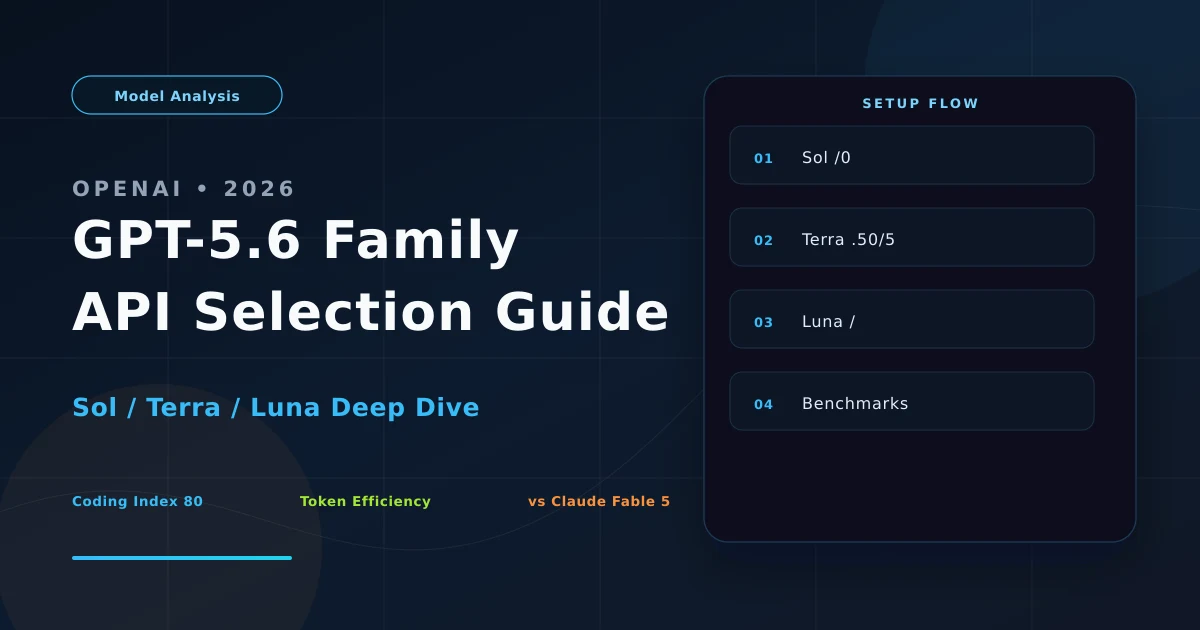
On July 9, 2026, OpenAI officially launched the GPT-5.6 family (Sol / Terra / Luna) for general availability. Sam Altman claims flagship Sol achieves 54% better token efficiency on agentic coding tasks. This article provides a deep comparison across pricing, coding performance, reasoning capabilities, and context windows, with cross-reference to Claude Sonnet 5 and Meta Muse Spark 1.1. Includes NixAPI integration examples.
Note: All facts sourced from OpenAI official announcement (openai.com, 2026-07-09), Artificial Analysis (artificialanalysis.ai, 2026-07-09), CNBC/Silicon Republic (2026-07-10), Simon Willison (simonwillison.net, 2026-07-09), and DataCamp (datacamp.com, 2026-06-30). Pricing based on official API pricing pages as of July 12, 2026.
1. Background: From Limited Preview to General Availability
On July 9, 2026, OpenAI moved the GPT-5.6 family from “limited preview” to general availability (GA), marking the formal entry of this generation into production environments. Unlike the restricted release at the end of June, this GA means all developers can call GPT-5.6’s three tiers via the OpenAI API without relying on a government-approved “trusted partners” list.
GPT-5.6 introduces a new naming system: numbers identify the generation, names identify capability tiers. Sol (flagship), Terra (balanced), and Luna (economy) are three independently evolvable capability tiers that may receive individual upgrades within the same generation. OpenAI’s announcement emphasizes that GPT-5.6’s “stronger performance per dollar” is its core selling point — more successful work for the same spend, or comparable results at lower total cost.
In a CNBC interview, Sam Altman stated that GPT-5.6 Sol achieves 54% better token efficiency on agentic coding tasks compared to competing models (Silicon Republic, 2026-07-10). This figure is also validated in OpenAI’s internal and external PR benchmarks: on code review tasks, GPT-5.6 Sol beats GPT-5.5 on F1 while using approximately 3× fewer tokens per PR (openai.com).
2. Three-Tier Model Parameter Comparison
| Parameter | GPT-5.6 Sol | GPT-5.6 Terra | GPT-5.6 Luna |
|---|---|---|---|
| Positioning | Flagship, strongest reasoning and agentic capabilities | Balanced, everyday production default | Economy, high-concurrency / low-latency scenarios |
| Input Pricing (/1M tokens) | $5.00 | $2.50 | $1.00 |
| Output Pricing (/1M tokens) | $30.00 | $15.00 | $6.00 |
| Cache Write (/1M tokens) | $6.25 | $3.125 | $1.25 |
| Cache Read (/1M tokens) | $0.50 | $0.25 | $0.10 |
| Long-context surcharge | >272K input: ×2 input / ×1.5 output | Same as Sol | Same as Sol |
| Knowledge cutoff | 2026-02-16 | 2026-02-16 | 2026-02-16 |
| Unique features | max reasoning, ultra sub-agent mode | None | None |
Pricing sources: OpenAI API official pricing, gpt-5.6-terra.
Model Aliases and Snapshots
gpt-5.6andgpt-5.6-solboth route to Solgpt-5.6-terraroutes to Terragpt-5.6-lunaroutes to Luna- Snapshot versions (e.g.,
gpt-5.6-sol-2026-07-09) lock a specific version for consistent behavior
3. Performance Benchmarks: Coding, Reasoning, and Agentic Capabilities
3.1 Artificial Analysis Coding Agent Index v1.1
Artificial Analysis (an independent third-party evaluation firm) conducted pre-release evaluations of the GPT-5.6 family. The results in the coding agent domain are definitive (artificialanalysis.ai):
| Model | Coding Agent Index | Reference |
|---|---|---|
| GPT-5.6 Sol (max) | 80 | Leads Claude Fable 5 (77.2) by 2.8 points |
| GPT-5.6 Terra (max) | 77.4 | Slightly above Fable 5, at ~50% of Sol’s cost |
| GPT-5.6 Luna (max) | 74.6 | Exceeds Claude Opus 4.8 (72.5), at ~20% of Sol’s cost |
| Claude Fable 5 (max) | 77.2 | — |
| Claude Opus 4.8 (max) | 72.5 | — |
| GPT-5.5 | 76.4 | — |
Sol ranks first in all three coding evaluations (DeepSWE, Terminal-Bench v2, SWE-Atlas-QnA), tying with Grok 4.5 on SWE-Atlas-QnA. More importantly, Sol’s per-task cost is approximately 40% lower than Fable 5 and about 10% lower than Opus 4.8; Terra and Luna’s per-task costs are 60% and 80% lower than Sol, respectively.
3.2 Terminal-Bench 2.1: Terminal Agent Dominance
| Model | Terminal-Bench 2.1 |
|---|---|
| GPT-5.6 Sol Ultra | 91.9% |
| GPT-5.6 Sol | 88.8% |
| GPT-5.5 | 88.0% |
| Claude Fable 5 | 83.4%–86.0% |
| Claude Opus 4.8 | 78.9% |
| GPT-5.6 Terra | 82.5%–87.4% |
| GPT-5.6 Luna | 84.3%–84.7% |
GPT-5.6 Sol shows clear advantages in terminal agent tasks, with Sol Ultra (multi-agent parallel mode) reaching 91.9%, leading all Claude models.
3.3 Agents’ Last Exam: Long-Horizon Professional Workflows
| Model | Score | Comparison |
|---|---|---|
| GPT-5.6 Sol | 53.6% | Leads Claude Fable 5 (adaptive) by 13.1 points |
| GPT-5.6 Terra | 50.4% | At roughly 1/16th the cost of Fable 5 |
| GPT-5.6 Luna | 50.3% | At roughly 1/16th the cost of Fable 5 |
| Claude Fable 5 | 40.5% | — |
3.4 Token Efficiency: Output Tokens and Speed
OpenAI official data (openai.com) on the Artificial Analysis Intelligence Index shows:
- GPT-5.6 Sol (max) is only 1 point behind Claude Fable 5 (max) (59 vs 60), but completes tasks 61% faster at roughly half the estimated cost
- Sol’s per-task token consumption on the Intelligence Index is 15k, lower than GPT-5.5’s 16k, and also lower than Claude Opus 4.8 (max), GLM-5.2 (max), and Gemini 3.5 Flash (high)
- On OSWorld 2.0, Sol surpasses Opus 4.8 while using 85% fewer output tokens
4. Cross-Comparison: Claude Sonnet 5 and Meta Muse Spark 1.1
4.1 Claude Sonnet 5 (Anthropic, released 2026-06-30)
Sonnet 5 is Anthropic’s mid-tier model launched in the same window as GPT-5.6, with an aggressive pricing strategy:
| Model | Input (/1M) | Output (/1M) | Notes |
|---|---|---|---|
| Claude Sonnet 5 (intro, through 2026-08-31) | $2.00 | $10.00 | Limited-time offer |
| Claude Sonnet 5 (standard) | $3.00 | $15.00 | Standard pricing |
| GPT-5.6 Sol | $5.00 | $30.00 | — |
| GPT-5.6 Terra | $2.50 | $15.00 | — |
| GPT-5.6 Luna | $1.00 | $6.00 | — |
Capability comparison: Sonnet 5’s SWE-bench Pro score is 63.2%, higher than GPT-5.5 (58.6%) but below Claude Opus 4.8 (69.2%) and Fable 5 (80.3%). No official Terminal-Bench score was published for Sonnet 5. In terms of positioning, Sonnet 5 is a “mid-tier capability + low entry price” strategy, competing in the same price band as GPT-5.6 Terra — but Terra outperforms or matches Sonnet 5 on Terminal-Bench and the Coding Agent Index, while Sol is clearly stronger on agentic coding tasks.
4.2 Meta Muse Spark 1.1 (Meta, released 2026-07-09)
Muse Spark 1.1 is Meta’s first API offering to developers, accessible via the Meta Model API with OpenAI SDK-compatible endpoints. The pricing is aggressively disruptive:
| Model | Input (/1M) | Output (/1M) | Notes |
|---|---|---|---|
| Meta Muse Spark 1.1 | $1.25 | $4.25 | New accounts get $20 free credits |
| GPT-5.6 Luna | $1.00 | $6.00 | — |
| GPT-5.6 Terra | $2.50 | $15.00 | — |
| Claude Sonnet 5 (intro) | $2.00 | $10.00 | Limited-time |
Muse Spark 1.1 features a 1M token context window, supports multimodal inputs (images, video, PDFs), and has built-in reasoning capabilities (thinking tokens billed as output). Meta claims competitiveness with Claude Opus 4.8, Gemini 3.1 Pro, and GPT-5.5 on benchmarks including SWE-bench Verified, Terminal-Bench, and BrowseComp (InfoWorld, 2026-07-10).
Key difference: Muse Spark 1.1’s output price is 29% lower than GPT-5.6 Luna, yet Luna’s Coding Agent Index (74.6) has already been verified to exceed Claude Opus 4.8. For pure coding agents, Luna offers exceptional value; for workflows requiring 1M context or multimodal reasoning, Muse Spark 1.1’s context window advantage is unmatched.
5. Selection Decision Tree: Which Tier Fits Your Use Case?
Choose GPT-5.6 Sol when:
- Complex terminal agents: Workflows requiring shell command orchestration and multi-step tool calling (Terminal-Bench 2.1: 88.8%–91.9%)
- Cybersecurity research: Leading on ExploitBench and ExploitGym
- Long-horizon multi-agent tasks: Ultra mode supports parallel sub-agents for Agents’ Last Exam-class tasks
- Frontend and design: BenchCAD 70.6%, with significantly improved design judgment
- Sufficient budget: Per-task cost is ~2× Terra and ~5× Luna, but offers the highest quality ceiling
Choose GPT-5.6 Terra when:
- Everyday production default: Most benchmarks lag Sol by only 2–3 points at half the price
- GPT-5.5 upgrade path: Terra surpasses GPT-5.5 on OSWorld and BrowseComp at lower cost
- Medium-complexity coding: Coding Agent Index 77.4, comparable to Fable 5
- Cost-sensitive without quality compromise: SWE-bench Pro 63.4%, approaching production-ready levels
Choose GPT-5.6 Luna when:
- High-concurrency pipelines: Classification, summarization, extraction at scale — $6 per million output tokens
- Low-latency responses: Fastest response times for customer service and real-time chat
- Lightweight agents: Tasks needing agentic structure (tool calling, function calling) without deep reasoning
- Maximum cost efficiency: 24 benchmark points per dollar on DeepSWE, far exceeding Fable 5’s 3.2
Avoid Luna for:
- Long-context recall: Luna scores only 41.3% on MRCR long-context evaluation, a massive gap behind Sol (91.5%) and Terra (89.6%). For large document analysis or long codebase reasoning, use Terra or Sol.
6. NixAPI Integration Examples
Through NixAPI, you can access the entire GPT-5.6 family via a unified endpoint without managing separate OpenAI API keys.
Basic Call (Sol)
import openai

client = openai.OpenAI(
    base_url="https://nixapi.com/v1",
    api_key="your-nixapi-key"  # Obtain from https://nixapi.com/console
)

response = client.chat.completions.create(
    model="gpt-5.6-sol",
    messages=[
        {"role": "system", "content": "You are a senior Python engineer."},
        {"role": "user", "content": "Write a FastAPI middleware that logs request duration and status code."}
    ]
)
print(response.choices[0].message.content)
Using Max Reasoning Mode (Sol only)
response = client.chat.completions.create(
    model="gpt-5.6-sol",
    messages=[...],
    reasoning_effort="max"  # Sol supports low / medium / high / max
)
Three-Tier Model Switching
models = {
    "sol": "gpt-5.6-sol",
    "terra": "gpt-5.6-terra",
    "luna": "gpt-5.6-luna",
}

for tier, model_id in models.items():
    response = client.chat.completions.create(
        model=model_id,
        messages=[{"role": "user", "content": "Explain the fundamentals of recursive functions."}]
    )
    print(f"[{tier}] tokens: {response.usage.total_tokens}, "
          f"cost: ${response.usage.total_tokens / 1e6 * price_map[tier]:.4f}")
NixAPI advantage: Check real-time model availability for the GPT-5.6 family. The current limited-time top-up rate is ¥0.80 = $1.00, with no separate OpenAI API access application required.
7. Summary and Outlook
The GA launch of the GPT-5.6 family marks OpenAI’s firm commitment to an “efficiency-first” strategy. Three key trends deserve developers’ attention:
- Token efficiency is cost competitiveness: The 54% token efficiency improvement means significantly lower total cost for the same tasks, directly impacting the feasibility of large-scale agent deployment.
- Three-tier stratification is becoming an industry standard: The Sol/Terra/Luna naming system is clearer than the traditional “mini/pro/max” approach. Future model selection will revolve around two dimensions: “tier + reasoning effort”.
- The price war is intensifying: The pricing of Claude Sonnet 5 ($2/$10 intro) and Meta Muse Spark 1.1 ($1.25/$4.25) forces OpenAI to maintain extreme competitiveness at the Luna tier ($1/$6). Multi-model procurement is becoming the enterprise default.
For developers, we recommend starting with Terra: it trails Sol by only 2–3 points on most benchmarks at half the price. Upgrade to Sol if your workload focuses on terminal agents, cybersecurity, or long-horizon multi-agent tasks. Luna is the optimal choice for high-concurrency, low-latency, lightweight tasks — just never use it for long documents.
References
- OpenAI GPT-5.6 Official Announcement
- GPT-5.6 Sol API Documentation
- Artificial Analysis GPT-5.6 Evaluation
- Simon Willison: GPT-5.6 Family Overview
- Silicon Republic: Altman on 54% Token Efficiency
- DataCamp: Claude Sonnet 5 vs GPT-5.6
- Vellum: GPT-5.6 Three-Tier Deep Comparison
- Meta Muse Spark 1.1 Official Blog
- The Decoder: Muse Spark 1.1 Pricing Analysis
- InfoWorld: Meta Muse Spark 1.1 Enterprise AI Spending
Try NixAPI Now
Reliable LLM API relay for OpenAI, Claude, Gemini, DeepSeek, Qwen, and Grok with ¥1 = $1 top-up
Sign Up Free