Grok API Watermarking Goes Live by Default: xAI's EU AI Act Move and What Developers Should Do
From 2026-11-07, xAI watermarks text from 7 Grok API models by default — covering plain responses, structured outputs, and tool-call arguments. This guide breaks down the x-watermark header, the team-admin opt-out process, EU AI Act Article 50 deadlines, and a four-step developer checklist.
Introduction: The Change That Breaks Nothing
On 2026-10-31, xAI announced on X a change that took effect 2026-11-07:
Starting today, text from the Grok API will carry an invisible watermark by default.
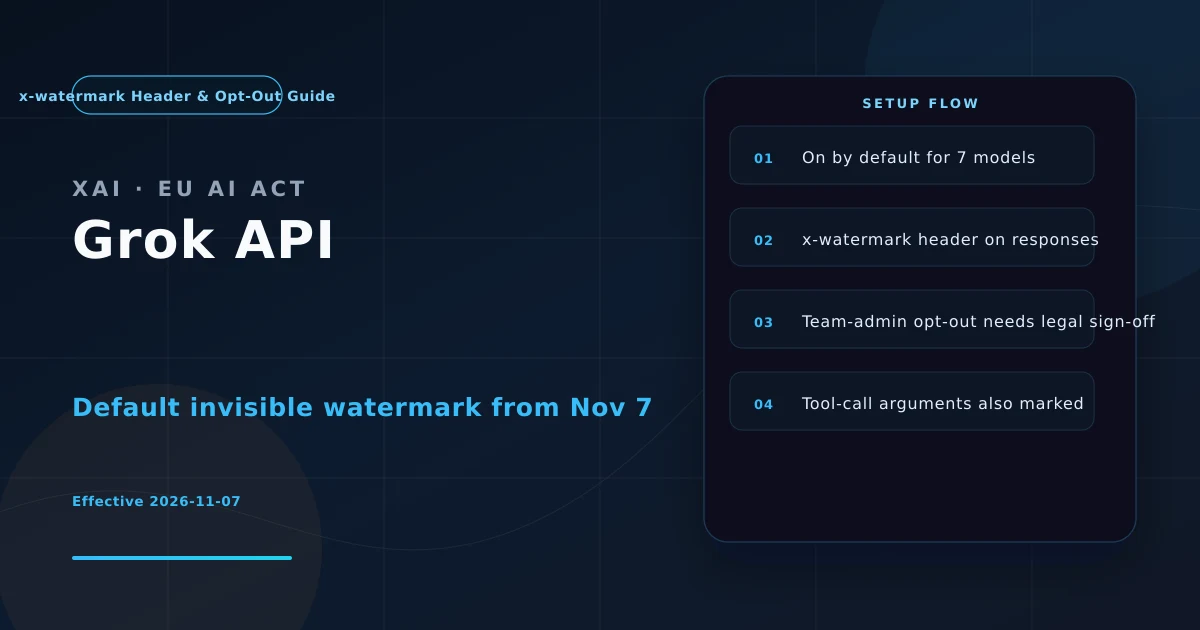
What’s unusual about this one is that your code won’t throw an error. The request still succeeds with HTTP 200, the body still parses. The only change is a new x-watermark: true response header — and the text itself is very slightly reshaped during sampling.
That’s exactly why it deserves a technical article. Silent breaking changes are the dangerous kind: no exception, no alert, no degradation signal. You find out months later, when you wonder why the same prompt now produces slightly different phrasing.
This article is based on xAI’s official developer documentation (Output Watermarking, updated 2026-10-31) and covers four things:
- Which models and which outputs get marked;
- How to use the
x-watermarkheader; - Why opting out is a governance decision, not a toggle;
- The four things developers should do now.
1. Scope: Wider Than “Text Output”
1.1 The Seven Covered Models
| Model | Type |
|---|---|
grok-4.7 | General |
grok-4.6 | General |
grok-4.5 | General |
grok-4.3 | General |
grok-4.20-reasoning | Reasoning |
grok-4.20-non-reasoning | Non-reasoning |
grok-4.20-multi-agent | Multi-agent |
Some models may be locked on and cannot be opted out of. xAI hasn’t published a lock list — so don’t assume every model is disable-able. Check each model you actually use in the console.
1.2 The Three Covered Output Types
This is the detail most people miss. The docs explicitly list what gets marked — and it’s not just chat replies:
- Ordinary text responses — the answer you see;
- Structured outputs — JSON mode, schema-constrained returns;
- Tool-call arguments — the function parameters the model generates.
Point 3 deserves expansion. If your agent architecture is “LLM decides which tool to call and with what arguments,” then:
- Tool-call arguments are watermarked too;
- downstream systems receive
arguments(a SQL string, a shell command, a URL) carrying a statistical signature; - if those arguments get logged, stored, or concatenated into other text, the watermark signal spreads into data flows you never intended.
That’s a real compliance boundary question: which fields in your system count as “AI-generated content”? You now need an answer.
1.3 Endpoints
- The global
api.x.aiendpoint; - Regional endpoints;
- Both the Responses API and the Chat Completions API.
2. How the Watermark Works
xAI’s own wording from the Output Watermarking docs:
“It is applied while the model generates text: it slightly shapes which tokens the model picks, so it adds no characters, markup, or hidden text to the response.”
Three properties, and what each means for you:
| Property | Meaning | Impact on you |
|---|---|---|
| Applied during sampling | Not a label added afterward — token sampling is nudged as the text is produced | Readability is unchanged, but word-choice distribution carries a statistical signature |
| Zero visible change | No characters, no markup, no hidden text | No filtering or sanitizing needed; copy-paste preserves the mark |
| No quality or speed impact | xAI explicitly states response quality and generation speed are unaffected | No performance regression |
Why not hidden characters? Because character-level watermarks (zero-width chars) are fragile — copy-paste, encoding conversion, and translation all break them. Statistical watermarks work by shifting token probability distributions, so copy-paste doesn’t remove them; only heavy rewriting weakens them. This is also why xAI’s detection API returns probabilistic answers.
2.1 Detection Results Are Probabilistic
This needs to be stated clearly, because otherwise people will treat it as a binary verdict.
xAI offers a separate detection API (available by application) that can return three outcomes:
watermarkednot watermarkeduncertain
That third state is real. It means: “this passage is too short or the signal too weak to decide.” Media coverage often describes detection as binary; the official API is not.
Length matters a lot: longer passages produce a stronger signal. Short sentences, single fragments, JSON snippets are the most likely to land on
uncertain.
3. The x-watermark Header: The Audit Trail Most Likely to Be Lost
This is the most actionable section of the article.
x-watermark: true
true→ this response was watermarked;- absent or
false→ it wasn’t (usually the model was opted out, or it isn’t in scope).
Engineering recommendation: persist this header.
The reasoning is blunt: if your pipeline drops response headers before storage, moderation, or tool execution, you lose the simplest possible evidence of whether the Grok-generated text carried a watermark at the time. And you can’t reconstruct that later.
3.1 Minimal Implementation
import json, datetime, uuid, hashlib

def call_grok(client, **kwargs) -> dict:
    resp = client.chat.completions.create(**kwargs)

    # Key: record the watermark header alongside the response, not just content
    audit = {
        "ts": datetime.datetime.now(datetime.timezone.utc).isoformat(),
        "request_id": str(uuid.uuid4()),
        "model": kwargs["model"],
        "watermarked": resp.headers.get("x-watermark"),   # "true" / None / "false"
        "content_sha256": hashlib.sha256(
            resp.choices[0].message.content.encode()
        ).hexdigest(),
    }
    with open("audit/grok_watermark.jsonl", "a") as f:
        f.write(json.dumps(audit) + "\n")

    return resp
Three design notes:
- Store the header, not just the content —
x-watermarkis the only direct proof of the state at generation time; - Fingerprint instead of raw text — if your log store has compliance constraints, a SHA-256 digest verifies integrity without duplicating sensitive content;
- Bind it to a request ID — so you can trace back to the exact call and prompt template.
3.2 The Middleware Version (Recommended for Production)
If you use multiple providers, don’t scatter this logic across business modules:
WATERMARK_HEADERS = {
    "grok": "x-watermark",
    # other vendors may introduce their own header names
}

class ProvenanceMiddleware:
    def __init__(self, log_path="audit/provenance.jsonl"):
        self.log_path = log_path

    def wrap(self, provider: str, resp, model: str, request_id: str):
        header = WATERMARK_HEADERS.get(provider)
        flag = resp.headers.get(header) if header else None
        self._append({
            "ts": datetime.datetime.now(datetime.timezone.utc).isoformat(),
            "provider": provider,
            "model": model,
            "request_id": request_id,
            "watermark_header": header,
            "watermarked": flag,
        })
        return resp
The value of a gateway layer is precisely this: it’s the only place guaranteed to collect every provider’s provenance header. Implementations scattered across business modules will inevitably miss one within three months.
4. Opting Out: Not a Technical Switch
4.1 Who Can Opt Out
Only team admins. Individual API key holders cannot disable it.
That’s deliberate: opting out is a governance decision, not a technical parameter.
4.2 What Opting Out Involves
- Disable it per model in the SpaceXSI Console (xAI’s developer platform, now operating under the SpaceXSI name);
- Confirm a legal exception applies — the console requires you to assert this;
- Accept responsibility yourself, including marking and disclosure obligations;
- All changes are logged in an audit trail;
- Takes effect within ~5 minutes, and applies to all API keys across the team.
4.3 The Team-Level Cascade
Note point 5: this is a team-scoped setting, not a key-scoped one.
That means:
- a new API key inherits the team’s setting;
- if a colleague opts out, you’re affected too;
- if your multi-tenant SaaS uses a single xAI team, every tenant shares one watermark switch.
For multi-tenant products this almost forces you to split teams by compliance posture — opt-out granularity stops at the team level, and there is no finer control.
4.4 The Real Policy Tension
In August 2026, xAI declined to join the EU’s voluntary code of practice on marking AI content. This default-on watermarking is a clear reversal of stance — because the regulatory deadline arrived.
Under EU AI Act Article 50, as amended by the AI Omnibus:
- Generative AI systems placed on the market after 2026-08-02: marking obligations apply immediately;
- Pre-existing systems (placed on the market before that date): grace period runs to 2026-12-02.
xAI chose 2026-11-07 — roughly three weeks before the grace period ends for existing systems.
Fines for breaching the transparency obligations can reach €15 million or 3% of worldwide annual turnover, whichever is higher.
That explains the oddly specific date. It wasn’t a technical choice — it was a compliance countdown.
5. Four Things Developers Should Do
1. Inventory the Grok models you actually use
Check each one in the console. Especially: if you’re on grok-4.20-* (reasoning / non-reasoning / multi-agent), the watermark scope includes tool-call arguments.
2. Capture the x-watermark header
Do it in the gateway/middleware layer, not scattered through business code. Log it or store it in an audit table.
3. Decide whether to opt out — and who decides
This is a compliance question, not a technical one:
| Your situation | Recommendation |
|---|---|
| EU-facing, output visible to end users | Leave it on — this is the regulatory requirement; opting out needs a genuine legal basis |
| Internal tooling, output never leaves | Leaving it on is usually harmless (no quality or speed impact) |
| Output is heavily reworked into “your own original content” | Be careful — opting out needs legal grounds, and opt-out events are audited |
| Multi-tenant SaaS with differing compliance needs per tenant | Split teams — opt-out granularity is team-scoped |
4. Test your downstream pipeline
If you post-process Grok output (summarize, rewrite, translate, splice into templates), the watermark signal gets diluted. Specifically:
- rewriting/summarizing → statistical features weaken, detection may fall to
uncertain; - translating to another language → signal degrades substantially;
- splicing into long template text → signal is diluted.
This affects your compliance claims. If you tell users “everything we publish is traceable,” verify your processing pipeline doesn’t quietly break that promise.
6. The NixAPI Angle: Where an Aggregator Actually Helps
This section needs to be honest.
Reality: Grok’s watermark setting is team-scoped, and the x-watermark header is response-scoped. If your requests are proxied through an aggregator:
- does the aggregator forward response headers? This determines whether your audit chain is complete;
- which team does the aggregator call with? That determines whose organization the watermark is attributed to;
- who can opt out — the aggregator’s admin, not your users.
So for teams that need fine-grained compliance control, Grok direct + your own team is usually still required.
Where an aggregator does help is uniformity:
- One collection point: the gateway preserves provenance headers from every provider (
x-watermarkand whatever comes next) without omissions; - One view: see what’s marked, by model, by team, by request;
- One audit trail: when compliance asks for evidence, you’re not digging through five vendor log systems.
NixAPI’s unified endpoint is positioned here as an observability layer — not a way to route around compliance. That distinction matters.
7. Conclusion
The lesson here is the mirror image of OpenAI’s textGrain launch (2026-09):
OpenAI’s approach: on by default, with the switch in Organization/Project settings and explicit guidance on auditing within an org. xAI’s approach: on by default, with opt-out requiring legal confirmation and personal accountability, and every change audited.
Both point to the same conclusion: once “AI-generated content must be traceable” becomes a legal requirement, model vendors are turning provenance from a model-internal feature into an operational process that organizations must govern.
Three practical takeaways for developers:
- Start capturing
x-watermarknow — it’s the only proof of the state at generation time, and it can’t be reconstructed later; - Opting out isn’t a technical decision — ask legal whether a real exception exists before turning it off for the sake of “more human-sounding” output;
- Tool-call arguments are in scope — re-audit which fields in your system count as AI-generated content.
One more note: if your product serves EU users, this change is almost certainly not optional. Treat it as compliance work, not an experiment.
Further reading:
- xAI official: Output Watermarking docs (updated 2026-10-31)
- xAI official: API documentation home
- European Commission: AI Act Article 50 transparency obligations
- European Commission: AI Omnibus and grace period for pre-existing systems
- Related reading: OpenAI textGrain API Complete Guide
This article was written by the NixAPI editorial team. NixAPI is a unified aggregator for multiple LLM APIs, supporting 30+ models including OpenAI / Anthropic / Google / DeepSeek / xAI. Console registration includes a $1 trial credit.