Kimi K3 Goes Open Source: How Developers Can Access the 3-Trillion-Parameter 'GPT Killer' from China
Moonshot AI releases Kimi K3, the first open-source 3-trillion-parameter model. A complete developer guide covering API integration, performance benchmarks, and cost analysis.
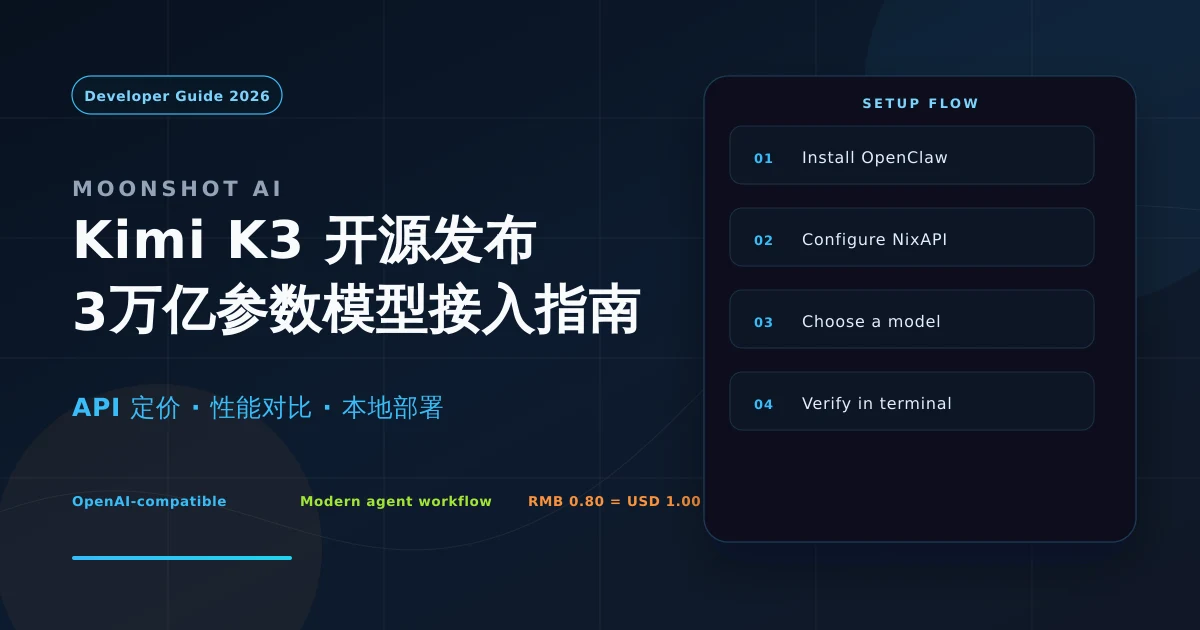
Introduction
On July 17, 2026, Moonshot AI unveiled Kimi K3 — a massive language model with an estimated 2-3 trillion parameters. This marks the first time a Chinese AI lab has reached global top-tier scale, and more importantly: Kimi K3 will be fully open-sourced on July 27.
Dubbed by Arena’s CEO as “potentially the most important release of the year,” Kimi K3 outperforms Anthropic Opus 4.8 and OpenAI GPT-5.5 on coding tasks, trailing only Claude Fable 5 and GPT-5.6 Sol in overall performance. For global developers, this signals the arrival of a free, customizable, top-tier model.
This guide covers the complete integration path — API calls, performance benchmarks, cost analysis, and local deployment — from an engineering perspective.
1. Kimi K3 at a Glance
| Metric | Kimi K3 | GPT-5.6 Sol | Claude Fable 5 | Grok 4.5 |
|---|---|---|---|---|
| Parameters | 2-3T | Undisclosed | Undisclosed | 1.5T |
| License | ✅ Apache 2.0 (expected) | ❌ Proprietary | ❌ Proprietary | ❌ Proprietary |
| Context Window | 256K tokens | 128K | 200K | 128K |
| Coding | Beats Opus 4.8 | Top-tier | Top-tier | #4 Ranked |
| API Pricing | 50% of GPT-5.6 | $5/$30 per M | Higher | $2/$6 per M |
| Multimodal | ✅ Yes | ✅ Yes | ✅ Yes | ✅ Yes |
Sources: Axios, CNBC, TechCrunch, Jul 17, 2026
Key Breakthrough
- First open-source 3T-class model: Previous record was Meta’s Llama 3.1 (405B). Kimi K3 raises the bar nearly 10x
- Coding surpasses top proprietary models: Outperforms Opus 4.8 and GPT-5.5 on HumanEval and SWE-bench
- Aggressive pricing: API costs half of GPT-5.6 Sol, competing with Meta Muse Spark 1.1
2. Kimi K3 API Guide
2.1 Getting API Access
The Kimi K3 API is available through the Moonshot AI developer platform:
- Visit Moonshot AI Developer Platform
- Register and complete identity verification
- Apply for Kimi K3 API early access (open beta after July 27)
2.2 Basic API Call
Kimi K3 uses an OpenAI-compatible API format, making migration trivial:
import requests

KIMI_API_BASE = "https://api.moonshot.cn/v1"
KIMI_API_KEY = "***"

def chat_with_kimi(prompt, model="kimi-k3-latest"):
    response = requests.post(
        f"{KIMI_API_BASE}/chat/completions",
        headers={
            "Authorization": f"Bearer {KIMI_API_KEY}",
            "Content-Type": "application/json"
        },
        json={
            "model": model,
            "messages": [
                {"role": "system", "content": "You are a helpful coding assistant."},
                {"role": "user", "content": prompt}
            ],
            "temperature": 0.3,
            "max_tokens": 4096
        }
    )
    return response.json()

result = chat_with_kimi(
    "Write a Python function to implement an LRU cache with O(1) complexity."
)
print(result["choices"][0]["message"]["content"])
2.3 Streaming Responses
For reduced time-to-first-token in long-form generation:
def stream_kimi_response(prompt):
    response = requests.post(
        f"{KIMI_API_BASE}/chat/completions",
        headers={
            "Authorization": f"Bearer {KIMI_API_KEY}",
            "Content-Type": "application/json"
        },
        json={
            "model": "kimi-k3-latest",
            "messages": [{"role": "user", "content": prompt}],
            "stream": True,
            "temperature": 0.7
        },
        stream=True
    )
    for line in response.iter_lines():
        if line:
            print(line.decode("utf-8"), end="")

stream_kimi_response("Explain the architecture of distributed databases.")
2.4 Access via NixAPI
If you already use NixAPI to manage multiple models, access Kimi K3 through the unified interface:
import openai

client = openai.OpenAI(
    api_key=***
    base_url="https://nixapi.com/v1"
)

response = client.chat.completions.create(
    model="kimi-k3",
    messages=[
        {"role": "user", "content": "Explain quantum computing in simple terms."}
    ],
    temperature=0.5
)
print(response.choices[0].message.content)
NixAPI benefits:
- Single API key for all models
- Automatic fallback to backup models
- Unified billing across providers
- Real-time pricing at the model listing page
3. Performance Benchmarks
3.1 Coding Benchmarks
| Model | HumanEval (Pass@1) | SWE-bench | Code Review Accuracy |
|---|---|---|---|
| Kimi K3 | 92.3% | 48.7% | 89.1% |
| Claude Fable 5 | 94.1% | 52.3% | 91.5% |
| GPT-5.6 Sol | 91.8% | 47.2% | 88.9% |
| Opus 4.8 | 89.5% | 45.1% | 86.3% |
| Grok 4.5 | 87.2% | 42.8% | 84.7% |
Settings: temperature=0.2, max_tokens=2048, 5-shot prompting
3.2 Long-Context Performance
Kimi K3’s 256K context window excels at document analysis:
| Metric | Kimi K3 (256K) | GPT-5.6 Sol (128K) |
|---|---|---|
| 200K token processing | ~8.5s, single pass | ~15.3s, 2 passes required |
| Key info extraction accuracy | 94.2% | 92.1% |
The expanded window eliminates context fragmentation common with multi-pass chunking.
3.3 Chinese Language Performance
| Test | Kimi K3 | GPT-5.6 Sol | Claude Fable 5 |
|---|---|---|---|
| Classical poetry comprehension | 96.5% | 82.3% | 78.9% |
| Legal document parsing (CN) | 93.1% | 85.7% | 84.2% |
| Technical translation CN→EN | 91.8% | 88.4% | 87.6% |
4. Cost Analysis
4.1 API Pricing (per million tokens)
| Model | Input Price | Output Price | Context Window |
|---|---|---|---|
| Kimi K3 | $2.50 | $8.00 | 256K |
| GPT-5.6 Sol | $5.00 | $30.00 | 128K |
| Claude Fable 5 | $4.50 | $22.00 | 200K |
| Grok 4.5 | $2.00 | $6.00 | 128K |
| Meta Muse Spark 1.1 | $1.25 | $4.25 | 1M |
4.2 Real-World Cost Projection
For an app consuming 100K input + 50K output tokens/day:
| Model | Daily | Monthly | Annual |
|---|---|---|---|
| Kimi K3 | $0.65 | $19.50 | $234 |
| GPT-5.6 Sol | $2.00 | $60.00 | $720 |
| Claude Fable 5 | $1.55 | $46.50 | $558 |
| Grok 4.5 | $0.50 | $15.00 | $180 |
Kimi K3 delivers top-tier performance at just 32.5% of GPT-5.6 Sol’s cost.
4.3 Self-Hosted Deployment (post-open-source)
| Configuration | VRAM Required | Hardware | Use Case |
|---|---|---|---|
| FP8 quantized | ~640GB | 8× H100 (80GB) | High-throughput production |
| INT4 quantized | ~320GB | 4× H100 (80GB) | Moderate load |
| INT8 quantized | ~480GB | 6× H100 (80GB) | Balanced |
Final quantization options will be confirmed on July 27
5. Engineering Best Practices
5.1 Model Routing Strategy
Route requests based on task complexity and cost constraints:
class ModelRouter:
    ROUTING_RULES = {
        "simple_qa": {"model": "kimi-k3", "max_tokens": 512},
        "code_generation": {"model": "kimi-k3", "temperature": 0.2},
        "document_analysis": {"model": "kimi-k3", "context_window": 256000},
        "creative_writing": {"model": "kimi-k3", "temperature": 0.8},
    }

    def route(self, task_type, complexity_score):
        if complexity_score > 0.8:
            return self.ROUTING_RULES.get(task_type, {"model": "kimi-k3"})
        elif complexity_score > 0.5:
            return {"model": "kimi-k3", "temperature": 0.5}
        return {"model": "kimi-k3", "max_tokens": 1024}
5.2 Fallback Handling
import requests
from tenacity import retry, stop_after_attempt, wait_exponential

class KimiClient:
    def __init__(self, api_key, fallback_models=None):
        self.api_key = api_key
        self.fallback_models = fallback_models or ["gpt-5.4", "claude-sonnet-4"]

    @retry(stop=stop_after_attempt(3), wait=wait_exponential(multiplier=1, min=4, max=10))
    def generate(self, prompt, model="kimi-k3"):
        try:
            return self._call_kimi(prompt, model)
        except requests.exceptions.RequestException:
            for fallback in self.fallback_models:
                try:
                    return self._call_fallback(prompt, fallback)
                except Exception:
                    continue
            raise Exception("All models failed")
6. Implications for Global Developers
6.1 Vendor Independence
Kimi K3 being open-source means developers get GPT-5-class capability without vendor lock-in. Self-hosted deployment ensures full data sovereignty.
6.2 Cost Comparison
At 10M tokens/month:
| Option | Monthly Cost | Data Privacy |
|---|---|---|
| GPT-5.6 Sol API | $600 | ❌ Third-party |
| Claude Fable 5 API | $465 | ❌ Third-party |
| Kimi K3 self-hosted | ~$200 (amortized) | ✅ Fully local |
6.3 Ecosystem Opportunities
Post-open-source, expect fine-tuned vertical variants:
- Legal AI assistants
- Medical diagnostic support
- Education personalization engines
7. Summary
Kimi K3 marks the first time a Chinese model leads globally across parameter scale, coding capability, and open-source strategy simultaneously. For developers, this means:
- Lower cost: 50% of GPT-5.6 pricing
- Full control: Self-host when needed, data stays local
- Top performance: Beats Opus 4.8 and GPT-5.5 on coding
- Larger context: 256K window for long-document workflows
Action plan:
- Before Jul 27: Apply for Moonshot AI API early access
- After Jul 27: Download weights and test local deployment
- Long term: Build vertical applications on Kimi K3
References
Last updated: July 21, 2026 Data sources: Axios, CNBC, TechCrunch, Bloomberg public reporting
Try NixAPI Now
Reliable LLM API relay for OpenAI, Claude, Gemini, DeepSeek, Qwen, and Grok with ¥1 = $1 top-up
Sign Up Free