MCP Hits 97M Downloads: How Model Context Protocol Became the USB of AI Agents
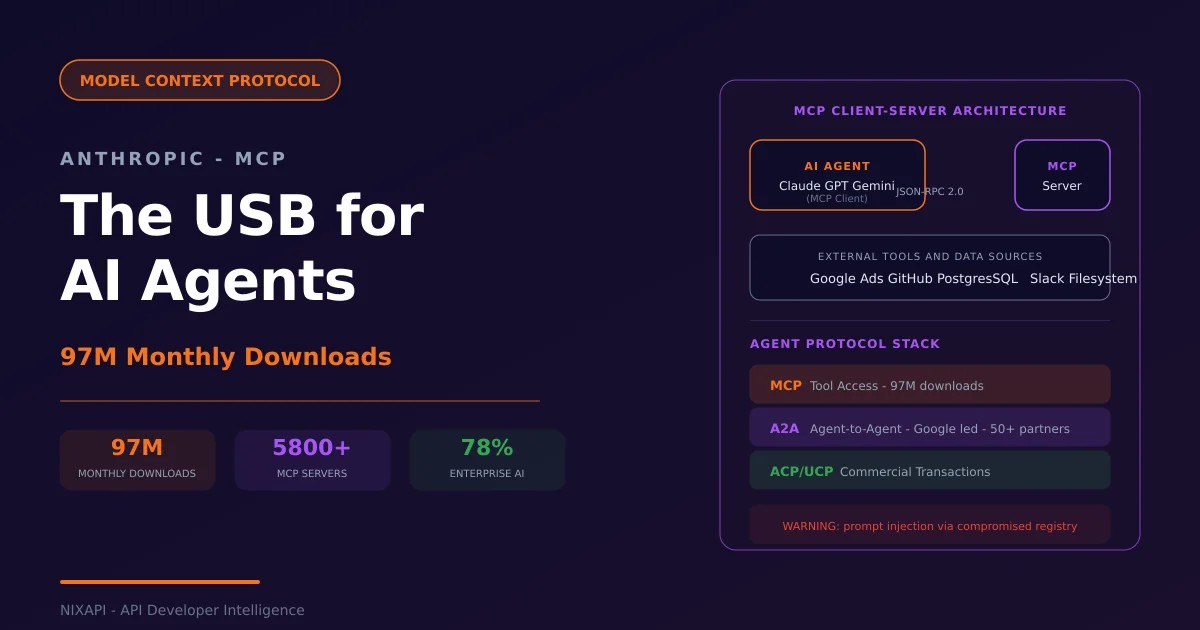
Anthropic's Model Context Protocol surpassed 97M monthly SDK downloads with 5,800+ MCP servers live. This deep dive covers MCP architecture, ecosystem status, security risks, and the 2026 AI Agent protocol stack.
1. What Is MCP: Solving the AI Agent “Integration Tax”
If you’ve ever tried to connect an AI Agent to external tools—asking Claude to pull Slack messages or GPT to call an internal API—you’ve likely hit this wall: every new tool requires a bespoke connector for each model/application combination.
This repetitive adaptation work has been community-dubbed the “Integration Tax”.
The Model Context Protocol (MCP) exists to end this. MCP defines a universal interface specification that enables AI Agents to, at runtime:
- Dynamically discover available tools (without hardcoding tool lists)
- Read tool descriptions and parameter schemas
- Dynamically invoke any MCP-compatible tool without pre-built connector code for each combination
Think of it this way: just as USB enabled devices to connect to any computer without custom drivers per machine, MCP serves as the “USB of AI Agents”—one protocol, universal interoperability.
2. The 97M Download Milestone: What the Numbers Mean
On March 25, 2026, Anthropic announced in an official milestone report: MCP SDK monthly downloads exceeded 97 million.
What does this number signify?
| Dimension | Data | Interpretation |
|---|---|---|
| SDK Monthly Downloads | 97M | Developer adoption is extremely rapid; past early-adopter phase |
| MCP Server Count | 5,800+ | 7.8x year-over-year growth, ecosystem expanding aggressively |
| Enterprise Penetration | 78% of enterprise AI teams | Already a standard for enterprise-grade AI Agents |
| Marketing Team Usage | 22% of marketing AI teams run 3+ MCP servers | Multi-tool chaining is routine in marketing |
97M is not just a number. It signals that MCP has evolved from an “experimental protocol” into industry consensus—just as REST APIs became the web services standard in the 2010s, MCP is doing the same for the AI Agent era.
3. MCP Architecture Deep Dive: How Client ↔ Server Works
MCP’s architecture is remarkably elegant, with only two core roles:
┌──────────────┐         MCP Protocol          ┌──────────────┐
│   MCP Host   │◄──────► (JSON-RPC over       ◄──────►  MCP Server │
│  (AI Client) │        stdio / HTTP)          │ (Tool Provider)│
└──────────────┘                               └──────────────┘
Core Components
MCP Host (宿主应用)
- Holds the MCP Client connection
- Typically the AI Agent’s runtime environment (e.g., Claude App, GPT Builder)
- Manages sessions, parses user requests, dispatches tool calls
MCP Server (工具服务端)
- Exposes a list of tools (tool list)
- Each tool includes: name, description, input schema
- Receives invocation requests from Client, executes business logic, returns results
Three Critical Protocol Messages
MCP communicates via JSON-RPC 2.0, with three core methods:
// 1. Dynamic Discovery: Host asks Server what tools are available
// Request
{ "jsonrpc": "2.0", "id": 1, "method": "tools/list" }

// Response
{
  "jsonrpc": "2.0",
  "id": 1,
  "result": {
    "tools": [
      {
        "name": "search_database",
        "description": "Search product inventory by SKU or category",
        "inputSchema": {
          "type": "object",
          "properties": {
            "sku": { "type": "string" },
            "category": { "type": "string" }
          }
        }
      }
    ]
  }
}

// 2. Dynamic Invocation: Host directs Agent to call a specific tool
// Request
{ "jsonrpc": "2.0", "id": 2, "method": "tools/call", "params": {
    "name": "search_database",
    "arguments": { "category": "electronics" }
}}

// 3. Resource Management (Server can expose readable resources to Host)
{ "jsonrpc": "2.0", "id": 3, "method": "resources/list" }
Throughout this process, the Host does not need to know in advance which tools the Server provides—tool discovery and invocation happen entirely at runtime via the protocol. This is a fundamental departure from the “pre-coded integration” model of traditional AI integrations.
4. MCP Ecosystem Status: 5,800+ Servers, All Major AI Providers On Board
MCP’s ecosystem expansion is unprecedented in AI protocol history.
Client Support (All Frontier Model Providers)
- Anthropic (Claude): Native MCP integration; Claude Code and Claude App both support it
- OpenAI (GPT): GPT Builder supports MCP Server integration
- Google (Gemini): Agent Space and Gemini API support MCP
This means any application supporting MCP can simultaneously connect to all major AI models—vendor lock-in is significantly mitigated.
MCP Server Ecosystem
As of May 2026, the public MCP server registry lists 5,800+ servers covering:
- Databases: PostgreSQL, MySQL, MongoDB MCP adapters
- Cloud Services: AWS S3, Google Drive, Slack, Notion
- Developer Tools: GitHub, GitLab, Jira, Linear
- Search Engines: Google Search, Bing Search, Elasticsearch
- E-commerce: Shopify product management plugins
Industry Penetration
“78% of enterprise AI teams are already running at least one MCP-backed Agent in production.”
Enterprises are no longer treating MCP as experimental—it has entered the core of production-grade AI architecture.
5. The Complete Agent Protocol Stack: MCP + A2A + ACP
MCP is not the only protocol rising in the AI Agent era. Understanding the full 2026 Agent protocol stack requires three layers working in concert:
┌─────────────────────────────────────────────┐
│           Agent-to-Agent (A2A)               │  ← Google-led, 50+ partners
│         (Task collaboration, capability      │
│          discovery)                          │
├─────────────────────────────────────────────┤
│           Agent-to-Tool (MCP)                │  ← Anthropic-led, tool access layer
│        (Dynamic tool discovery & invocation)│
├─────────────────────────────────────────────┤
│           Agent-to-Commerce (ACP/UCP)       │  ← Commerce transaction layer
│         (Payments, subscriptions, billing)  │
└─────────────────────────────────────────────┘
MCP: Tool Access Layer
MCP solves the problem of “how does an Agent invoke external tools”—via a unified protocol, Agents can connect to any MCP-compatible server.
A2A: Agent Collaboration Layer
Google’s Agent-to-Agent Protocol (A2A) addresses “how do Agents collaborate with each other”. For example:
- A data analysis Agent detects an anomaly and hands off to a risk control Agent
- A marketing Agent syncs customer info with a CRM Agent
- A2A enables Agents from different vendors to discover each other’s capabilities and collaborate
A2A already has 50+ partners, including enterprise software giants like Salesforce, SAP, and Atlassian.
ACP/UCP: Commerce Transaction Layer
The Agent Commerce Protocol (ACP) or its equivalent implementations (e.g., UCP) address “how do Agents pay and charge”. When an Agent performs commercial acts on behalf of a user:
- Payment authorization
- Subscription management
- Invoicing and billing
- Commercial identity verification
This layer is still evolving rapidly, but multiple competing standards are emerging.
6. Security Risks and Mitigation Strategies
MCP’s open ecosystem introduces a significant attack surface. The core threat is prompt injection via a compromised tool registry.
Attack Model
Attack path:
Malicious MCP Server → Registered to public Registry → AI Agent discovers and invokes it →
→ Server returns poisoned tool description/results → Prompt injection occurs
The problem is not the AI model itself, but rather the trust validation gap in the tool registration and distribution chain.
Mitigation Strategies
1. Server Source Allowlisting
// Host side: only connect to trusted MCP Servers
const allowedServers = new Set([
  "github/anthropic/mcp-server",
  "verified/aws-mcp-connectors",
]);

function isTrusted(serverId: string): boolean {
  return allowedServers.has(serverId);
}
2. Tool Description Content Filtering Inject a detection layer when the Agent parses tool descriptions:
- Detect prompt injection signatures (e.g., instruction overrides, role-playing prompts)
- Sanitize tool descriptions from unverified Servers
3. Principle of Least Privilege MCP Servers should not receive the Agent’s master account full permissions. Limit per Server:
- Data access scope
- Operation types (read-only / write)
- Invocation rate limits
4. Signature Verification In future MCP spec evolution, tool descriptions and execution results should support cryptographic signatures to ensure tampering detection in transit.
7. Developer Integration Guide with Code Examples
Quick Integration: Using the Official SDK
import { Client } from "@modelcontextprotocol/sdk";

// Initialize MCP Client
const client = new Client({
  name: "my-agent",
  version: "1.0.0",
});

// Connect to MCP Server (stdio transport)
await client.connect({
  transport: "stdio",
  command: "npx",
  args: ["-y", "@modelcontextprotocol/server-filesystem", "./data"],
});

// Dynamically discover tools
const { tools } = await client.request({ method: "tools/list" });
console.log(`Discovered ${tools.length} available tools:`);
tools.forEach((t) => console.log(`  - ${t.name}: ${t.description}`));

// Let Agent select and invoke a tool
const result = await client.request({
  method: "tools/call",
  params: {
    name: "read_file",
    arguments: { path: "data/report.txt" },
  },
});

console.log(result.content);
Production Readiness Checklist
| Checklist Item | Description |
|---|---|
| Server source verification | Only connect to trusted MCP Servers |
| Tool description auditing | Check tool descriptions for injection signatures |
| Permission isolation | Independent least-privilege config per Server |
| Audit logging | Log all tool invocation requests and responses |
| Timeout controls | Prevent malicious Servers from monopolizing Agent resources |
Conclusion
MCP went from late 2024 launch to 97M monthly downloads in under two years—a leap from proposal to industry standard. The “Integration Tax” problem it solves is one of the core obstacles to real-world AI Agent deployment.
With A2A (Agent collaboration) and ACP (commerce transactions) protocols maturing, the 2026 AI Agent protocol stack is clear: MCP handles tools, A2A handles collaboration, ACP handles commerce. Three layers, each with a distinct responsibility, together forming the infrastructure of the Agent economy.
For developers, now is the optimal time to go deep on MCP—the ecosystem is mature, standards are established, and early movers will enjoy the红利 of shaping the specification.
References: Anthropic MCP Milestone Report (March 25, 2026), Google A2A Protocol Specification (May 2026), MCP Official Documentation.
Try NixAPI Now
Reliable LLM API relay for OpenAI, Claude, Gemini, DeepSeek, Qwen, and Grok with ¥1 = $1 top-up
Sign Up Free