MiniMax M3 Deep Dive: 1M Context + Native Multimodality, The Open-Weight Cost Revolution
MiniMax M3 delivers 1M context window and native multimodal capabilities at just 5% of Claude Opus cost. Deep dive into MSA architecture, API pricing, cost comparison with closed-source models, and production deployment recommendations.
MiniMax M3 Deep Dive: 1M Context + Native Multimodality, The Open-Weight Cost Revolution
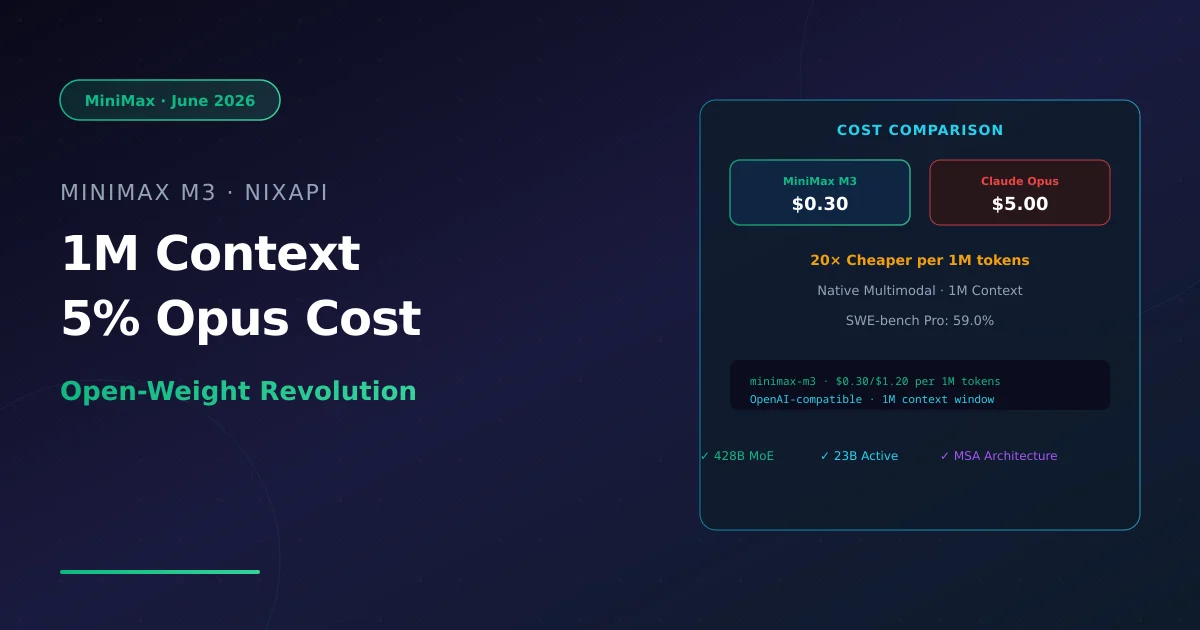
TL;DR: MiniMax M3 provides a 1M context window, native multimodal capabilities, and near-frontier coding performance at just 5% of Claude Opus cost. It’s one of the most cost-effective open-weight options in 2026.
1. Release Context: MiniMax’s Open-Weight Strategy
On June 1, 2026, MiniMax officially launched M3—its flagship open-weight model. This wasn’t a routine iteration but a serious commitment to the open-source ecosystem:
- Open weights: Available on Hugging Face (MiniMaxAI/MiniMax-M3)
- License: MiniMax Community License (commercial use terms require review)
- Multi-platform: SGLang, vLLM, Transformers, TensorRT LLM, llama.cpp quantized builds
- Enterprise deployment: AWS, GCP, Azure, and on-premises options
On June 18, Cast AI announced M3 as the default builder model for its Kimchi Coding platform, making it the first commercial platform to adopt M3 for autonomous coding agents. This marks M3’s transition from “launch” to “production validation.”
2. Technical Architecture: MSA Sparse Attention
2.1 Core Specifications
| Metric | Value |
|---|---|
| Total parameters | ~428B (MoE architecture) |
| Active parameters | ~23B per inference |
| Context window | 1M tokens (512K guaranteed) |
| Multimodal | Native text, image, video support |
| Training data | ~100 trillion interleaved tokens |
2.2 MSA (MiniMax Sparse Attention)
M3’s key innovation is the MSA sparse attention mechanism, solving the computational explosion of long-context inference:
- 1M context compute at 1/20th the cost of M2
- 9x faster prefill speed
- 5x faster decode speed
This means: at 1M context, M3 is not only cheaper than closed-source models but faster.
3. Performance Benchmarks: Head-to-Head with Closed-Source Models
3.1 Coding Capabilities
| Benchmark | MiniMax M3 | GPT-5.5 | Claude Opus 4.7 |
|---|---|---|---|
| SWE-bench Pro | 59.0% | ~58.6% | ~58.4% |
| Terminal-Bench 2.1 | 66.0% | ~64% | ~65% |
| BrowseComp | 83.5 | ~80% | ~78% |
⚠️ Note: Some figures are from MiniMax’s official release. Independent third-party validation is ongoing. Benchmark on your actual workloads before committing.
3.2 Long-Context Capabilities
- 512K input guaranteed, 1M is initial-access-limited
- Automatic “long-context pricing tier” beyond 512K
- Supports full-repository reasoning, ultra-long document parsing, multi-hour agent sessions
4. API Pricing Deep Dive
4.1 Pricing Structure (Two-Tier)
| Tier | Input ($/M tokens) | Output ($/M tokens) | Cache Read ($/M tokens) |
|---|---|---|---|
| Standard (≤512K) | $0.30 (promo) / $0.60 (list) | $1.20 / $2.40 | $0.06 / $0.12 |
| Long-context (>512K) | $0.60 (promo) / $1.20 (list) | $2.40 / $4.80 | $0.12 / $0.24 |
Promo: 50% launch discount. Plan budgets against list prices for production.
4.2 Cost Comparison with Closed-Source Models
For a typical agent task with 500K input + 100K output:
| Model | Cost |
|---|---|
| MiniMax M3 (standard promo) | ~$0.27 |
| Claude Opus 4.7 | ~$5.00 |
| GPT-5.5 | ~$5.50 |
M3 costs approximately 5% of Claude Opus, 4.9% of GPT-5.5.
4.3 Subscription Plans (Token Plan)
| Plan | Monthly Fee | Monthly Quota |
|---|---|---|
| Plus | $20 | ~1.6B tokens |
| Max | $50 | ~5.1B tokens |
| Ultra | $120 | ~9.8B tokens |
Subscriptions suit stable high-volume traffic; PAYG for spiky or long-context-heavy workloads.
5. Access Paths: Three Routes
5.1 Official API (api.minimax.io)
curl https://api.minimax.io/v1/chat/completions \
  -H "Authorization: Bearer $MINIMAX_API_KEY" \
  -H "Content-Type: application/json" \
  -d '{
    "model": "minimax-m3",
    "messages": [{"role": "user", "content": "Explain this code..."}],
    "max_tokens": 32768
  }'
- OpenAI-compatible endpoint
- Native multimodal support
- Thinking mode toggle
5.2 Aggregation Platforms (OpenRouter / Fireworks)
# OpenRouter
curl https://openrouter.ai/api/v1/chat/completions \
  -H "Authorization: Bearer $OPENROUTER_KEY" \
  -d '{"model": "minimax/minimax-m3", "messages": [...]}'

# Fireworks
# Endpoint: accounts/fireworks/models/minimax-m3
5.3 Self-Hosted (Hugging Face Weights)
# SGLang deployment
python -m sglang.launch_server \
  --model-path MiniMaxAI/MiniMax-M3 \
  --tp 8  # Multi-GPU required
⚠️ Self-hosting notes:
- Full BF16 checkpoint requires multi-GPU datacenter infrastructure
- Quantized builds (GGUF/Ollama/LM Studio) run on consumer hardware
- License is MiniMax Community License, not standard Apache/MIT—review commercial terms before shipping
6. Production Recommendations
6.1 When to Choose M3?
✅ Recommended for:
- Long-context coding agents (full-repository reasoning)
- High-volume inference (cost-sensitive)
- Multimodal workflows (text + image + video)
- Private deployment requiring data sovereignty
❌ Use with caution for:
- Sensitive data (verify MiniMax data processing policies)
- Scenarios requiring absolute deterministic output (third-party validation ongoing)
- Ultra-complex mathematical reasoning (Humanity’s Last Exam benchmarks pending)
6.2 Cost Optimization Strategies
- Leverage caching: Automatic prompt caching reduces input costs by ~54% on subsequent turns
- Control context: Stay within 512K to use standard pricing tier
- Subscription vs PAYG: Subscriptions for steady traffic, PAYG for variable or long-context-heavy loads
- Aggregation platform comparison: OpenRouter/Fireworks may offer different pricing
7. NixAPI Perspective: The Value of Unified Routing
For developers using NixAPI, M3’s addition means:
# Route through NixAPI, switch models on demand
from nixapi import Client

client = Client(api_key="your-key")

# Long-context coding task → M3 (low cost)
response = client.chat.completions.create(
    model="minimax-m3",  # Or let routing auto-select
    messages=[...],
    max_tokens=100000
)

# Sensitive task → Claude Opus (high reliability)
response = client.chat.completions.create(
    model="claude-opus-4.8",
    messages=[...]
)
Value of unified API layer:
- No multiple API key management
- Automatic failover (fallback)
- Unified billing and usage monitoring
- Zero-cost model A/B testing
8. Summary and Outlook
| Dimension | Rating | Notes |
|---|---|---|
| Cost Efficiency | ⭐⭐⭐⭐⭐ | 5% of closed-source cost, extreme value |
| Technical Depth | ⭐⭐⭐⭐ | MSA architecture innovation, long-context breakthrough |
| Ecosystem Maturity | ⭐⭐⭐ | Recently launched, third-party validation ongoing |
| NixAPI Relevance | ⭐⭐⭐⭐⭐ | Open weights + API aggregation natural fit |
MiniMax M3 represents a critical inflection point for open-weight models in 2026: near-frontier performance at an order-of-magnitude lower cost. For developers needing long-context and multimodal capabilities on a budget, M3 is the most compelling option to evaluate.
As enterprise platforms like Cast AI adopt M3, production validation will accelerate in the coming weeks. Recommended actions:
- Test immediately: Validate via OpenRouter or official API
- Establish benchmarks: Compare M3 vs Claude/GPT on your actual workloads
- Monitor updates: Watch for independent third-party benchmark results
This article is based on publicly available information as of June 18, 2026. MiniMax M3 pricing and performance data may change over time—refer to the latest official documentation.
Try NixAPI Now
Reliable LLM API relay for OpenAI, Claude, Gemini, DeepSeek, Qwen, and Grok with ¥1 = $1 top-up
Sign Up Free