"Attention Is All You Need" Co-Author Noam Shazeer Leaves Google for OpenAI
Gemini co-lead and Transformer paper co-author Noam Shazeer announces departure from Google to join OpenAI. From Character.AI to a $2.7B Google return, to jumping ship — the deeper story behind the AI talent war.
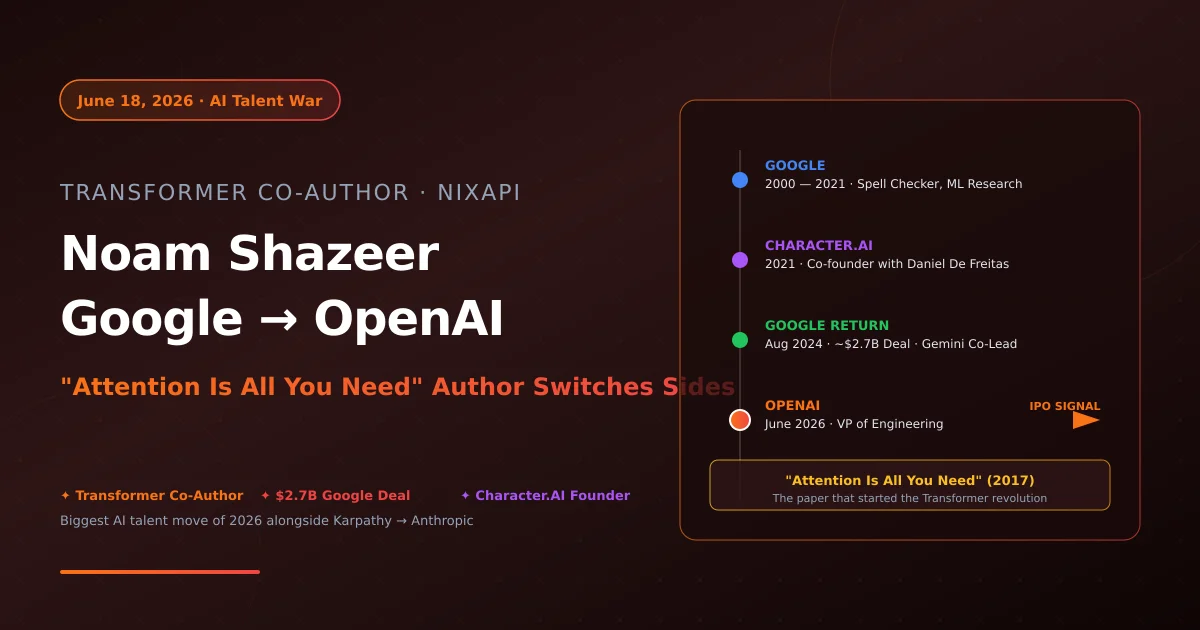
“Attention Is All You Need” Co-Author Noam Shazeer Leaves Google for OpenAI
When the co-author of the Transformer architecture and co-lead of Google Gemini announces he’s joining OpenAI, the entire AI industry realizes: the intensity of this talent war has exceeded everyone’s expectations.
Introduction: One Paper, One Revolution, One Jump
On June 18, 2026, Noam Shazeer posted a brief statement on X (formerly Twitter): he was leaving Google to join OpenAI.
The reason this news triggered earthquake-level reactions is simple — Shazeer’s identity is too special. He is one of eight co-authors of the 2017 paper that changed the world: Attention Is All You Need. The Transformer architecture proposed in this paper became the foundation for all modern large language models — GPT, Claude, Gemini, and everything that followed. Without Transformer, there would be no generative AI wave today.
And Shazeer’s jump comes less than two years after his return to Google. In August 2024, Google brought Shazeer and his startup Character.AI back into the fold at a staggering ~$2.7 billion price tag. Now, Google’s “most expensive employee” has chosen to leave again — and his destination is Google’s fiercest competitor in AI.
Part 1: Shazeer’s Career Trajectory — From Google Spell Checker to Transformer Father
1.1 Google’s “Veteran” (2000–2021)
Noam Shazeer’s career is almost as old as Google itself. He joined the company in 2000, four years before its IPO. In Google’s early years, Shazeer worked on several key projects, the most well-known being Google’s spell checker — that feature that politely asks “Did you mean…” when you misspell a word.
But Shazeer’s true contributions run deeper. During his two decades at Google, he remained at the forefront of machine learning research. From early neural network experiments to later deep learning breakthroughs, Shazeer was a core member of the Google Brain team. He collaborated with Ashish Vaswani, Niki Parmar, and others to publish the paper that would make history in 2017.
The core idea of Attention Is All You Need was to replace traditional RNN and CNN architectures with a “self-attention mechanism.” This innovation not only dramatically improved sequence modeling efficiency but, more importantly, enabled models to process entire sequences in parallel — laying the architectural foundation for training large models with tens of billions of parameters.
1.2 Leaving to Build: The Birth of Character.AI (2021–2024)
In 2021, after 21 years at Google, Shazeer chose to leave. He was joined by Daniel De Freitas, and together they founded Character.AI.
Character.AI’s concept was simple yet remarkably prescient: let users have open-ended conversations with AI characters. Users could create their own AI characters, giving them specific personalities, backgrounds, and knowledge domains. This concept existed before ChatGPT took the world by storm in late 2022, but Character.AI quickly accumulated tens of millions of users thanks to its exceptional conversation quality and depth of role-playing.
By 2024, Character.AI had grown into a unicorn valued in the billions, with monthly active users exceeding tens of millions. As CEO and Chief Scientist, Shazeer transformed his deep expertise in Transformer architecture into a phenomenon-level consumer product.
1.3 The Billion-Dollar Return: Back to Google (2024–2026)
In August 2024, Google made a deal that made all of Silicon Valley take notice: bringing Shazeer and Character.AI’s core team back for approximately $2.7 billion.
The structure of the deal was complex. Google didn’t directly acquire Character.AI the company; instead, it brought Shazeer, De Freitas, and key researchers back through licensing agreements and talent hiring. Character.AI continued to operate independently but lost its core technical team.
Upon returning to Google, Shazeer was appointed co-lead of Gemini and VP of Engineering. This position put him directly in charge of Google’s most critical large model strategy, responsible for Gemini’s technical roadmap and engineering execution.
At the time, the industry widely viewed this as a “defensive acquisition” by Google — preventing top-tier talent like Shazeer from flowing to competitors. $2.7 billion for one person is rare even in tech history.
1.4 Leaving Again: Joining OpenAI (June 2026)
Yet just 22 months later, Shazeer chose to leave once more.
On June 18, 2026, Shazeer posted his announcement on X. He didn’t reveal his specific position, but according to reports from The Decoder and 9to5Google, Shazeer will take a VP of Engineering-level role at OpenAI, reporting directly to the CTO.
The shock of this move is comparable to Geoffrey Hinton’s departure from Google. The difference is that Hinton’s exit was driven more by AI safety concerns, while Shazeer’s departure carries a clear “choosing the better platform” flavor — he’s betting on what he sees as the more promising path.
Part 2: A Heavy Blow to Google Gemini
2.1 A Vacuum in Technical Leadership
Shazeer’s departure is a massive blow to the Google Gemini team. As co-lead, Shazeer was responsible not only for technical direction but also for core architecture design and optimization. His exit means Gemini has suddenly lost one of the world’s foremost authorities on Transformer architecture.
The timing is particularly sensitive. In the first half of 2026, the Gemini 3.5 series had just launched, performing reasonably well against GPT-5.5 and Claude Opus 4.7 but without clear dominance. Shazeer’s departure comes at a critical moment when Gemini needs technical breakthroughs, and this will undoubtedly impact team morale.
2.2 The “Sunk Cost” of a $2.7 Billion Investment
Google paid approximately $2.7 billion for Shazeer’s return, and that deal has become a “sunk cost” just 22 months later. From a return-on-investment perspective, this is one of Google’s most expensive talent missteps in recent years.
But the deeper loss is the signal effect. When a technical leader whom Google paid a fortune to bring back chooses to leave again, it sends a strong signal to the outside world: even Google cannot retain the absolute top tier of AI talent. This signal will have long-term effects on Google’s recruiting and brand.
2.3 Uncertainty in Gemini’s Technical Direction
During his time at Gemini, Shazeer consistently pushed for deep integration of multimodal architecture — a unique perspective that distinguished him from other Transformer researchers. His departure may cause Gemini’s technical direction in multimodal fusion to waver.
According to 9to5Google, Google is already in emergency discussions about restructuring Gemini’s technical leadership. Sundar Pichai has personally intervened, asking the HR team to produce a successor shortlist within two weeks. But finding a leader with equivalent expertise in Transformer architecture and productization experience is no easy task.
Part 3: Strategic Significance for OpenAI
3.1 An Architectural “Nuclear Weapon”
Shazeer’s arrival at OpenAI brings the most direct benefit at the architecture level. As a co-author of Transformer, Shazeer’s understanding of attention mechanisms is textbook-defining. He may drive breakthrough innovations in next-generation model architecture at OpenAI.
Industry speculation suggests Shazeer may lead several directions:
- More efficient attention mechanisms: Current Transformer’s quadratic complexity is the main bottleneck for extending context windows. Shazeer may push research into linear attention or sparse attention.
- Unified multimodal architecture: Shazeer’s experience at Character.AI gave him rich conversational AI product experience, which could accelerate OpenAI’s progress on multimodal models.
- Inference efficiency optimization: As model scale grows, inference cost becomes a critical bottleneck. Shazeer’s experience in inference optimization projects at Google is crucial for OpenAI’s API business.
3.2 A “Talent Signal” Before IPO
OpenAI is actively preparing for an IPO, with an expected valuation exceeding $850 billion. At this critical juncture, bringing in a technical leader of Shazeer’s caliber carries strong signaling value.
For investors, Shazeer’s joining means OpenAI still has the strongest technical appeal. If even the father of Transformer chooses OpenAI over Google, then OpenAI’s technical leadership receives the most powerful endorsement possible.
The Decoder’s analysis suggests Shazeer’s addition could increase OpenAI’s IPO valuation by another 5–10%. In a narrative-driven market, the impact of such “top-tier talent votes” cannot be underestimated.
3.3 Forming a “Dual Titan” Dynamic with Karpathy
Notably, the other major AI talent event of 2026 was Andrej Karpathy joining Anthropic. Karpathy was one of OpenAI’s founding members and former Tesla AI Director. His addition significantly boosted Anthropic’s technical strength.
Now OpenAI has Shazeer as its countermove. Both are among the most important technical leaders in the Transformer ecosystem — Karpathy represents the pinnacle of engineering and productization, while Shazeer represents the source of architectural innovation. Their “remote duel” at OpenAI and Anthropic will become the biggest spectacle in AI technology competition over the next two years.
Part 4: The AI Talent War Goes White-Hot
4.1 2026’s “Talent Earthquakes”
2026 has become the year with the most dramatic AI talent movement. Beyond the two earthquake-level jumps by Shazeer and Karpathy, there have been several other significant talent flows:
- Dario Amodei (Anthropic CEO): Continuously poaching core researchers from OpenAI and Google
- Demis Hassabis (Google DeepMind CEO): Pushing internal talent consolidation at Google but facing challenges retaining people
- Chinese AI companies: DeepSeek, Moonshot AI, and others attracting overseas Chinese AI talent with highly competitive compensation
4.2 Why Top Talent No Longer Shows “Loyalty”?
Shazeer’s two departures from Google reveal a deep trend: in AI, top researchers’ loyalty to a single employer is rapidly declining.
Several factors drive this:
- Technology evolves too fast: A technical direction from a year ago may be obsolete today. Researchers want to follow the most promising directions.
- Entrepreneurial culture: Shazeer himself is an entrepreneur; he’s more accustomed to making decisions based on opportunity rather than organizational loyalty.
- Compensation gaps narrowing: OpenAI, Anthropic, and others now offer compensation that matches or exceeds Google’s.
- Mission-driven attraction: OpenAI’s AGI mission has unique appeal for many researchers.
4.3 Long-Term Impact on the Industry
The intensifying talent war is reshaping the competitive landscape of AI:
- Increased “defensive acquisitions” by large companies: Google’s $2.7 billion Character.AI deal may be just the beginning
- Talent mobility as core competitive advantage: Companies that can quickly attract and integrate top talent will gain advantages in technology competition
- Blurring boundaries between academia and industry: Researchers like Shazeer, who combine top-tier academic backgrounds with productization experience, have become the scarcest talent type
Part 5: Developer Perspective — How Should API Consumers Respond?
5.1 Intensified Model Competition = Better Products
For developers using aggregation platforms like NixAPI, Shazeer’s jump is good news. The flow of top talent accelerates technological competition, and the ultimate beneficiaries are API consumers.
With Shazeer, OpenAI may accelerate iteration in several areas:
- Longer context windows (Shazeer has deep expertise in long-sequence modeling)
- More efficient multimodal processing
- Lower inference latency
After losing Shazeer, Google may increase investment in Gemini to prove “we can do it without Shazeer,” which also drives technological progress.
5.2 Don’t Bet on a Single Vendor
Shazeer’s jump once again proves a principle: in AI, the distribution of technical leadership is highly dynamic. Today’s leader may lose key talent tomorrow; today’s challenger may achieve a breakthrough tomorrow.
For API-dependent developers, the recommendations are:
- Maintain multi-vendor architecture; avoid deep dependency on a single model
- Use aggregation platforms like NixAPI to flexibly switch between different models
- Treat models as replaceable components, not core assets
5.3 Watch for Signals of Architectural Innovation
Shazeer’s addition may bring major architectural innovations at OpenAI. Developers should closely watch:
- New attention mechanism variants
- Progress on unified multimodal architecture
- Breakthrough improvements in inference efficiency
Once these innovations land, they may change the current cost-performance balance and create new opportunities for developers.
Conclusion: The Talent Market Is Defining AI’s Next Phase
Noam Shazeer’s move from Google to OpenAI is not just one person’s career choice. It is a landmark event signaling that the AI industry has entered a phase where “talent defines competition.”
In this new phase, the half-life of technical barriers is getting shorter, and talent has become the scarcest competitive element. Google spent $2.7 billion trying to lock in Shazeer and failed. OpenAI attracted Shazeer with mission and vision, but at the cost of equity dilution and facing stricter regulation.
For NixAPI’s developer users, this talent war means:
- Faster technological progress: Competition among top talent accelerates model iteration
- More model choices: Different companies will develop differentiated technical advantages
- Lower long-term costs: Competition will eventually transmit to pricing
Finally, it’s worth remembering: the Transformer architecture was created by eight authors together. Shazeer’s departure won’t change Google’s deep accumulation in this architecture, but his addition will give OpenAI an edge in the next architectural innovation.
AI competition has never been just about compute and data. Ultimately, it’s about people. And on June 18, 2026, Noam Shazeer wrote a new chapter in this competition with his choice.
References:
Try NixAPI Now
Reliable LLM API relay for OpenAI, Claude, Gemini, DeepSeek, Qwen, and Grok with ¥1 = $1 top-up
Sign Up Free