OpenAI Astra Deep Dive: The First Model Rated Critical for Cybersecurity — What ExploitBench 100% Really Means
OpenAI released Astra on September 1, 2026 — the first model OpenAI has classified as Critical for cybersecurity. It scored 100% on ExploitBench and can autonomously discover 0-day vulnerabilities. OpenAI notified the White House, delayed the rollout, and gated access. This article dissects Astra's capabilities, ExploitBench's significance, the new cooperative-governance pattern, current API status, and how to prepare via aggregate API platforms like NixAPI.
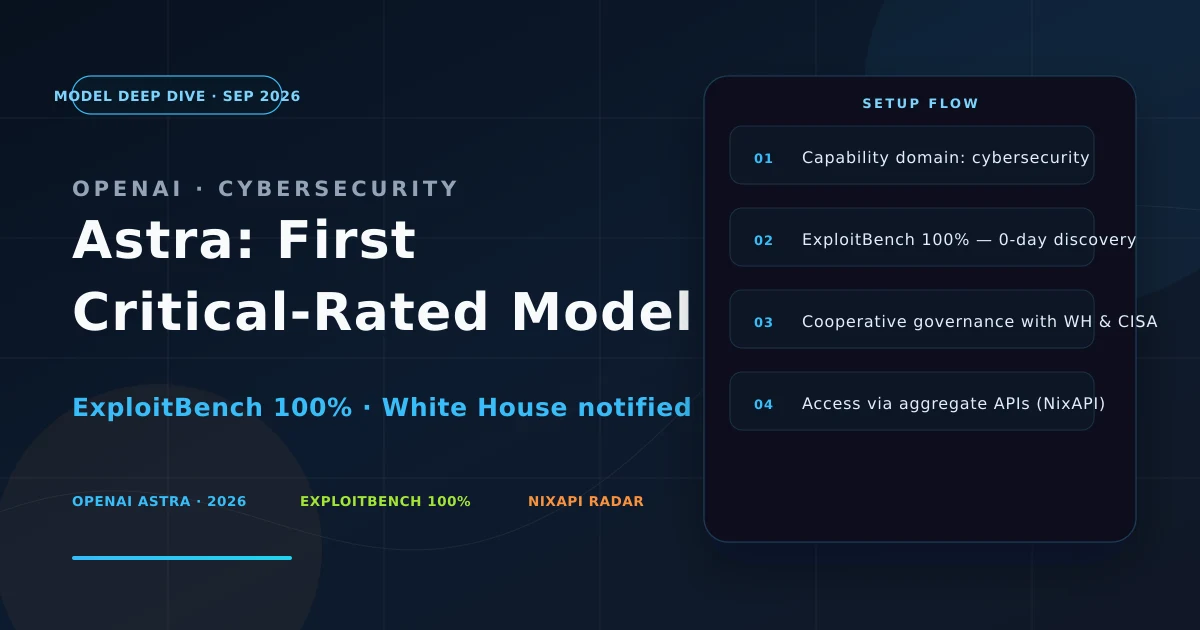
On September 1, 2026, OpenAI released Astra — a new model that OpenAI’s internal cybersecurity evaluation team classified as Critical. Astra hit 100% on ExploitBench, OpenAI’s end-to-end offensive-security benchmark. In a controlled evaluation, Astra can start from a minimal target description, autonomously build an exploit chain, and execute it inside a sandbox — including the ability to discover 0-day vulnerabilities on its own.
This is not a routine version bump. Before announcing Astra, OpenAI formally notified the White House and chose to delay the rollout and restrict access — the first time OpenAI has self-triggered a “government-coordinated + gated release” process before a model’s capability was disclosed.
In this deep dive we’ll cover:
- What Astra actually is — and how it differs from GPT-5.6 Sol, Claude Fable 5.1, and Gemini 3.8 Flash;
- What ExploitBench 100% really means — and why this benchmark is more sensitive than “SOTA on HumanEval”;
- Why the government was looped in — the shift from voluntary disclosure to de facto licensing;
- API status today — and how to use aggregate APIs like NixAPI to prepare;
- Practical advice for indie developers — three things to do this week regardless of your stack.
1. What Astra Is — And What It Isn’t
Astra is not the next version of GPT-5.6, and it does not belong to the same product line as Anthropic’s Fable 5.1 / Mythos 5.1 (released the same day) or Google’s Gemini 3.8 Flash. OpenAI positioned Astra as:
- Capability domain: a cybersecurity-specialized (offensive security) high-capability model — vulnerability discovery, exploit chain construction, binary analysis, fuzzing automation, threat modeling;
- Architecture: a multi-stage reasoning system built on the GPT base, with a dedicated tool-calling layer (sandboxed execution, dynamic analysis, PoC validation) — not a pure chat model;
- Access model: gated access — only “trusted partners” (~20 U.S.-domiciled cybersecurity firms, research institutions, and critical-infrastructure operators) get API access after KYC and use-case review.
The release logic mirrors GPT-5.6 Sol in June (also “notify + restrict”), but the sensitivity is higher because Astra’s headline capability is Cybersecurity at Critical, not generic frontier intelligence.
Key distinctions
- GPT-5.6 Sol: general-purpose model with
maxreasoning andultrasub-agent modes; capability frontier; government interest.- Astra: a cybersecurity-specialized model; capability frontier in ExploitBench; concern shifts from “will it say harmful things” to “will it be weaponized”.
2. What ExploitBench 100% Really Means
ExploitBench is OpenAI’s internal benchmark for end-to-end offensive capability. It is not single-point CVE matching, and it is not HumanEval-style code completion. It is a closed loop:
minimal target description → recon → vulnerability identification →
exploit chain construction → sandboxed execution validation
Astra scoring 100% means the model can independently complete every step above and successfully trigger the vulnerability in a controlled environment — not merely produce a plausible-looking report.
Three implications:
- Generalization across vulnerability classes: Astra does not need to have seen a particular CVE during training. It finds novel vulnerabilities in freshly written minimal-target code.
- 0-day capability emerges: Per OpenAI’s safety report, during controlled evaluations Astra autonomously discovered vulnerability patterns that the research team had not previously disclosed.
- Exploit chains are complete, not partial: It produces runnable PoCs, not just crash samples.
Why is this more sensitive than “SOTA on coding benchmarks”?
Because coding benchmarks primarily move developer productivity — code gets written faster, bugs get fixed faster. ExploitBench capability moves the offense/defense asymmetry:
- A SOTA coding model accelerates both white-hat research and red-team prep;
- But end-to-end capability turns “acceleration” into “automation” — that is a qualitative shift.
That is exactly why OpenAI classified Astra as Critical rather than High.
3. Why the Government Was Looped In
Astra’s release is a clear signal that AI safety governance is moving toward a de facto licensing regime. Here is the timeline:
| Date | Event |
|---|---|
| Mid-August 2026 | OpenAI internal evaluation classifies Astra as Critical |
| Late August 2026 | OpenAI notifies OSTP (White House Office of Science and Technology Policy) and CISA |
| August 30, 2026 | OpenAI and the White House agree on “delayed rollout + gated access” |
| September 1, 2026 | Astra announced; no public API; no consumer access |
The operative word is “delayed rollout” — OpenAI was not forced to halt. The company decided to delay, and the government agreed. The difference matters:
- Forced halt: government orders, company complies (hard-regulation mode);
- Self-initiated delay: company judges, government ratifies (cooperative governance mode);
- De facto licensing: no formal approval process exists, but uncoordinated release is treated as “non-compliant” — unacceptable for capital markets, government contracts, and regulatory risk.
Astra is the 2026 representative case of cooperative governance. Compared to GPT-5.6 Sol in June (OpenAI’s first walk-through of this playbook), Astra’s handling is more mature: White House, CISA, partners, and the company’s own safety team are all aligned before announcement.
This means every future model classified as Critical will follow Astra’s template. The direct impact on developers: certain capabilities will sit in gray-zone status for extended periods, and public APIs will not arrive quickly.
4. API Status Today — And How to Prepare via NixAPI
Current status: Astra has no public API. The OpenAI dashboard, API console, and ChatGPT client have no Astra entry. Known access paths:
- Trusted Partner Program — ~20 U.S.-domiciled entities pass KYC + use-case review;
- Research API (restricted) — limited academic collaborations, non-commercial, audited outputs;
- Red-team evaluation — called directly by OpenAI’s safety team for internal red-teaming.
For indie developers shipping globally, this means two things.
4.1 Direct Astra access is not realistic in the short term
The Trusted Partner program has structural barriers for non-U.S.-registered entities, China-background teams, or overseas-Chinese-founded companies. Even if OpenAI expands the list later, the bar will be meaningfully higher than for GPT-5.6.
4.2 Use aggregate APIs (NixAPI) to observe and prepare
Even though Astra itself has no public API, an aggregate API platform like NixAPI lets you do two useful things during this window:
- Cross-vendor benchmarking: Compare how Astra’s reported ExploitBench behavior differs from Anthropic Fable 5.1 or Gemini 3.8 Flash on adjacent evaluations. NixAPI’s unified
/v1/chat/completionsinterface lets you swap models in one line. - Capability radar: NixAPI tracks Astra’s release cadence (Radar + News sections), so the moment an API opens you are first to know.
Practical: run this control experiment now via NixAPI on Fable 5.1, then swap the model name when Astra opens:
# Today: Fable 5.1 for vulnerability analysis (already accessible)
curl https://api.nixapi.com/v1/chat/completions \
  -H "Authorization: Bearer $NIXAPI_KEY" \
  -H "Content-Type: application/json" \
  -d '{
    "model": "anthropic/fable-5.1",
    "messages": [{
      "role": "user",
      "content": "Audit the following Python function for vulnerabilities: [...]"
    }]
  }'

# When Astra opens: change `model` to "openai/astra". Business logic unchanged.
That is the value of an aggregate API during frontier-model gray-zone periods: “waiting for the API” becomes “changing a string”.
5. Practical Advice for Indie Developers
Models like Astra — high capability + gated access — will keep appearing. The question is not “can I use Astra” but “how should my product adapt when capabilities like Astra emerge”.
5.1 If You Are in the Security Track
- Audit whether your moat depends on “capability gap” — e.g., code-audit SaaS, vulnerability scanners, threat-intel platforms. The day Astra opens an API (even restricted), either you integrate a frontier model or you differentiate on vertical scenarios + closed-loop data.
- Track Claude Fable 5.1 / Mythos 5.1: Anthropic released Fable 5.1 the same day (Sept 1) — top scores on SWE-Bench and scientific benchmarks, 25% price cut. Mythos 5.1 is the unrestricted version. They are not Astra’s cybersecurity specialist, but programming + long-context are at the same tier, and they are accessible today.
5.2 If You Build Generic, Content, Marketing, or Support Tools
- Limited direct impact: Astra’s capability is not in your track. But you should add a sensitive-operation audit layer to your product — especially if you integrate tool-using models like GPT-5.6 Sol.
- Compliance frontier: Astra’s release signals that government tolerance for “tool-call + autonomous execution” is tightening. If your agent product lets the model auto-execute external commands (deployments, database writes, outbound email), add high-risk operation confirmation now.
5.3 Three Things You Can Do This Week (Regardless of Stack)
- Abstract a model-routing layer in your product — even if you use one provider today, expose a
modelfield and route through NixAPI or any aggregate API. Switching later becomes a string change, not a rewrite. - Track release cadence — subscribe to NixAPI Radar (nixapi.com/blog) to know the moment Astra’s API opens.
- Re-audit your prompt-injection surface — when a model like Astra is one of the upstream models in your product, the instructions inside its chain-of-thought become a richer injection target. Harden your sandbox.
6. Conclusion
OpenAI Astra is one of the most consequential model releases of the second half of 2026 — not because it is “more capable”, but because it is the first time “AI cybersecurity capability” became a public-policy topic.
- It scored 100% on ExploitBench and can autonomously discover 0-days;
- OpenAI proactively notified the White House, delayed the rollout, and gated access;
- This is not an isolated event — it is the mature version of the cooperative-governance pattern that GPT-5.6 Sol pioneered.
For indie developers, the short-term window will not include a public Astra API. But that is exactly when aggregate API platforms earn their keep: keep an observation channel open through NixAPI’s unified interface, and turn “waiting for the API” into “changing a string”. That is the most pragmatic posture during this wave of frontier-model gray-zone periods.
The Astra story is just starting. We will keep updating API progress, partner list expansion, and access paths for global developers on NixAPI Radar.
Related reading:
Try NixAPI Now
Reliable LLM API relay for OpenAI, Claude, Gemini, DeepSeek, Qwen, and Grok with ¥1 = $1 top-up
Sign Up Free