GPT-5.6 Deep Dive: Sol, Terra, Luna — Why the US Government Restricted OpenAI's Latest Release
OpenAI's GPT-5.6 series introduces three tiered models: flagship Sol, balanced Terra, and economical Luna. Sol features max reasoning and ultra sub-agent modes, but the Trump administration restricted public access. Deep analysis of technical specs, API pricing, safety architecture, and implications for global developers.
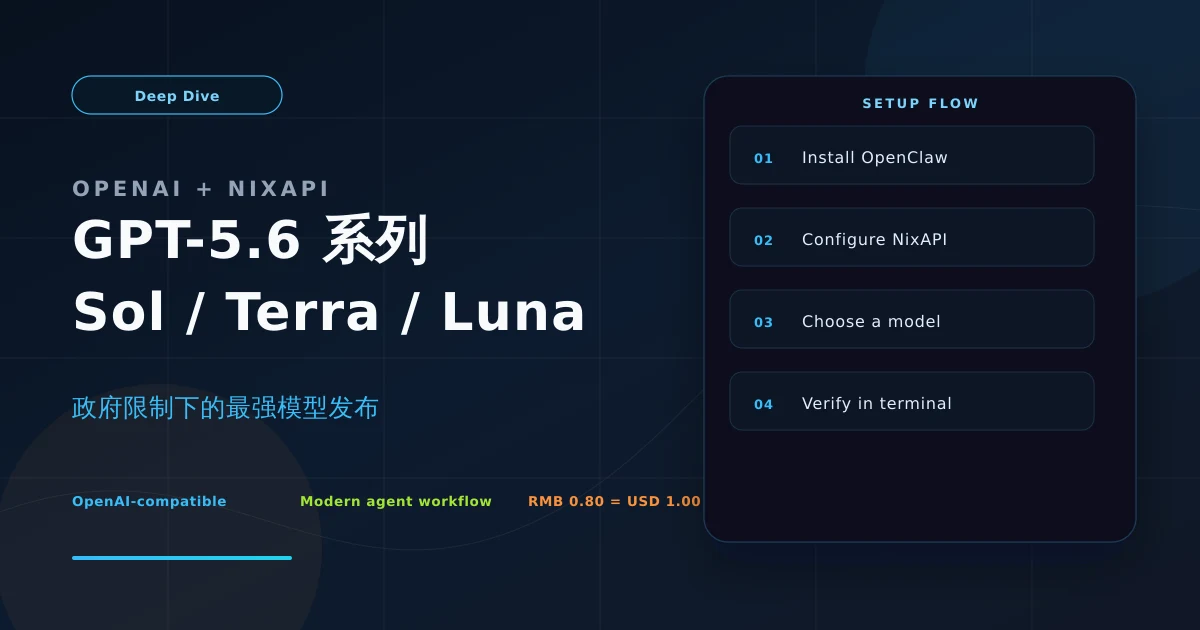
On June 26, 2026, OpenAI launched the GPT-5.6 model series—Sol, Terra, and Luna—under unprecedented government restriction. The Trump administration requested OpenAI limit the release to a “small group of trusted partners,” approved by the U.S. government, marking the first time an AI company has explicitly conditioned a model release on government review.
This is far from a routine model iteration. GPT-5.6 Sol introduces max reasoning mode for deep deliberation and ultra sub-agent mode for coordinated multi-agent problem solving, establishing new performance frontiers in cybersecurity, coding, and biology. But the launch also signals a fundamental shift: frontier AI model releases are no longer purely technical and commercial decisions—they are national security matters.
This article provides a comprehensive technical and policy analysis of the GPT-5.6 release.
1. The Three-Tier Architecture: Sol, Terra, Luna
OpenAI introduced a new naming system with GPT-5.6: the number denotes generation, the name denotes capability tier. Sol, Terra, and Luna are durable tiers that can advance on independent cadences within the same generation.
| Model | Positioning | Input/Output Pricing (per 1M tokens) | Primary Use Cases |
|---|---|---|---|
| Sol | Flagship, strongest reasoning & agentic capabilities | $5 / $30 | Complex coding, cybersecurity research, long-horizon bioinformatics |
| Terra | Balanced model for high-volume daily work | $2.50 / $15 | General development, documentation, moderate complexity tasks |
| Luna | Fast, affordable everyday model | $1 / $6 | Simple conversations, low-latency interactions, large-scale batch processing |
Sol’s Three Competitive Pillars
1. Max Reasoning Effort
Sol introduces a new “max reasoning effort” mode that allocates significantly more compute time to deeply reason through complex problems. This parallels Anthropic’s extended thinking, but OpenAI emphasizes Sol’s advantage in long-horizon planning tasks—particularly command-line workflows requiring multi-step tool coordination.
2. Ultra Sub-Agent Mode
Sol’s ultra mode transcends single-agent limitations by coordinating multiple sub-agents in parallel to solve highly complex tasks. This architecture echoes OpenClaw’s multi-agent orchestration patterns, signaling the technical influence of Peter Steinberger (OpenClaw founder, now at OpenAI) on agent architecture.
3. Efficiency Frontier
On ExploitBench (cybersecurity benchmark), Sol matches Anthropic Mythos Preview performance while using approximately 1/3 of the output tokens. This translates to substantially lower API costs for equivalent task quality—a meaningful advantage for token-intensive security research and vulnerability analysis.
2. Performance Benchmarks: Coding, Biology, Cybersecurity
OpenAI published benchmark results across three critical domains:
Coding: New SOTA on Terminal-Bench 2.1
Sol achieved a new state-of-the-art score on Terminal-Bench 2.1, which evaluates command-line workflows requiring planning, iteration, and tool coordination. This domain—end-to-end development agent capabilities—represents the frontier of AI coding evolution from autocomplete to autonomous software engineering.
Sol slightly outperformed Anthropic’s Claude Mythos 5, which was fully taken down this month under US export control orders.
Bioinformatics: GeneBench v1 Improvements
On GeneBench v1, a benchmark for long-horizon genomics and quantitative biology analysis, Sol showed significant improvements over GPT-5.5 while using fewer tokens. Long-horizon bioinformatics analysis is a high-value, low-tolerance domain where Sol’s improvements have direct implications for research and pharmaceutical applications.
Cybersecurity: Dual-Use Capability
Sol’s cybersecurity capabilities are the most nuanced and heavily guarded aspect of the release. OpenAI explicitly positions Sol as “defense-first”:
- Sol is better at helping people find and fix vulnerabilities than reliably carrying out end-to-end attacks
- In Chromium and Firefox evaluations, Sol identified bugs and exploitation primitives but did not autonomously produce a functional full-chain exploit
- Sol does not cross the “Cyber Critical” threshold under OpenAI’s Preparedness Framework
This positioning is deliberate. As OpenAI states: “As these capabilities continue to advance, our priority is to make sure they reach and benefit defenders—those who can use these tools to find weaknesses, develop patches, and strengthen systems.”
3. Safety Architecture: How OpenAI Avoided Anthropic’s Trap
GPT-5.6 ships with OpenAI’s most robust safety stack to date, incorporating lessons from Anthropic’s Fable 5 rollout—where overly cautious safety classifiers (automatically downgrading high-risk topics to older models) caused widespread false positives and user backlash.
Three-Layer Defense System
OpenAI uses a layered safeguard strategy rather than a single gating mechanism:
Layer 1: Model-Level Behavior Training
GPT-5.6 is trained to refuse prohibited cyber assistance, including when users attempt to disguise intent or jailbreak the model. Unlike Anthropic’s approach of detecting high-risk topics and routing to older models, OpenAI’s safety mechanisms are embedded directly in the core model behavior rather than layered as an external filter.
Layer 2: Real-Time Generation Monitoring
Real-time cyber and biology misuse classifiers evaluate output as it’s generated. For higher-risk cases, if a potential violation is detected, generation is paused for review by a larger reasoning model. If the output is assessed as disallowed, it’s withheld before reaching the user.
Layer 3: Account-Level Review
Flagged activity can trigger cross-conversation and cross-risk-signal account-level review. This wider perspective helps distinguish persistent malicious behavior from legitimate dual-use security work, where similar technical concepts may appear in very different contexts.
700,000 GPU Hours of Automated Red Teaming
OpenAI dedicated over 700,000 A100-equivalent GPU hours to automated red teaming focused on finding “universal jailbreaks”—attacks that work across many prompts or contexts, not just narrow settings.
This strategy’s advantages:
- Covers far more attack patterns than human testing alone
- Earlier identification of failure modes
- Shorter path from finding a weakness to fixing it
Third-party human expert red teaming continues throughout the preview period, complementing automated testing with creative adversarial pressure.
4. Government Restrictions: From Voluntary Submission to de Facto Licensing
GPT-5.6’s release lands in a rapidly shifting regulatory landscape.
Timeline of Events
- Early June: Trump signs AI oversight executive order, asking specific AI companies to voluntarily submit frontier models for government review up to 30 days before release
- Mid-June: Anthropic releases Fable 5 and Mythos 5, then is ordered to disable them—removing access for any foreign national
- June 25: News breaks that the Trump administration asked OpenAI to restrict GPT-5.6 release
- June 26: OpenAI launches GPT-5.6 as a limited preview to ~20 government-approved “trusted partners”
OpenAI’s Position
OpenAI was unusually direct in expressing its disagreement:
“We don’t believe this kind of government access process should become the long-term default. It keeps the best tools from users, developers, enterprises, cyber defenders, and global partners who need them.”
However, OpenAI frames the restriction as a pragmatic “short-term step” to achieve broader availability within weeks, while working with the administration on a “repeatable process for future model releases.”
Industry Criticism
Dean Ball—former White House AI adviser and soon-to-be OpenAI employee—argues that the executive order has created a de facto involuntary licensing regime for frontier AI. The core problem: the government hasn’t clearly defined safety standards, which could lead to indefinite launch delays.
Ball warns this uncertainty could not only hand an advantage to China in the AI race but also jeopardize billions of dollars in AI infrastructure investment.
5. API Pricing and Cost Analysis
GPT-5.6’s pricing clearly reflects the capability tier structure:
| Model | Input ($/1M tokens) | Output ($/1M tokens) | Relative Cost |
|---|---|---|---|
| GPT-5.6 Sol | $5.00 | $30.00 | Baseline |
| GPT-5.6 Terra | $2.50 | $15.00 | 50% of Sol |
| GPT-5.6 Luna | $1.00 | $6.00 | 20% of Sol |
| Claude Fable 5 | $10.00 | $50.00 | 2x / 1.67x Sol |
Key Cost Insights
1. Sol vs Fable 5: Sol’s input cost is half of Fable 5’s, and output cost is 60%. Given Sol matches Mythos Preview with 1/3 the output tokens on ExploitBench, effective task cost could be 1/5 to 1/6 of Fable 5.
2. Prompt Caching Improvements: GPT-5.6 introduces more predictable prompt caching with explicit cache breakpoints and a 30-minute minimum cache life. Cache writes are billed at 1.25x uncached input rate; cache reads continue receiving the 90% cached-input discount. For workflows requiring repeated context references (codebase analysis, long document processing), this optimization significantly reduces costs.
3. Cerebras High-Speed Deployment: Starting July, Sol will be available on Cerebras at up to 750 tokens/second, enabling frontier intelligence at unprecedented inference speeds for latency-sensitive applications like real-time security analysis and interactive coding.
6. Implications for Global Developers
GPT-5.6’s launch and the government restrictions have direct implications for developers building globally-oriented products:
1. Access Limitations and Compliance Risk
GPT-5.6 is currently only available to US government-approved partners. For developers outside this circle:
- No direct API access to Sol’s full capabilities in the short term
- Need to watch for “broader availability” scope in coming weeks—will it include non-US enterprises?
- Applications involving sensitive domains (cybersecurity, bioinformatics) may face additional usage scrutiny
2. Rising Model-Switching Costs
Anthropic Fable 5/Mythos 5 taken down. OpenAI GPT-5.6 restricted. Frontier model availability is shifting from “commercial decision” to “geopolitical decision.” For products dependent on specific model capabilities, this uncertainty demands:
- Stronger model abstraction layers to reduce single-vendor dependency
- More flexible architectures supporting rapid model switching
- Ongoing evaluation of open-source alternatives (e.g., Zhipu GLM 5.2)
3. Cost Model Reevaluation
While Sol’s pricing is lower than Fable 5, max reasoning and ultra sub-agent modes dramatically increase token consumption. Developers need to:
- Re-evaluate task-level cost models
- Match task complexity to the appropriate model tier (Sol/Terra/Luna)
- Leverage prompt caching to optimize recurring workflow costs
7. Summary and Outlook
GPT-5.6’s launch marks two simultaneous accelerations:
Technical: AI models are evolving from “monolithic giant models” toward layered capability tiers. Sol/Terra/Luna’s tiered design, combined with max reasoning and ultra sub-agent modes, signals a future where AI usage is increasingly granular—different tasks matched to different intelligence levels and cost structures.
Policy: US government control over frontier AI is shifting from “ex post regulation” toward ex ante review. The consecutive restrictions on OpenAI and Anthropic make clear that model releases are no longer purely technical and commercial decisions—they are national security matters.
For developers, this means adding “policy risk” as a factor in technical architecture decisions. The value of model abstraction layers (like NixAPI’s unified OpenAI-compatible interface) is evolving from “convenience” to “risk management”—when a model suddenly becomes unavailable due to policy changes, the ability to quickly switch to alternatives without application refactoring becomes critical.
GPT-5.6’s full availability timeline remains uncertain. OpenAI says “in the coming weeks,” but specifics depend on government negotiations. In this transition period, maintaining architectural flexibility and pursuing multi-model strategies will be key to navigating uncertainty for globally-oriented developers.
References:
Try NixAPI Now
Reliable LLM API relay for OpenAI, Claude, Gemini, DeepSeek, Qwen, and Grok with ¥1 = $1 top-up
Sign Up Free