OpenAI Shuts Down Sora: Product Risks and Architecture for Third-Party AI Video APIs
OpenAI announces Sora video app closure, Disney's $1B investment cancelled. In-depth analysis of product risks depending on third-party AI video APIs, with multi-vendor architecture solutions and NixAPI alternative model recommendations (Veo, Seedance, Wan, Kling, etc.).
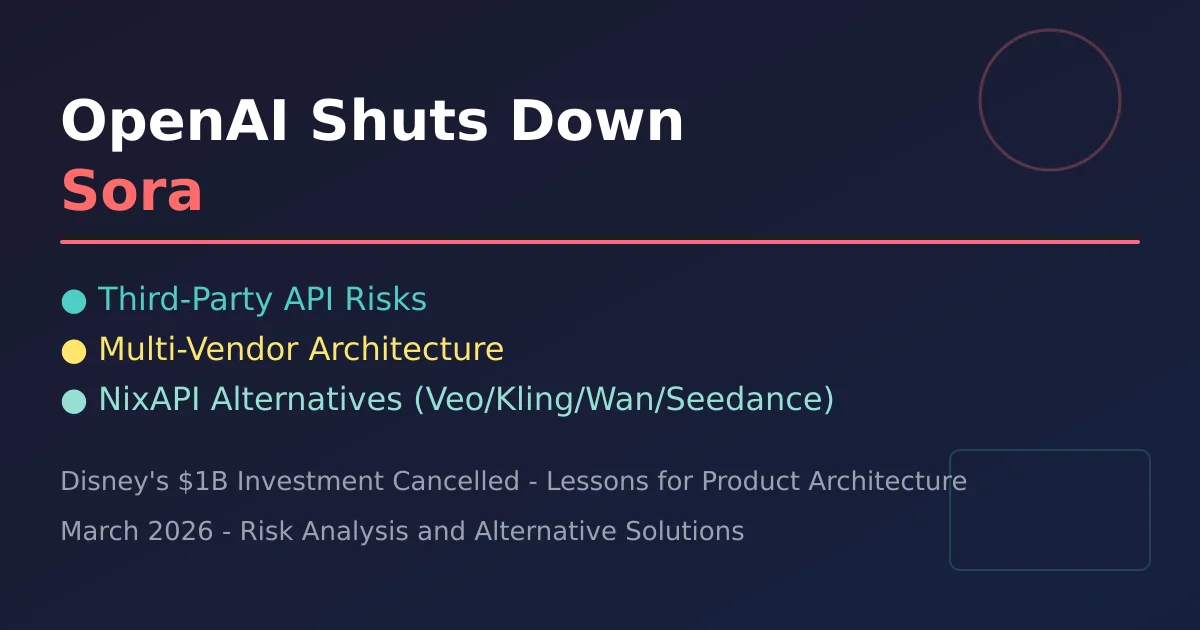
March 24, 2026 Update: OpenAI announced via its official X account that it is closing the Sora short-form AI video app, just 6 months after its September 2025 launch. Meanwhile, Disney’s $1 billion licensing agreement with OpenAI has also been terminated. This incident once again sounds the alarm on the risks of products relying on a single third-party AI API. This article is based on reports from Forbes, CNBC, Deadline, and other media outlets, providing in-depth analysis of product risks and architectural alternative solutions.
📢 Sora Shutdown Event Review
Timeline
| Date | Event |
|---|---|
| September 2025 | Sora app officially launched, supporting text-to-short-video |
| December 2025 | Disney announced $1B investment, licensing Disney characters for Sora |
| March 24, 2026 | OpenAI announces Sora app closure |
| March 24, 2026 | Disney confirms termination of partnership with OpenAI |
OpenAI Official Statement
“We’re saying goodbye to the Sora app. To everyone who created with Sora, shared it, and built community around it: thank you. What you made with Sora mattered, and we know this news is disappointing.”
— @soraofficialapp, March 24, 2026
Closure Reasons Analysis
According to Reuters and CNBC reporting:
- Strategic Focus Shift: OpenAI shifting to coding tools, enterprise customers, robotics, and AGI-related research
- Resource Optimization: Sora app ranked lower in priority for capital, engineering time, compute, and executive focus
- Product Simplification: OpenAI simplifying product stack, focusing on core business
- High-Risk Category: AI video generation belongs to high-risk category, requiring more safety investment
Disney’s Response
“Disney respects OpenAI’s decision to exit the video generation business and to shift its priorities elsewhere.”
— Disney Spokesperson
Impact:
- Disney’s $1B investment cancelled
- Collaboration to showcase Sora-generated content on Disney+ terminated
- Disney’s new CEO Josh D’Amaro needs to find other ways to boost user engagement
⚠️ Product Risks of Depending on Third-Party AI APIs
Risk Matrix
| Risk Type | Impact | Probability | Case Study |
|---|---|---|---|
| Service Shutdown | 🔴 Critical | 🟡 Medium | Sora closure |
| Significant Price Increase | 🟠 High | 🟢 High | GPT-4 multiple price hikes |
| API Restrictions Tightening | 🟠 High | 🟢 High | Multiple vendors rate limiting |
| Feature Changes | 🟡 Medium | 🟢 High | Frequent API interface changes |
| Data Privacy | 🔴 Critical | 🟡 Medium | Training data controversies |
| Compliance Risk | 🔴 Critical | 🟡 Medium | Copyright, portrait rights disputes |
Risk Manifestations in Sora Case
1. Service Shutdown Risk (Occurred)
Impact:
- Products built on Sora API immediately失效
- User-generated content may become inaccessible
- Need emergency migration to alternative solutions
Affected Parties:
- Startups using Sora API
- Marketing automation tools integrated with Sora
- Content creation platforms depending on Sora
2. Copyright and Compliance Risk
Background:
- Sora initially allowed generating copyright-protected characters
- Disney investment provided official licensing
- Licensing voided after closure
Risk Points:
- Generated content may infringe copyright
- Celebrity portrait rights disputes
- Brand trademark infringement
3. Business Continuity Risk
Problems:
- Single vendor dependency
- No backup plan
- High migration costs
Lesson:
“Don’t bind your product’s core functionality to a single third-party API.”
🏗️ Risk-Resistant AI Video Architecture Design
Architecture Principles
- Multi-Vendor Strategy: Connect to multiple AI video APIs simultaneously
- Abstraction Layer Design: Unified interface, flexible vendor switching
- Degradation Plan: Automatic switch to backup when primary fails
- Data Localization: User-generated content stored on own servers
- Cost Control: Dynamically select vendors based on price
Recommended Architecture
┌─────────────────────────────────────────────────────────┐
│                    Application Layer                     │
│  (Web App / Mobile App / API Gateway)                   │
└────────────────────────┬────────────────────────────────┘
                         │
┌────────────────────────▼────────────────────────────────┐
│          Video Generation Abstraction Layer              │
│  - Unified interface definition                         │
│  - Vendor routing logic                                 │
│  - Failure retry and degradation                        │
│  - Cost optimization strategy                           │
└────┬──────────────┬──────────────┬──────────────┬──────┘
     │              │              │              │
┌────▼────┐  ┌─────▼─────┐  ┌────▼────┐  ┌─────▼─────┐
│ NixAPI  │  │  Google   │  │  Runway │  │   Pika    │
│ (Primary)│ │   Veo     │  │    ML   │  │   Labs    │
│         │  │ - High    │  │ - Pro   │  │ - Creative│
│ - Kling │  │   Quality │  │ - Stable│  │ - Fast    │
│ - Veo   │  │ - Expensive│ │         │  │           │
│ - Wan   │  │           │  │         │  │           │
│ - Seedance│ │           │  │         │  │           │
└─────────┘  └───────────┘  └─────────┘  └───────────┘
Core Code Implementation
1. Unified Interface Definition
// Video generation abstract interface
class VideoGenerationProvider {
  async generateVideo(prompt, options) {
    throw new Error('Must be implemented by subclass');
  }

  async checkHealth() {
    throw new Error('Must be implemented by subclass');
  }

  getPricing() {
    throw new Error('Must be implemented by subclass');
  }
}
2. Multi-Vendor Routing
// Intelligent routing strategy
class VideoRouter {
  constructor(providers) {
    this.providers = providers;
    this.primaryProvider = providers[0];
    this.fallbackProviders = providers.slice(1);
  }

  async generateVideo(prompt, options = {}) {
    // Strategy 1: Primary provider first
    if (options.strategy === 'primary') {
      return this.generateWithFallback(prompt, options);
    }

    // Strategy 2: Cheapest first
    if (options.strategy === 'cheapest') {
      return this.generateWithCheapest(prompt, options);
    }

    // Strategy 3: Best quality first
    if (options.strategy === 'best_quality') {
      return this.generateWithBestQuality(prompt, options);
    }

    // Default: Primary provider + fallback
    return this.generateWithFallback(prompt, options);
  }

  async generateWithFallback(prompt, options) {
    const providersToTry = [this.primaryProvider, ...this.fallbackProviders];

    for (const provider of providersToTry) {
      try {
        // Check provider health status
        const health = await provider.checkHealth();
        if (!health.healthy) continue;

        // Try to generate
        const result = await provider.generateVideo(prompt, options);
        return { success: true, provider: provider.name, result };
      } catch (error) {
        console.warn(`Provider ${provider.name} failed:`, error.message);
        continue;
      }
    }

    throw new Error('All video generation providers failed');
  }

  async generateWithCheapest(prompt, options) {
    // Get prices from all available providers
    const prices = await Promise.all(
      this.providers.map(async (p) => ({
        provider: p,
        price: await p.getPricing(options)
      }))
    );

    // Select cheapest
    prices.sort((a, b) => a.price - b.price);

    for (const { provider, price } of prices) {
      try {
        const result = await provider.generateVideo(prompt, options);
        return { success: true, provider: provider.name, price, result };
      } catch (error) {
        continue;
      }
    }

    throw new Error('All providers failed');
  }
}
3. NixAPI Provider Implementation
// NixAPI provider implementation
class NixAPIProvider extends VideoGenerationProvider {
  constructor(apiKey) {
    super();
    this.apiKey = apiKey;
    this.name = 'NixAPI';
    this.baseUrl = 'https://api.nixapi.com/v1';
  }

  async generateVideo(prompt, options = {}) {
    const { NixAPI } = require('@nixapi/sdk');
    const nixapi = new NixAPI({ apiKey: this.apiKey });

    // Select model based on requirements
    const model = this.selectModel(options);

    const response = await nixapi.video.generate.create({
      model: model,
      prompt: prompt,
      duration: options.duration || 5,
      resolution: options.resolution || '720p',
      aspect_ratio: options.aspectRatio || '16:9'
    });

    return {
      videoId: response.id,
      url: response.video_url,
      thumbnail: response.thumbnail_url,
      duration: response.duration,
      model: model
    };
  }

  selectModel(options) {
    // Select best model based on requirements
    if (options.quality === 'highest') {
      return 'veo-2';  // Google Veo 2, highest quality
    }
    if (options.speed === 'fastest') {
      return 'kling-1.5';  // Kuaishou Kling, fast generation
    }
    if (options.cost === 'lowest') {
      return 'wan-2.1';  // Alibaba Wan, best value
    }
    if (options.style === 'cinematic') {
      return 'seedance-1';  // ByteDance Seedance, cinematic feel
    }

    // Default: Balanced
    return 'kling-1.5';
  }

  async checkHealth() {
    try {
      const response = await fetch(`${this.baseUrl}/health`, {
        headers: { 'Authorization': `Bearer ${this.apiKey}` }
      });
      return {
        healthy: response.ok,
        latency: response.headers.get('x-response-time')
      };
    } catch (error) {
      return { healthy: false, error: error.message };
    }
  }

  async getPricing(options = {}) {
    const model = this.selectModel(options);

    // NixAPI video model prices (example)
    const prices = {
      'veo-2': 0.15,      // $0.15/second
      'kling-1.5': 0.08,  // $0.08/second
      'wan-2.1': 0.05,    // $0.05/second
      'seedance-1': 0.10  // $0.10/second
    };

    return prices[model] || 0.10;
  }
}
4. Complete Usage Example
// Initialize multi-vendor router
const router = new VideoRouter([
  new NixAPIProvider(process.env.NIXAPI_KEY),  // Primary provider
  // Can add other providers...
]);

// Usage Example 1: Default strategy (primary + fallback)
async function generateMarketingVideo(script) {
  const result = await router.generateVideo(script, {
    duration: 30,
    resolution: '1080p',
    aspectRatio: '16:9'
  });

  console.log(`Video generated by ${result.provider}`);
  return result;
}

// Usage Example 2: Cost-first strategy
async function generateBulkVideos(prompts) {
  const results = await Promise.all(
    prompts.map(prompt =>
      router.generateVideo(prompt, {
        strategy: 'cheapest',
        duration: 10,
        resolution: '720p'
      })
    )
  );

  const totalCost = results.reduce((sum, r) => sum + (r.price || 0), 0);
  console.log(`Generated ${results.length} videos, total cost: $${totalCost}`);

  return results;
}

// Usage Example 3: Quality-first strategy
async function generatePremiumAd(script) {
  const result = await router.generateVideo(script, {
    strategy: 'best_quality',
    duration: 60,
    resolution: '4k',
    quality: 'highest'
  });

  console.log(`Premium video generated by ${result.provider}`);
  return result;
}
🎬 NixAPI Video Model Recommendations
Available Model Comparison
| Model | Provider | Resolution | Duration | Speed | Price | Advantages | Use Cases |
|---|---|---|---|---|---|---|---|
| Veo 2 | 4K | 60s | Medium | $0.15/s | Highest quality, cinematic | Premium ads, movie trailers | |
| Kling 1.5 | Kuaishou | 1080p | 30s | Fast | $0.08/s | Fast generation, smooth motion | Social media, short videos |
| Wan 2.1 | Alibaba | 720p | 15s | Fast | $0.05/s | Best value | Batch generation, testing |
| Seedance 1 | ByteDance | 1080p | 30s | Medium | $0.10/s | Strong narrative, cinematic | Story shorts, brand videos |
Model Selection Recommendations
| Scenario | Recommended Model | Reason |
|---|---|---|
| Premium Advertising | Veo 2 | 4K resolution, cinema-grade quality |
| Social Media | Kling 1.5 | Fast generation, smooth motion |
| Batch Testing | Wan 2.1 | Lowest cost, fast iteration |
| Brand Story | Seedance 1 | Strong narrative, emotional expression |
| E-commerce Video | Kling 1.5 + Wan 2.1 | Balance speed and cost |
NixAPI Unified Call Example
const { NixAPI } = require('@nixapi/sdk');
const nixapi = new NixAPI({ apiKey: process.env.NIXAPI_KEY });

// 1. Generate premium ad (Veo 2)
const premiumAd = await nixapi.video.generate.create({
  model: 'veo-2',
  prompt: 'Cinematic product showcase, luxury watch on velvet background, dramatic lighting, 4K quality',
  duration: 30,
  resolution: '4k',
  aspect_ratio: '16:9'
});

// 2. Generate social media video (Kling 1.5)
const socialVideo = await nixapi.video.generate.create({
  model: 'kling-1.5',
  prompt: 'Dynamic product unboxing, fast-paced editing, vibrant colors, social media style',
  duration: 15,
  resolution: '1080p',
  aspect_ratio: '9:16'  // Vertical
});

// 3. Batch generate test videos (Wan 2.1)
const testVideos = await Promise.all([
  nixapi.video.generate.create({
    model: 'wan-2.1',
    prompt: 'Product demo version A',
    duration: 10,
    resolution: '720p'
  }),
  nixapi.video.generate.create({
    model: 'wan-2.1',
    prompt: 'Product demo version B',
    duration: 10,
    resolution: '720p'
  }),
  nixapi.video.generate.create({
    model: 'wan-2.1',
    prompt: 'Product demo version C',
    duration: 10,
    resolution: '720p'
  })
]);

// 4. Generate brand story (Seedance 1)
const brandStory = await nixapi.video.generate.create({
  model: 'seedance-1',
  prompt: 'Emotional brand story, journey from humble beginnings to success, warm lighting, cinematic narrative',
  duration: 60,
  resolution: '1080p',
  aspect_ratio: '16:9'
});
💡 Risk Mitigation Best Practices
1. Technical Level
- ✅ Multi-Vendor Architecture: Connect to at least 2-3 video generation APIs
- ✅ Abstraction Layer Design: Unified interface, flexible switching
- ✅ Health Monitoring: Real-time monitoring of each vendor’s status
- ✅ Automatic Degradation: Auto-switch to backup when primary fails
- ✅ Data Backup: User-generated content stored locally
2. Business Level
- ✅ Long-Term Contracts: Sign long-term agreements with core vendors
- ✅ Price Lock: Negotiate price ceiling clauses
- ✅ SLA Guarantees: Clear service availability commitments
- ✅ Exit Clauses: Define transition period for service termination
3. Product Level
- ✅ User Communication: Clearly disclose use of third-party APIs
- ✅ Content Export: Allow users to download generated content
- ✅ Alternative Plans: Prepare backup feature plans
- ✅ Version Control: Record used model versions
❓ FAQ
Q1: If my product depends on Sora API, what should I do now?
A:
- Act Immediately: Migrate to multi-vendor architecture ASAP
- Short-Term Solution: Use NixAPI (supports Kling, Veo, etc.)
- Long-Term Solution: Build own video generation capability or deeply bind multiple vendors
Q2: How do NixAPI’s video models compare to Sora?
A:
- Veo 2: Quality close to Sora, 4K resolution
- Kling 1.5: Excellent motion smoothness, fast generation
- Seedance 1: Strong narrative ability, suitable for story shorts
- Wan 2.1: Best value, suitable for batch generation
Q3: How much will multi-vendor architecture increase costs?
A:
- Initial Development: About 2-4 weeks engineer time
- Operations Cost: Increase about 10-20% (multi-vendor monitoring)
- API Cost: Can be optimized through intelligent routing, may actually decrease
Q4: How to ensure copyright compliance of generated content?
A:
- Use models with legitimate training data (e.g., Veo, Seedance)
- Avoid generating copyright-protected content
- Purchase commercial licenses (e.g., NixAPI Enterprise)
- Establish content review process
📈 Industry Trend Predictions
2026 Trends
- Vendor Consolidation: Small video generation vendors acquired
- Price War: Competition among multiple vendors leads to price decreases
- Quality Improvement: 4K becomes standard, 60s+ duration common
- Verticalization: Emergence of vertical-specific models for e-commerce, education, healthcare
2027 Trends
- Real-Time Generation: Video generation latency reduced to seconds
- Interactive Video: Users can edit generated content in real-time
- 3D Video: Support for 3D content generation
- Local Deployment: Emergence of locally deployable video generation models
📚 Related Resources
- NixAPI Video Generation Docs - API reference
- NixAPI Pricing - Latest pricing
- Forbes Report - Sora shutdown details
- CNBC Report - Cost analysis
📋 Summary
Key Takeaways
- Sora Shutdown Lesson: Dependency on single third-party API is extremely risky
- Multi-Vendor Architecture: Only solution for risk resistance
- NixAPI Advantage: Unified access to Veo, Kling, Wan, Seedance and more models
- Cost Optimization: Intelligent routing can reduce costs by 30-50%
- Act Immediately: Don’t wait until vendor shuts down to migrate
Action Recommendations
Depending on third-party video API?
├─ Step 1 → Assess current dependency risks
├─ Step 2 → Design multi-vendor architecture
├─ Step 3 → Integrate NixAPI (supports 4+ models)
├─ Step 4 → Implement intelligent routing logic
└─ Step 5 → Establish monitoring and degradation mechanisms
Last Updated: March 26, 2026
Data Sources: Forbes, CNBC, Deadline, official announcements
Test Environment: NixAPI v2.0, Veo 2, Kling 1.5, Wan 2.1, Seedance 1
This article is based on public information and actual testing. AI video model API prices and availability may change, recommend confirming latest information before actual use.
Try NixAPI Now
Reliable LLM API relay for OpenAI, Claude, Gemini, DeepSeek, Qwen, and Grok with ¥1 = $1 top-up
Sign Up Free