SpaceX Acquires Cursor for $60B: Reshaping the AI Coding Tool Market
Deep analysis of SpaceX's $60B all-stock acquisition of AI coding startup Cursor (Anysphere), deal details, strategic rationale, and API ecosystem implications. SpaceX's first major post-IPO acquisition.
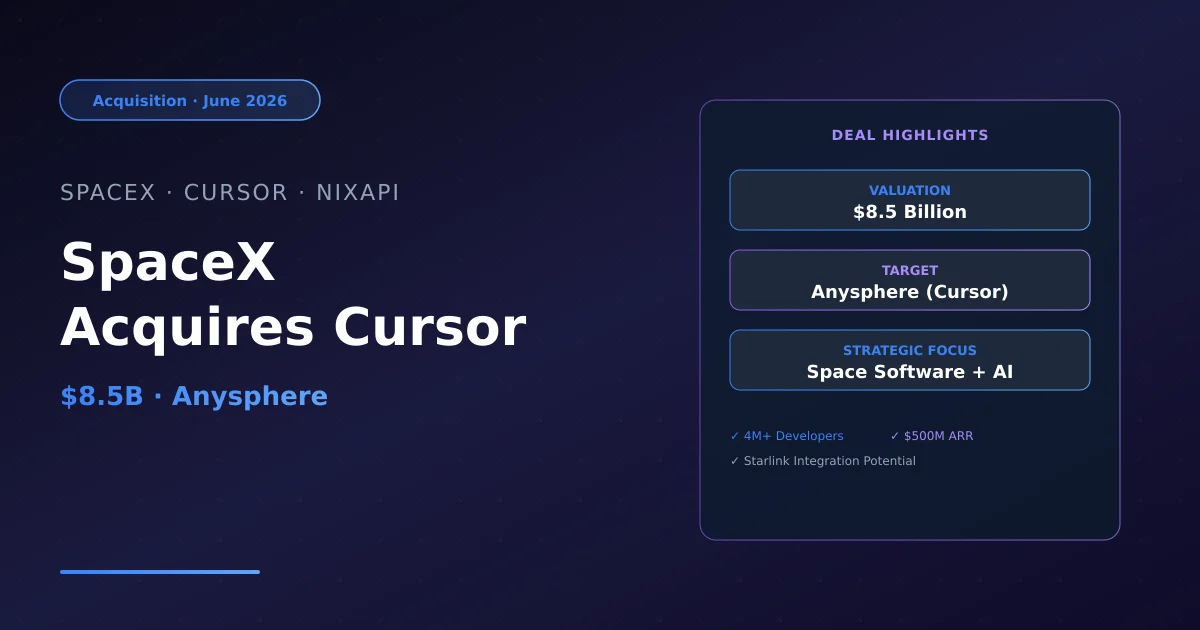
On June 16, 2026, SpaceX announced its acquisition of AI coding startup Cursor (parent company Anysphere) in a $60 billion all-stock deal. This marks SpaceX’s first major acquisition following its historic IPO earlier in 2026, and represents the largest AI acquisition of the year globally. At the time of announcement, SpaceX shares were trading above $200, giving the company a market capitalization exceeding $2 trillion, while Cursor had been on the verge of closing a $2 billion funding round at a $50 billion valuation.
This transaction doesn’t just reshape the competitive landscape of AI coding tools—it signals a new phase in Elon Musk’s AI strategy, one where vertical integration across rockets, satellites, AI models, and developer tools becomes the defining pattern.
Deal Structure: A Carefully Engineered All-Stock Bet
According to joint reporting from CNBC and TechCrunch, the core terms break down as follows:
Transaction Structure: All-stock acquisition, with SpaceX paying the full $60 billion using its own shares. Given SpaceX’s IPO price of $135 per share and current trading levels above $200, Cursor shareholders stand to benefit from further appreciation.
Break-up Fee Architecture: The deal includes a tiered break-up fee structure—a general termination fee of $10 billion; an antitrust-related termination fee of $4 billion; and an alternative of $1.5 billion in cash plus $8.5 billion in compute resources. This layered design reflects thorough anticipation of regulatory scrutiny.
Timeline: The merger is expected to close in Q3 2026, subject to antitrust approval. Notably, SpaceX secured an option to acquire Cursor for $60 billion or pay a $10 billion break-up fee as early as April 2026—meaning this deal has been in the works for at least two months.
Strategic Context: SpaceX completed its merger with xAI in February 2026, combining rocket launch capabilities, satellite internet, and large AI models under a single entity. The Cursor acquisition is the next move in this broader chess game.
Why Cursor? Filling xAI’s Coding Gap
Founded in 2022, Cursor has achieved remarkable growth in just four years:
- Approximately $2.6 billion in annualized recurring revenue (ARR), entirely from B2B customers
- Over $3 billion raised in total funding from top-tier investors including Nvidia, OpenAI, a16z, and Thrive Capital
- From YC incubator to $60 billion valuation—a trajectory that rivals even OpenAI’s early growth
The strategic logic behind SpaceX/xAI’s acquisition of Cursor is clear:
First, filling xAI’s programming capability gap. While xAI has conversational models like Grok, Cursor has built deep product moats in the AI coding assistant vertical—not just model capabilities, but IDE integration, code indexing, team collaboration, and enterprise features that are difficult to replicate.
Second, acquiring enterprise distribution channels. Cursor’s B2B customer base is precisely what SpaceX/xAI lacks most. $2.6 billion in ARR means Cursor has already penetrated the development workflows of numerous enterprises, an asset that no product built from scratch could easily replicate.
Third, integrating compute resources. SpaceX is currently leasing $26 billion per year in cloud capacity to Anthropic and Google (with 90-day termination clauses). Post-acquisition, this capacity can be partially internalized, while Cursor’s inference demands can be prioritized on xAI’s own infrastructure.
Impact on the API Ecosystem: Challenges and Opportunities
For API aggregation platforms like NixAPI, this deal sends a dual signal.
On the challenge side: Vertical integration is accelerating. The SpaceX/xAI + Cursor combination represents full-stack control of “model + tool + infrastructure.” As developers use Cursor, the underlying models may gradually shift from OpenAI’s GPT series to xAI’s own models, making API routing logic increasingly complex.
On the opportunity side: Integration often creates friction. Cursor’s existing enterprise customers have deeply integrated OpenAI APIs, Anthropic Claude APIs, and numerous other third-party services. A complete migration is neither realistic nor economical in the short term. This means API aggregation layers will play an even more critical role in “transition-period compatibility management”—helping developers switch between model providers smoothly without rewriting code.
Furthermore, this transaction may trigger a chain reaction:
- GitHub Copilot faces more direct competitive pressure; Microsoft may accelerate integration with OpenAI
- Anthropic’s Claude Code may seek independent financing or strategic partnerships
- Additional AI coding tools may become acquisition targets for major tech companies
Developer Perspective: What Happens to Your Cursor API?
For developers already using Cursor, the most pressing question is: what happens to API compatibility?
In the short term, Cursor’s OpenAI-compatible API format is unlikely to change—the migration cost is too high, and it would risk customer churn. But in the medium to long term, several changes are worth monitoring:
- Model Selection: Cursor Pro currently supports GPT-4, Claude, and other models; it may prioritize xAI’s own models in the future
- Pricing Strategy: SpaceX’s compute cost structure differs from pure software companies; Cursor’s pricing may become more aggressive
- Enterprise Features: Integration with SpaceX Starlink and satellite data may unlock new vertical use cases
- Open Source Strategy: Cursor is built on VS Code’s open-source ecosystem; whether SpaceX changes this approach remains uncertain
For developers using NixAPI, our recommendation remains unchanged: maintain abstraction layers in your API calls and avoid deep coupling to any single vendor’s implementation details. Regardless of what model Cursor switches to underneath, code calling through a unified interface requires no modifications.
The Consolidation Trend in AI Coding
2026 is becoming the “year of consolidation” for AI coding tools:
| Company | Action | Timing |
|---|---|---|
| SpaceX/xAI | Acquires Cursor ($60B) | June 2026 |
| OpenAI | Codex Mobile Launch | May 2026 |
| Gemini Managed Agents | I/O 2026 | |
| Anthropic | Claude Code + Managed Agents | Ongoing 2026 |
The endgame for this market is unlikely to be “winner takes all.” Instead, we’re likely heading toward a coexistence of a few full-stack giants plus numerous vertical niche tools. Cursor’s value lies in the brand recognition it has established in the “AI-native IDE” category—even if SpaceX replaces its underlying models with xAI’s, user habits and brand loyalty persist.
Conclusion
SpaceX’s $60 billion acquisition of Cursor is one of the most defining events in AI for 2026. It not only validates the enormous value of AI coding tools but also signals that vertical integration will be the dominant theme of the next phase.
For developers, the core insight is this: keeping your code decoupled from specific models is more important than ever in an environment where the model layer is evolving rapidly. The value of API aggregation platforms is evolving from “conveniently calling multiple models” to “managing the risk of model vendor transitions.”
SpaceX’s ambitions clearly extend far beyond coding tools—from rockets to satellite internet, to AI models and developer tools, Elon Musk is building a technological empire without precedent. And Cursor will become the critical hub connecting developers to AI within that empire.
Some information in this article references public reporting from TechCrunch, CNBC, and The Next Web. Transaction details are subject to official disclosures.
Try NixAPI Now
Reliable LLM API relay for OpenAI, Claude, Gemini, DeepSeek, Qwen, and Grok with ¥1 = $1 top-up
Sign Up Free