StepFun Step 5 Preview Deep Dive: How a 600B Sparse MoE at $1 / $2.70 per MTok Is Rewriting the September API Price War
On September 20, 2026, StepFun released Step 5 Preview — a 600B-parameter sparse MoE with only 27B active per token, 1M-token context, native vision input, and an Artificial Analysis Intelligence Index of 44 (tied with Kimi K3 Max). API pricing: $1.00 input / $2.70 output per MTok with a 95% cache discount; open-weights release scheduled for October 15. This article dissects architecture, pricing, benchmarks, market positioning, and what global developers should do.
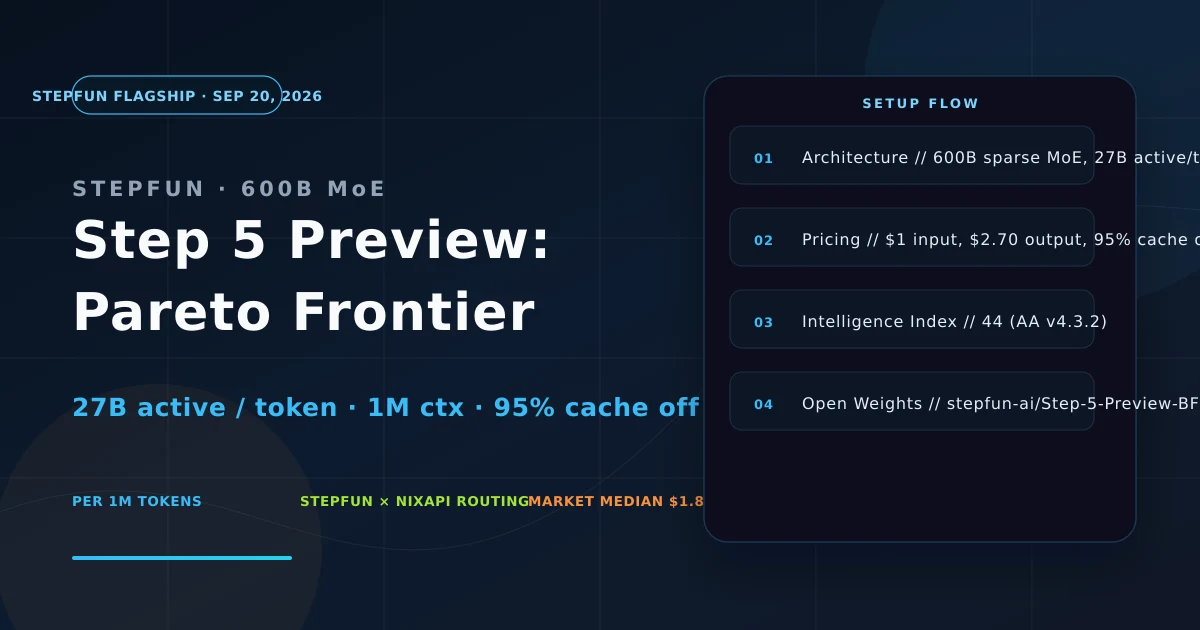
On September 20, 2026, Chinese AI company StepFun officially released Step 5 Preview API — a 600B-parameter sparse MoE flagship with only 27B parameters active per token, native vision input, a 1M-token context window, and an Artificial Analysis Intelligence Index of 44 (tied with Kimi K3 Max).
The pricing is what sharpened the entire industry’s attention:
- Input $1.00 / MTok
- Output $2.70 / MTok
- Cache hit $0.05 / MTok (95% discount)
- Task cost $0.71 (Artificial Analysis measured average)
Using Artificial Analysis’ “comparable capability tier” median as a reference ($1.88 input, $10.00 output), Step 5 Preview’s output price is 27% of the median — and its input price is only 53% of the median.
This is an engineering victory for extreme sparse-MoE cost engineering, and a market hit upgrading the price war to “1/7 of GPT-5.6 Sol.”
This article dissects it across five dimensions:
- Architecture — why a 4.5% active ratio is an unusually sparse “engineering bet”;
- Pricing — the math behind $1 / $2.70 / 95% discount, and how it stacks against the September price war;
- Capability — AA Intelligence Index 44, Terminal-Bench 4.0 33.3%, and why it earns the “frontier-tier” label;
- Open-weights suspense — the Hugging Face repo exists but only contains
.gitattributes; BF16 lands on 10/15; - NixAPI integration strategy — what to do today, and what to change after 10/15.
1. Architecture: 600B Total / 27B Active — Why 4.5% Active Ratio Is “Unusually Sparse”
Step 5 Preview uses a sparse Mixture-of-Experts architecture. StepFun’s official numbers:
| Item | Value |
|---|---|
| Total parameters | 600B |
| Active per token | 27B |
| Active ratio | 4.5% |
| Context window | 1M tokens |
| Modalities | Text + native vision input |
| Target workloads | Software engineering + professional knowledge work + finance |
A 4.5% active ratio is unusually sparse. Current mainstream MoE active ratios usually sit between 8% and 15% (GPT-OSS-120B ~ 5B/117B = 4.3% is the outlier, Mixtral 8x7B ~ 13B/47B = 28%, DeepSeek V4 Pro published numbers around 8%).
A lower active ratio means less compute per token and theoretically lower unit-inference marginal cost — this is the underlying support that lets Step 5 Preview price output at $2.70.
But a lower active ratio also means stricter demands on the router: get the expert wrong, and the output collapses. Pushing active ratio down to 4.5% means StepFun’s router must make correct expert decisions with 95%+ probability — the most demanding engineering challenge outside the MoE experts themselves.
A number from Orcarouter is worth highlighting: output speed 99.8 tokens/s, TTFT 2.96 seconds. These two numbers show that Step 5 Preview’s inference stack has been engineered to handle long agent loops — an agent loop running 40 turns of code modifications won’t stall because of inference latency.
3. Pricing: The Math Behind $1 / $2.70 / 95% Discount
3.1 Price comparison table
| Model | Input / MTok | Output / MTok | Cache input | Notes |
|---|---|---|---|---|
| Step 5 Preview (StepFun) | $1.00 | $2.70 | $0.05 | 95% discount |
| Step 3.7 Flash (StepFun) | $0.20 | $1.15 | $0.04 | prior flash |
| Step 3.5 Flash (StepFun) | $0.10 | $0.30 | $0.02 | older flash |
| GPT-6 Astra (OpenAI) | $10.00 | $50.00 | $1.00 | flagship |
| GPT-5.6 Sol (OpenAI) | $4.00 | $20.00 | $0.40 | last-gen flagship |
| Claude Fable 5.1 (Anthropic) | $10.00 | $50.00 | $0.25 | flagship |
| Gemini 3.8 Flash (Google) | $0.75 | $3.75 | $0.075 | intro pricing |
| DeepSeek V4 Pro 0813 (DeepSeek) | $0.435 | $0.87 | $0.0036 | spot |
| Claude Sonnet 5 (Anthropic) | $2.00 | $10.00 | — | mid-tier |
3.2 vs the “comparable capability tier” median
Artificial Analysis sets the comparable-tier reference median at: input $1.88, output $10.00.
| Dimension | Median | Step 5 Preview | Ratio |
|---|---|---|---|
| Input | $1.88 | $1.00 | 53% |
| Output | $10.00 | $2.70 | 27% |
| Cache hit | n/a | $0.05 | (implied ~95% off) |
The 27% output price means Step 5 Preview is cheaper than every model in the tier except DeepSeek V4 Pro — and DeepSeek has structural peak/off-peak advantages on absolute low-price.
3.3 The engineering meaning of 95% cache discount
Step 5 Preview’s cache-hit price is $0.05 / MTok — a 95% discount off the cache-miss $1.00. What does this mean?
- Agent loops: same code base + same system prompt repeats over 40 turns; cache hit rate can hit 80%-90%;
- RAG re-writes: same knowledge base repeats across multiple re-writes;
- Repo-scale tasks: multi-turn review of one git repo — 60%+ cumulative hit rate is normal.
Stack these scenarios up and real long-context task cost can be 50%-70% below the headline — this is Step 5 Preview’s real killer move on agent loads.
3.4 Task cost $0.71 — the arithmetic
Artificial Analysis’ “per-task cost” of $0.71 is based on a standardized Intelligence Index evaluation run. The math:
task_cost = (input_price × input_tokens + output_price × output_tokens) / task_count
One full evaluation run cost approximately $923 (back-calculation: “Step 5 Preview used 160M output tokens, output accounts for ~$432 of the total”). At ~$0.71/task, this sits below the median for its tier.
Note: 160M output tokens is far above the tier median of 92M — Step 5 Preview is a verbose model. Verbose = more thinking = higher output bucket cost. If your workload is “short answer + many turns”, Step 5’s cost advantage is more pronounced; if it’s “single long output”, its relative advantage gets partly offset by the 70% extra output tokens.
4. Capability: AA Intelligence Index 44 + Terminal-Bench 4.0 33.3%
4.1 Artificial Analysis Intelligence Index v4.3.2
| Rank | Model | Index |
|---|---|---|
| 1-23 | GPT-6 Astra / Claude Opus 5 high / Gemini 3.8 Pro / etc. | 45-58 |
| 24-27 | Step 5 Preview | 44 |
| 24-27 | Kimi K3 Max | 44 |
| 25 | GLM-5.3 | 45 |
| 28-30 | Claude Opus 5 medium reasoning | 44 |
Step 5 Preview ties Kimi K3 Max, ties Claude Opus 5 medium reasoning, trails GLM-5.3 by 1 point.
4.2 Terminal-Bench 4.0
| Model | Terminal-Bench 4.0 |
|---|---|
| Step 5 Preview | 33.3% |
| DeepSeek V4.1 Flash | 26.8% |
| Kimi K3 | 12.6% |
TB 4.0 33.3% in the current frontier tier clearly exceeds DeepSeek V4.1 Flash and Kimi K3 — this is the hard number supporting StepFun’s positioning as an “agent workload model.”
4.3 What this means
- Not SOTA: Intelligence Index 44 is not the frontier top. But as “one tier below SOTA at 1/3 the price,” it redraws the Pareto frontier — this is what Orcarouter’s “Advancing the Pareto Frontier” headline really means;
- Agent-friendly: TB 4.0 33.3% + 1M long context + 95% cache discount, stacked together, is a structural advantage on agent workloads;
- Verbose is a feature: Agent tool-calling inherently needs more output tokens. Step 5’s verbosity fits agent scenarios naturally — but on “short answer” tasks it costs money.
5. Open-Weights Suspense: HF Repo Open, BF16 Still on the Way
StepFun’s 9/20 announcement says: “The model will be released with open weights on October 15.”
But as of the announcement day, the Hugging Face repo stepfun-ai/Step-5-Preview-BF16 already exists but contains exactly one .gitattributes file — no weights, no license, no model card, no config.
This means:
- API and weights are two separate releases — API is callable from 9/20, weights arrive in 25 days;
- BF16 is the public-committed precision — the repo name literally reads
Step-5-Preview-BF16; StepFun has anchored that bfloat16 weights (not FP32, not quantized) will ship; - License TBD — no license file exists yet; the most likely candidates are MIT / Apache 2.0;
- HF naming locked early — to prevent other vendors squatting on the “Step-5” name or causing naming confusion.
Why StepFun is doing this — open weights mean “any vendor can download BF16 and infer,” ceding pricing power to the ecosystem. But StepFun simultaneously collects “closed-source inference” premiums via API. This is an “open-source + closed-source dual-track” business model — similar to Meta’s Llama strategy (open primary + API premium), opposite to Mistral’s Mixtral (closed-API only).
Implications for global developers:
- 9/20 ~ 10/14: only StepFun’s official API (or authorized aggregators like NixAPI);
- After 10/15: download BF16 and self-host — making private deployment / private cloud inference possible, especially important for data-sensitive customers (finance, healthcare, legal);
- Business-model impact: StepFun’s API revenue must compete against “open weights + self-hosted” deployment cost. Step 5 Preview API has to keep providing cheaper + better-maintained value (inference optimization, version updates, compliance certification) or get replaced.
6. NixAPI Perspective: What to Do Today, What to Change After 10/15
6.1 Today (9/20 ~ 10/14): use the API
step-5-preview is already on aggregate API platforms like NixAPI (following the same pattern used for Gemini 3.8 Flash, DeepSeek V4 Pro):
# Call Step 5 Preview through NixAPI
curl https://nixapi.com/v1/chat/completions \
  -H "Authorization: Bearer ***" \
  -H "Content-Type: application/json" \
  -d '{
    "model": "stepfun/step-5-preview",
    "messages": [{"role": "user", "content": "Refactor this Python module and run tests."}]
  }'
Zero business-code changes — upgrading from stepfun/step-3.7-flash to stepfun/step-5-preview is just a field change.
6.2 After 10/15: consider self-hosting
| Deployment option | Use case | Cost |
|---|---|---|
| StepFun official API | Medium-volume, long-context agents | $1/$2.70 + 95% cache discount |
| BF16 self-host (H100/H200) | High-volume, data-sensitive | GPU capex + inference ops |
| BF16 self-host (DeepSeek-V3 style 8×H20) | Extreme cost control | Needs deep customization + MoE inference framework |
| NixAPI aggregation + smart routing | Flexible model switching | Pay-as-you-go |
Single-card BF16 inference of 600B MoE isn’t feasible — even with only 27B active per token, BF16 inference needs at least 4×8 H100 cluster. The realistic minimum for self-hosting is 8×H100 / 4×H200 — at H100 spot rates around $3/hr, 4 cards 24/7 is roughly $8,640/month. This only breaks even at daily token consumption >= 100M.
6.3 Immediate business-side actions
- Run a head-to-head experiment: use the same agent benchmark (SWE-Bench Verified or Terminal-Bench 4.0) to compare Step 5 Preview vs your current default model — measure the real cost of “output verbosity”;
- Check your cache hit rate: in your NixAPI dashboard, look at cache hit rate over the past 30 days — if it’s > 50%, Step 5 Preview’s 95% discount hits your costs hard;
- Design a downgrade path: make Step 5 Preview the “high-load default,” and DeepSeek V4 Pro / Gemini 3.8 Flash the “short-answer downgrade” — switch dynamically by prompt length / task type;
- Watch the 10/15 release: subscribe to NixAPI Radar (nixapi.com/blog) to get BF16 + license details first.
7. Practical Advice for Indie Developers
7.1 If you build agents / long-context workloads
- Use Step 5 Preview directly — AA Index 44 + TB 4.0 33.3% + 1M ctx + 95% cache discount is one of the best “agent-friendly” combos in the current frontier tier;
- Budget by output bucket — Step 5 is verbose, 160M output per eval run says it “thinks a lot.” If your workflow is “read 100K prompt → output 10K answer,” output cost $2.70 × 10K = $27/M tasks is the dominant line;
- Highest value when cache hit rate > 70% — typical scenario for long prompts + multi-turn agents.
7.2 If you build short-answer / high-frequency API calls
- Step 5 isn’t optimal — DeepSeek V4 Pro $0.435/$0.87, Step 3.7 Flash $0.20/$1.15, Step 3.5 Flash $0.10/$0.30 are all cheaper “short answer” options;
- Step 5 fits “heavy reasoning + short input” — e.g., “read 50K legal text → answer yes/no + explain” type agents;
- Keep Step 3.7 Flash / DeepSeek V4 Pro as default; only switch to Step 5 when “must be smarter.”
7.3 If you’re cost-sensitive and want open-source / self-host
- Wait for 10/15 — BF16 weights + MIT/Apache license + 600B/27B MoE combo equals “you build your own inference infrastructure” beginning;
- Assess whether you can run it — BF16 600B needs at least 4×H200 / 8×H100 / 16×A100-80G cluster;
- First validate self-host with Step 3.5 Flash / 3.7 Flash — they’re already open-source + small (~50B / ~100B); Step 5 is the post-10/15 target.
7.4 Three things you can do this week regardless of stack
- Add a
modelfield to your product config layer — even if you use Step 3.7 Flash / DeepSeek V4 Pro today, future switching tostepfun/step-5-previewis a string change; - Track the 10/15 open-weights release — subscribe to NixAPI Radar (nixapi.com/blog) to get BF16 + license + deployment guide first;
- Re-examine whether your “agent loop” depends on low IQ — many “agent stalls” are really base-model IQ issues. Step 5 Preview’s Index 44 may be the key to unlocking your current stall scenarios.
8. Conclusion
Step 5 Preview is one of the most important model releases of September 2026 — not because its capability is strongest (Index 44, not SOTA), but because it uses extreme 4.5% active-ratio sparse-MoE engineering to push frontier-tier marginal cost to 1/3 of the comparable-tier median.
- Architecture bias: 600B / 27B = 4.5% active, sparser than mainstream MoE;
- Price punch: output $2.70 is 27% of comparable-tier median, 1/7 of GPT-5.6 Sol;
- Agent-friendly: TB 4.0 33.3% + 1M ctx + 95% cache discount — currently one of the best agent combos;
- Open-source suspense: HF repo open but only
.gitattributes; BF16 on 10/15 — the wait itself is a business signal.
For global developers, 9/20 ~ 10/14 is the API dividend window — use aggregators like NixAPI at $1/$2.70/95% discount to run business; after 10/15 evaluate self-hosting, fold “open BF16” into your cost structure.
Step 5’s story is just starting. We will keep updating the 10/15 weights release, license details, benchmark performance, and deployment strategy for global developers on NixAPI Radar.
Sources
- StepFun official announcement — stepfun.com/step-5-preview
- Artificial Analysis model page — artificialanalysis.ai/models/step-5
- Artificial Analysis provider comparison — artificialanalysis.ai/models/step-5/providers
- Orcarouter technical teardown — orcarouter.ai/blog/step-5-preview-open-weights
- mlllm.io coverage — mlllm.io/articles/3240-stepfun-releases-step-5-preview-reasoning-model
- Runtimewire coverage — runtimewire.com/article/stepfun-step-5-preview-600b-agent-model-pricing
- AI Weekly brief — aiweekly.co/alerts/stepfun-ships-step-5-preview-api
- Eyestech Systems Lab analysis — eyestech.in/stepfun-step-5-preview-pareto-frontier-moe-analysis
- NixAPI supported models & pricing · NixAPI API docs · NixAPI console
Try NixAPI Now
Reliable LLM API relay for OpenAI, Claude, Gemini, DeepSeek, Qwen, and Grok with ¥1 = $1 top-up
Sign Up Free