Tencent's ClawPro on Top of OpenClaw: What Enterprise Agent Platforms Mean for API Developers
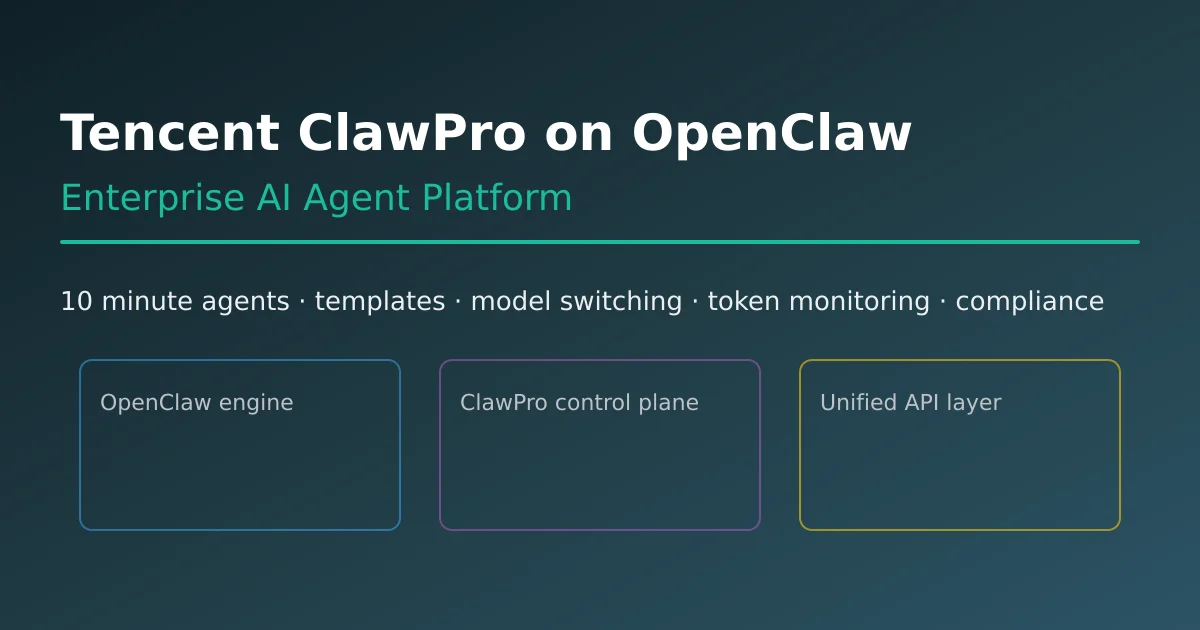
In April 2026, Tencent Cloud launched ClawPro—an enterprise AI agent management platform built on the open-source framework OpenClaw. Promising 10-minute agent deployments, templates, model switching, token usage monitoring, and security/compliance, ClawPro is an early example of a pattern that will likely repeat across clouds. This article, based on reports from The Next Web and others, analyzes what ClawPro means for developers and where platforms like NixAPI still add value.
Note: All factual information about ClawPro and OpenClaw in this article is drawn from public reports (notably The Next Web, AOL, and others). We do not speculate about Tencent’s undisclosed internals. Architecture and NixAPI-related commentary reflects engineering interpretation based on those sources.
1. What exactly is ClawPro? Three layers to keep separate
Before we talk about ClawPro, it’s helpful to distinguish three conceptual layers:
- LLM model layer
- Individual models such as Claude, GPT, and Tencent’s own models—responsible for understanding and generating text/code.
- Agent framework layer (OpenClaw)
- An open-source framework for giving LLMs the ability to act in the real world:
- Call operating system APIs, browsers, HTTP services, terminals, etc.;
- Maintain long-lived context and task state;
- Plug in tools/skills and orchestration logic.
- An open-source framework for giving LLMs the ability to act in the real world:
- Enterprise agent platform layer (ClawPro)
- Tencent’s managed service on top of OpenClaw, aimed at enterprises:
- Agent templates;
- Model switching and multi-provider support;
- Token usage monitoring and budgeting;
- Security and compliance controls.
- Tencent’s managed service on top of OpenClaw, aimed at enterprises:
The Next Web’s description can be compressed to:
ClawPro = an enterprise agent management shell + cloud resources + compliance wrapper built around open-source OpenClaw.
In other words:
- OpenClaw is the open-source engine;
- ClawPro is the Tencent Cloud vehicle + fleet management system.
2. ClawPro’s key capabilities (from The Next Web)
Based on The Next Web and related coverage, ClawPro’s main value props are:
-
“10-minute” OpenClaw-based agent deployment
- Wizard-driven flows and templates for quickly spinning up OpenClaw-based agents;
- Connect data sources/systems, pick a model, and deploy an agent into the enterprise environment.
-
Templated agent workflows
- Prebuilt templates for common enterprise scenarios:
- Customer support / FAQ agents;
- Internal knowledge agents;
- Reporting / analytic agents;
- DevOps / IT operations agents;
- Enterprises can start from templates instead of building orchestration from scratch.
- Prebuilt templates for common enterprise scenarios:
-
Model switching and multi-provider support
- In the ClawPro control plane, teams can manage model providers:
- Tencent’s own models;
- Partner models (Claude / GPT, depending on region and agreements);
- Different agents or tasks can use different models:
- Lightweight models for retrieval or simple classification;
- Heavier models for complex reasoning or refactors.
- In the ClawPro control plane, teams can manage model providers:
-
Token usage monitoring and budgeting
- Monitor token usage and request volume by agent / team / application;
- Track per-task or per-user costs;
- Enforce budgets and alerts to prevent surprise bills.
-
Security and compliance features
- Integrate with enterprise IAM / RBAC systems;
- Provide audit logs for who invoked which agent against what resources and when;
- Help satisfy regulatory and internal audit requirements in regulated industries.
In other words, ClawPro does the thing large cloud vendors are best at:
Take a powerful but engineering-heavy open-source framework (OpenClaw) and wrap it into an enterprise-ready, billable, governed managed service.
3. Why the pattern “open-source agent framework + cloud wrapper” makes sense
From both a business and engineering perspective, OpenClaw + ClawPro is a very natural pattern:
-
Open-source framework responsibilities:
- Move fast with community-driven innovation;
- Provide a common agent abstraction and plugin system;
- Let developers experiment locally or in self-hosted environments.
-
Cloud vendor platform responsibilities:
- Provide stable hosting and SLAs;
- Add billing, monitoring, identity, auditing, and compliance;
- Turn a “lab-grade” technology into a production-grade service.
For Tencent, this is a particularly logical move:
- OpenClaw’s surge in developer popularity proves real demand for agent-style workflows;
- Enterprise customers care more about:
- Who runs and maintains it;
- Who handles security and compliance;
- Who gives them reliable bills and budgets.
This is why The Next Web frames ClawPro less as a one-off product and more as a template:
The open-source AI stack is global; the speed of enterprise adoption depends on ecosystems that can productize and distribute it.
4. Enterprise view: self-host OpenClaw or use ClawPro?
From an enterprise architect or CTO perspective, the key question is not “agent or no agent”, but:
Do we self-host OpenClaw, or do we let ClawPro host it for us?
A rough comparison of the two paths:
4.1 Self-hosting OpenClaw
Pros:
- Full control:
- Choose exactly where to deploy (on-prem, private cloud, multi-cloud);
- Define how to connect to internal networks and systems;
- High customizability:
- Deeply customize agent behavior, plugin systems, persistence mechanisms;
- Strong data sovereignty:
- Particularly valuable in finance, government, and other highly sensitive sectors.
Cons:
- Significant DevOps / SRE burden:
- Upgrades, monitoring, alerting, capacity planning, and DR are fully your responsibility;
- Security responsibility lies with you:
- Misconfigurations and vulnerabilities are on your risk budget;
- Cost transparency requires more internal work:
- You must integrate model billing, compute usage, network, and storage into a coherent cost picture.
4.2 Using ClawPro (managed service)
Pros:
- Fast time-to-value:
- Templates + wizards + managed runtime give you a working agent quickly;
- Enterprise-grade capabilities bundled in:
- Identity, audit, budgeting, billing, compliance—areas where large clouds have deep experience;
- Reduced operational overhead:
- Offload a large amount of non-differentiated heavy lifting to Tencent Cloud.
Risks/Tradeoffs:
- Platform lock-in:
- Templates, configurations, monitoring, and extension mechanisms are tightly bound to ClawPro;
- Multi-cloud and cross-border complexity:
- If you operate across multiple clouds or regions, you still need higher-level coordination;
- You still need a unifying API layer on top:
- When you mix multiple agent platforms and self-hosted agents, you need a centralized place for orchestration and governance.
In short:
ClawPro solves “how do we get OpenClaw into production quickly”; it does not solve “how do we manage agents and models across multiple platforms and clouds”.
5. Cross-cloud, multi-platform agent orchestration: why a unified API layer still matters
Even if you fully embrace cloud-hosted agent platforms like ClawPro, real-world setups often look like this:
- Some workloads in domestic clouds (e.g., Tencent Cloud + ClawPro);
- Others in overseas clouds (AWS, GCP, Azure, etc.);
- Model layer spanning:
- Tencent models;
- OpenAI / Anthropic / others;
- Self-hosted / private models;
- Agent layer including:
- ClawPro-hosted enterprise agents;
- Self-hosted OpenClaw instances;
- Other vendors’ agent products (Copilot, Claude Code, in-house agent platforms).
In that world, a new problem emerges:
Agent platforms themselves become vendors. How do you orchestrate and govern across them?
This is where a unified API & orchestration layer—like NixAPI—becomes highly valuable.
6. A concrete pattern: putting NixAPI above ClawPro
Imagine a more resilient enterprise architecture:
- Bottom: multiple models and multiple agent platforms (ClawPro, self-hosted OpenClaw, others);
- Middle: NixAPI as the unified API and orchestration layer;
- Top: business apps, frontends, and internal systems talking only to NixAPI.
Simplified diagram:
        ┌──────────────────────────────┐
        │  Business Apps / Frontends  │
        │      / Internal Systems     │
        └──────────────────────────────┘
                       ▲
                       │ Unified HTTP / SDK
                       │
        ┌──────────────────────────────┐
        │           NixAPI             │
        │  - Multi-model routing       │
        │  - Agent platform abstraction│
        │  - Cost/quota governance     │
        │  - Observability & alerts    │
        └──────────────────────────────┘
             ▲                 ▲
             │                 │
   ┌────────────────┐  ┌────────────────────┐
   │   ClawPro       │  │ Self-hosted OpenClaw│
   └────────────────┘  │  / other platforms  │
                       └────────────────────┘
Under this pattern:
-
ClawPro focuses on:
- Managed OpenClaw agents and enterprise governance;
- Templates, permissions, audit, budgeting and cloud resource integration.
-
NixAPI focuses on:
- Abstracting ClawPro into one or more logical providers;
- Abstracting self-hosted OpenClaw, other agent platforms, and raw model APIs in the same way;
- Presenting a unified interface and policy surface to business applications.
The immediate benefits:
-
Avoid agent-platform lock-in
- If a second or third ClawPro-like platform emerges from other clouds, you add providers to NixAPI rather than rewrite business logic;
- Migration cost lives primarily in the platform layer, not in every application.
-
Centralize cost and security governance
- Budgets and quotas: configured once at the NixAPI level instead of per-platform;
- Security policies: least privilege, rate limits, and anomaly detection implemented at the API edge, not scattered across various consoles.
-
Leave room for multi-cloud and cross-border layouts
- Different regions and clouds can use different models and agent platforms;
- Business teams still see a consistent API and behavior contract.
7. Practical takeaways for developers and founders
From the ClawPro case, we can distill several trends:
7.1 “Open-source agent framework + cloud wrapper” will likely be the norm
OpenClaw + ClawPro is likely the first of many:
- Other clouds will build agent platforms on OpenClaw or similar frameworks;
- More “XPro”-style products will appear:
- Templated agents;
- Deep integration with cloud models, storage, and monitoring;
- Enterprise-grade billing and compliance baked in.
7.2 Real differentiation will shift from model layer to orchestration & governance
Over the last year, the conversation has been dominated by:
- GPT vs Claude vs Gemini: who has the best model?
Going forward, the more important questions will be:
- Which agent platforms offer the best experience for developers and enterprises?
- Whose orchestration and governance stack is more usable, more composable, and more controllable?
In other words:
“How many models can you connect?” is no longer the only question. “Can you govern them across platforms and clouds?” will matter more.
7.3 API infrastructure becomes more crucial, not less
On top of the stack “models → agent frameworks → cloud agent platforms”, there is still a growing need for a dedicated API & orchestration infrastructure layer:
- For developers:
- A single, coherent SDK / HTTP interface to build against, without exploding code complexity;
- For enterprises:
- One place to manage cost, quotas, security policies, and observability;
- For future-proofing:
- The ability to swap out or add vendors at any layer without rewriting every application.
This is exactly where products like NixAPI make sense in a ClawPro world.
8. Conclusion: ClawPro is a starting gun, not the finish line
To summarise:
ClawPro shows that open-source agent frameworks like OpenClaw are mature enough to be productized by first-tier clouds. The real contest now shifts to: who can give developers and enterprises a truly unified, controllable foundation across models, agents, and clouds?
If you’re a developer or founder, three concrete actions to consider:
-
Short term
- Explore ClawPro or similar platforms to validate agent use cases in your environment.
-
Medium term
- Avoid baking all your logic directly into a single agent platform’s configuration and templates;
- Start extracting an internal API layer—or adopt something like NixAPI—to sit above your agent platforms.
-
Long term
- Shift focus from “integrating model X or platform Y” to:
- Designing cross-platform, cross-cloud orchestration strategies;
- Building enterprise-grade baselines for observability, audit, cost control, and security.
- Shift focus from “integrating model X or platform Y” to:
With Claude Code source leaks and ClawPro launches happening in the same quarter, the message is clear:
- Agents have moved from concept to infrastructure;
- The real competition is no longer “who has the biggest model”, but who offers the most usable and controllable infrastructure stack.
For NixAPI and similar platforms, now is the time to clearly define your place in that stack—and to show, article by article and API by API, that:
On top of models and agent platforms, we still need an API layer explicitly designed for developers and enterprises.
Try NixAPI Now
Reliable LLM API relay for OpenAI, Claude, Gemini, DeepSeek, Qwen, and Grok with ¥1 = $1 top-up
Sign Up Free