Tencent Hy4 API and Pricing: Is 770B MoE at 49B Active Worth $0.834?
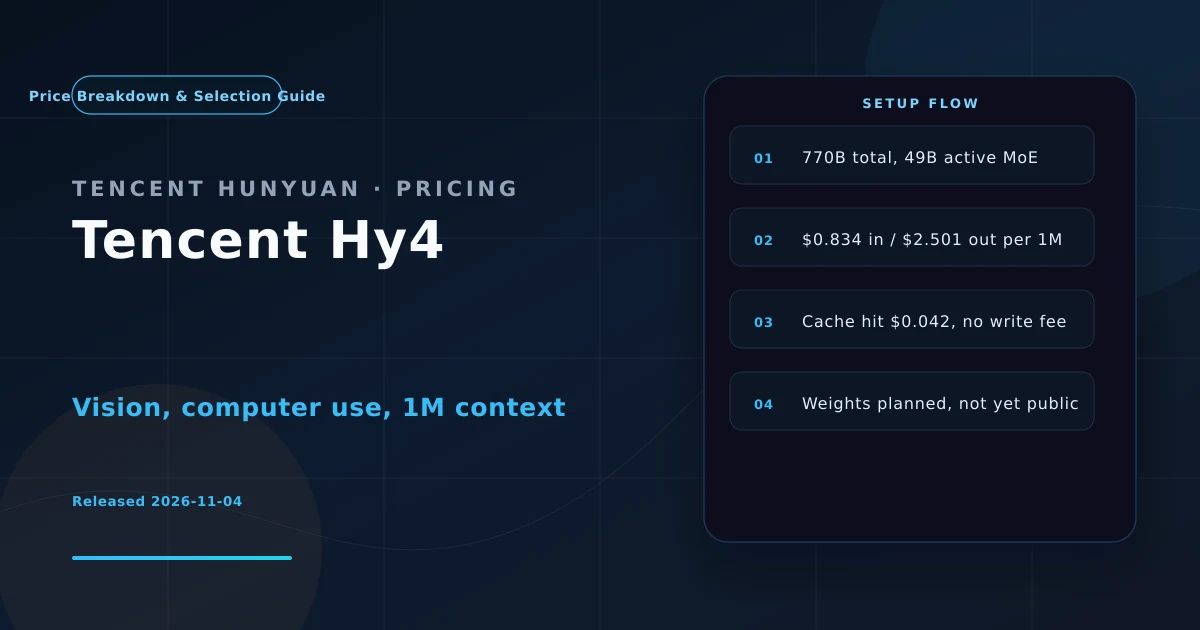
Tencent Hunyuan's Hy4 shipped on 2026-11-04: a 770B-total / 49B-active MoE with 1M context, new vision and computer use, at $0.834/$2.501 per 1M tokens. This guide breaks down the real pricing structure, benchmark comparisons against Opus 5.5 and DeepSeek V4.1 Flash, the practical impact of unreleased weights, and selection advice.
Introduction: The Cheapest “Open Flagship” — and One Fact You Must Clear First
On 2026-11-04, Tencent’s Hunyuan team released the full Hy4 model — the complete version following the 2026-08-28 Hy4 preview, adding visual understanding and computer use, with API pricing identical to the preview.
The official price:
$0.834 input / $2.501 output / $0.042 cached input (per million tokens)
Against Claude Opus 5.5 ($4/$20), that’s 79% cheaper on input and 87% cheaper on output. Aggressive pricing.
But before writing any code, one fact must be cleared — it’s the first section of this article and the most valuable line in it:
Hy4’s final weights are not public. Tencent’s own wording is “plans to open-source,” with a complete system card promised alongside. Verified on 2026-11-05:
huggingface.co/tencent/Hy4returns HTTP 401, andgithub.com/Tencent-Hunyuan/Hy4returns 404.
A lot of secondary coverage — including articles published after 11-08 — conflates “Hy4 preview’s Apache-2.0 weights” with “Hy4 final.” These are two different things:
| Hy4 preview | Hy4 final | |
|---|---|---|
| Released | 2026-08-28 | 2026-11-04 |
| Weights | Public, Apache-2.0 | Not public (planned) |
| Vision | ||
| Computer use | ||
| API price | $0.834 / $2.501 | Same as preview, unchanged |
The rest of this article evaluates Hy4 final as an API service.
1. Architecture: 770B Total, 49B Active
| Property | Value |
|---|---|
| Total parameters | 770B |
| Active parameters | 49B (6.4%) |
| Architecture | Sparse MoE (Mixture-of-Experts) |
| Context | 1M (960,000 input / 64,000 output) |
| Modalities | Text + image input → text output |
| Reasoning levels | none / low / medium / high (default high) |
| Model IDs | hy4 (Tencent Cloud TokenHub) / tencent/hy4 (OpenRouter) |
| License | TBD — open-source and system card promised, not delivered |
| Self-host requirement | Official vLLM recipe: 16× NVIDIA B200 or 8× B300 |
The 6.4% activation rate is the entire secret of Hy4’s cost structure: 770B total determines “how big the model is,” but 49B active per token determines “how much each token costs.” This is the same pattern as Qwen3.8-Max (2.4T / 95B active = 4%) and Kimi K3 (2.8T / 104B active = 3.7%) — total scale buys capability, activation sparsity buys cost.
1.1 Self-Hosting: This Is Not a Casual Deployment
The official vLLM recipe calls for 16 B200s or 8 B300s. The community consensus is blunt: “viable for a team that already operates distributed inference; not a sensible first experiment for a normal product team.”
The math: 8× B300 typically runs $300K–$500K. Amortized across 49B active parameters at 6.4% sparsity, the per-token cost of self-hosting is hard to beat the API price — unless utilization stays near 100% at meaningful scale.
Bottom line: for most teams, the API is cheaper than self-hosting. Hy4’s API price is already low enough that infrastructure rarely pays for itself.
2. Pricing: Three Channels, Three Prices — Pick Carefully
This is the most practical section. Hy4’s actual price depends on where you buy it:
| Channel | Input | Output | Cache read | Notes |
|---|---|---|---|---|
| Tencent Cloud TokenHub (official) | $0.834 | $2.501 | $0.042 | Official rate, no cache write fee |
| OpenRouter | $0.417 | $1.251 | — | 50% off, promo through 12-31 |
| AIHubMix | $0.8823 | $2.647 | $0.4412 | Includes routing markup |
| Vercel AI Gateway | $0.83 | $2.50 | — | Relaying Tencent Cloud |
2.1 Three Details That Matter
① Cache hits are 95% off, and there’s no write fee
$0.042 / $0.834 = 5%, i.e. a 95% discount. More importantly — no cache write fee. Compare GPT-6.1 Terra (writes at $1.25 or $2.50), and Hy4’s cache policy is extremely agent-loop friendly.
② OpenRouter’s 50% off expires 12-31
This is a limited-time promotion, not a long-term rate. If you’re signing an annual contract or building a 2027 budget, compute against $0.834/$2.501, not the pre-December price. It may revert.
③ All three channels quote different numbers — that’s normal
OpenRouter’s own quoted price floats with provider mix. Don’t write any single vendor’s number into a budget document as “the official price” — there’s exactly one official rate: Tencent Cloud’s $0.834/$2.501.
2.2 What Caching Actually Does to the Bill
Agent loop, 12,000-token prefix, 10 turns, 1,500 output tokens per turn:

No cache:  140,000 input × $0.834  = $0.117
           15,000 output × $2.501  = $0.038
           total ≈ $0.155

Cached:    12,000 written (free) + 108,000 hits × $0.042 = $0.0045
           32,000 new input × $0.834 = $0.027
           15,000 output × $2.501  = $0.038
           total ≈ $0.069
A 55% saving, entirely from caching. Note output cost didn’t change — Hy4’s output rate ($2.501) is 87% below Opus 5.5 but still 3× its input rate, so output dominates in long-generation workloads.
3. Benchmarks: Where Hy4 Is Strong, Where It Isn’t
Important caveat: every number below comes from Tencent’s own launch tables. No independent lab (Artificial Analysis among them) has evaluated Hy4 final yet — 20 of the 34 tests in Tencent’s full table are internal.
| Benchmark | Hy4 | DeepSeek V4.1 Flash | Kimi K3.1 Pro | GPT-6.1 Sol | Claude Opus 5.5 |
|---|---|---|---|---|---|
| APEX-Agents v1.1 (office agents) | 75.2 🏆 | 72.9 | 68.2 | 61.7 | 74.8 |
| DeepSWE v1.1 (real repo changes) | 74.9 | 73.8 | 76.3 | 72.7 | 72.6 |
| Terminal-Bench 4.0 (terminal tasks) | 44.4 | 40.0 | 66.8 | 55.5 | 66.4 |
| SWE-Marathon v1.1 (long coding) | 43.8 | 46.3 | 53.8 | — | 44.4 |
| ProgramBench (coding) | 30.0 | 29.1 | 31.5 | 46.0 | 65.0 |
| OSWorld 2.1 (computer use) | 78.9 | 68.4 | 79.6 | 75.2 | 81.8 |
| MMMU-Pro (image understanding) | 78.6 | 76.7 | 83.4 | 84.9 | 88.2 |
| Agents’ Last Exam (professional tasks) | 41.0 | 35.3 | 43.4 | 40.2 | 43.4 |
| HLE-Full with tools | 59.1 | 57.1 | 70.0 | 60.6 | 67.7 |
3.1 Three Conclusions
① Hy4’s real strength is office / process-oriented agent work
APEX-Agents 75.2 is the top score in the table — a benchmark measuring document handling, spreadsheet operations, and multi-step office workflows. For enterprise automation (financial analysis, report generation, cross-document workflows), this is exactly the right capability, and it matches Tencent’s own “officework” messaging.
② Coding is not Hy4’s strength — and the gap is large
ProgramBench 30.0 vs Opus 5.5’s 65.0 — less than half. Terminal-Bench 44.4 vs 66.4, a 22-point gap. SWE-Marathon 43.8 vs Kimi’s 53.8.
Independent testing echoes this: in AI/ML API’s run, Hy4 passed all 23 attempts, its APEX-Agents score was the highest of six models, and median task cost was $0.019 — below Claude Opus 5.5 and GLM 5.3. But in the same test, DeepSeek V4.1 Flash was about 10× faster and 10× cheaper on coding.
③ Vision and computer use are competitive but not winning
OSWorld 2.1: Hy4 78.9 vs Opus 5.5’s 81.8 — 2.9 points behind. MMMU-Pro trails by 9.6.
Independent observation is specific: “Hy4 matched Opus on the vision tests but took much longer to answer, and wrote fewer working programs.”
3.2 The State of Independent Verification: Basically None Yet
This must be stated plainly:
- 20 of 34 tests in Tencent’s table are internal;
- Artificial Analysis has only listed Hy3 models so far, not Hy4 final;
- every third-party Hy4 score in circulation is ultimately a restatement of Tencent’s numbers, not an independent reproduction.
A practitioner comment on X is worth remembering: “Tencent shipped 12 benchmark charts, and Hy4 isn’t the tallest bar in any of them. Most labs would have cropped until it was.”
That’s a good sign — it means Tencent didn’t cherry-pick. But it also means you cannot treat any single score as proof that “Hy4 is the strongest.”
4. Price Position: Which Tier Does It Occupy?
| Model | Input | Output | Cache hit | Context |
|---|---|---|---|---|
| Hy4 (Tencent Cloud official) | $0.834 | $2.501 | $0.042 | 1M |
| Hy4 (OpenRouter promo) | $0.417 | $1.251 | — | 1M |
| DeepSeek V4.1 Flash | $0.22 – $0.44 | $0.66 – $1.32 | $0.007 | 1M |
| DeepSeek V4 Pro | $0.66 | $1.98 | $0.022 | 1M |
| GPT-6.1 Sol | $2.00 | $10.00 | $0.10 | 1.05M |
| Claude Sonnet 5.5 | $2.00 | $10.00 | ~$0.50 | 1M |
| Claude Opus 5.5 | $4.00 | $20.00 | ~$0.50 | 1M |
| GLM-5.3 | $1.40 | $4.40 | $0.26 | — |
| Kimi K3.1 Pro | $3.00 | $15.00 | $0.20 | 1M |
| Qwen 3.8 Max | $2.00 | $6.00 | $0.25 | 1M |
4.1 Where Hy4 Sits
It’s on the cheaper end of the “open/self-hostable flagship” tier — but not the price floor.
- 2–4× more expensive than DeepSeek V4.1 Flash;
- 5–8× cheaper than Claude Opus 5.5;
- 3.6–6× cheaper than Kimi K3.1 Pro;
- in the same league as GLM-5.3.
Only DeepSeek is cheaper — and DeepSeek V4.1 Flash is 10× faster and 10× cheaper on coding.
4.2 So Why Would You Pick Hy4?
Three things DeepSeek can’t give you:
- #1 on APEX-Agents — capability leadership on office-process agents;
- 6.4% activation + 95% cache discount + no write fee — extreme cache friendliness, very low cost in long agent loops;
- Domestic deployment, compliance, and latency — domestic deployment, RMB settlement, data residency. OpenRouter measured P50 latency at 2.88s and 64 tok/s, currently via a single provider — predictable latency, but also no automatic failover between providers.
5. Selection Advice: When to Use Hy4
| Scenario | Recommendation | Why |
|---|---|---|
| Enterprise office / finance / reporting agent flows | Hy4 first choice | #1 on APEX-Agents, $0.019 median task cost |
| Vision + computer use + 1M context in one model | Hy4 | All three in one, no stitching |
| Domestic deployment / data residency / RMB billing | Hy4 | Tencent Cloud TokenHub |
| Long documents with heavy cache reuse | Hy4 | 5% cache rate, no write fee |
| Pure code generation / repo-level refactoring | Not this one | ProgramBench 30.0 vs Opus 65.0 — more than half the gap |
| Terminal / CLI agents | Not this one | Terminal-Bench 44.4 vs 66.4 |
| Extreme cost-sensitive batch work | DeepSeek V4.1 Flash | 10× faster, 10× cheaper |
| Need to self-host or fine-tune | Wait | Final weights not public |
5.1 Integration Code
Hy4 exposes an OpenAI-compatible endpoint, so migration is nearly free:
import openai

client = openai.OpenAI(
    api_key="YOUR_KEY",
    base_url="https://api.hunyuan.cloud.tencent.com/v1",   # Tencent Cloud TokenHub
)

resp = client.chat.completions.create(
    model="hy4",
    messages=[{"role": "user", "content": "Analyze this quarterly report and summarize three key changes"}],
    reasoning_effort="medium",     # none / low / medium / high, default high
)

print(resp.choices[0].message.content)
If your task is simple, set reasoning_effort="low" or "none" explicitly. The default is high, and thinking tokens bill as output ($2.501/1M). Using high on trivial reasoning is pure waste.
5.2 If You Use OpenRouter
client = openai.OpenAI(
    api_key="OPENROUTER_KEY",
    base_url="https://openrouter.ai/api/v1",
)

resp = client.chat.completions.create(
    model="tencent/hy4",     # note the tencent/ prefix on the slug
    messages=[{"role": "user", "content": "..."}],
    reasoning_effort="medium",
)
The slug differs between channels (hy4 vs tencent/hy4) — if you have channel-switching logic, handle this.
6. Three Gotchas to Know Up Front
Gotcha 1: No weights = you can’t self-host or fine-tune today
Tencent has promised open weights and a system card, but HF returns 401 and GitHub returns 404 as of now. That means:
- No self-hosting (the preview weights are public, but that’s the older model without vision or computer use);
- no fine-tuning;
- no deep audit — you cannot inspect what’s in the weights, which is exactly why the system card commitment matters.
For enterprise procurement this is substantive risk: a 770B model exposed only through an API, with no public weights and no published system card, means you cannot complete a standard model safety assessment. Waiting for weights and the system card before production is the more prudent pace.
Gotcha 2: Default reasoning_effort is high, and thinking tokens bill as output
Mentioned above; repeating it as an operating rule: set reasoning_effort explicitly, don’t rely on the default.
Gotcha 3: The promo has an end date
OpenRouter’s 50% rate ($0.417/$1.251) runs through 2026-12-31, with no post-December arrangement stated. Budget against the official rate.
7. The NixAPI Angle: Why “Mid-Tier Price + Strong Ability + 1M Context” Belongs in a Routing Layer
Hy4’s position in an aggregator is very clear — it fills a specific gap:
| Routing slot | Model | Character |
|---|---|---|
| Lowest cost | DeepSeek V4.1 Flash | Cheapest, weaker outside coding |
| Office / process agents | Hy4 | #1 APEX-Agents + cache-friendly + 1M + vision |
| Coding | Claude Opus 5.5 / GPT-6.1 Sol | Expensive, but ProgramBench 65.0 / 46.0 |
| Vision | Gemini family | Higher MMMU-Pro |
The NixAPI unified endpoint turns those routing rules into executable policy rather than manual model-swapping:
- task-type detection (office flow / code / general) → automatic model selection;
- cache and latency observability per channel — Hy4 is currently single-provider, so latency is predictable but there’s no failover, and that characteristic should be visible;
- real usage-based accounting — with a 95% cache discount, only real hit-rate statistics produce the true cost;
- model slug normalization — the
hy4vstencent/hy4difference is absorbed by the gateway.
Live model list and current pricing: NixAPI pricing.
8. Conclusion
Hy4 is an interesting release: aggressive pricing (87% below Opus 5.5), aggressive architecture (6.4% activation), a clear capability peak (#1 on office agents), and a clear valley (coding trails Opus by more than half).
But two things matter most:
- It is an API service, not a self-hostable open model. “Plans to open-source” and “has open-sourced” are different things — write the former in procurement docs.
- It is not a coding model. If your scenario is repo-scale refactoring, pick Opus 5.5 or DeepSeek V4.1 Flash directly. “10× cheaper but 10× faster” DeepSeek and “5× cheaper but 2× slower” Hy4 are entirely different propositions for coding work.
For most enterprise automation teams, Hy4 is currently the best price-performance combination of 1M context + vision + computer use. But run it on your real workload first — 20 of Tencent’s benchmark items are internal, and independent verification is still outstanding.
Further reading:
- Tencent Hunyuan official: Introducing Hy4 (research blog)
- Tencent official: Hunyuan API documentation
- OpenRouter: tencent/hy4 model page
- Tencent official: Hy4 self-hosting vLLM recipe (16× B200 / 8× B300)
- Related reading: GPT-6.1 Terra API Pricing & Selection Guide
- Related reading: Gemini 4 Argon Price Cliff and Cliff-Proof Routing
This article was written by the NixAPI editorial team. NixAPI is a unified aggregator for multiple LLM APIs, supporting 30+ models including OpenAI / Anthropic / Google / DeepSeek / Tencent Hunyuan. Console registration includes a $1 trial credit.