Vercel Eve Deep Dive: Next.js for Agents, Production-Grade Open-Source Agent Framework
Vercel releases Eve, an open-source Agent framework treating agents as directories. Built-in durable execution, sandboxed compute, human approvals, MCP connections, and 8+ channels. Deep dive into architecture, comparison with Mastra/LangGraph, and production deployment recommendations.
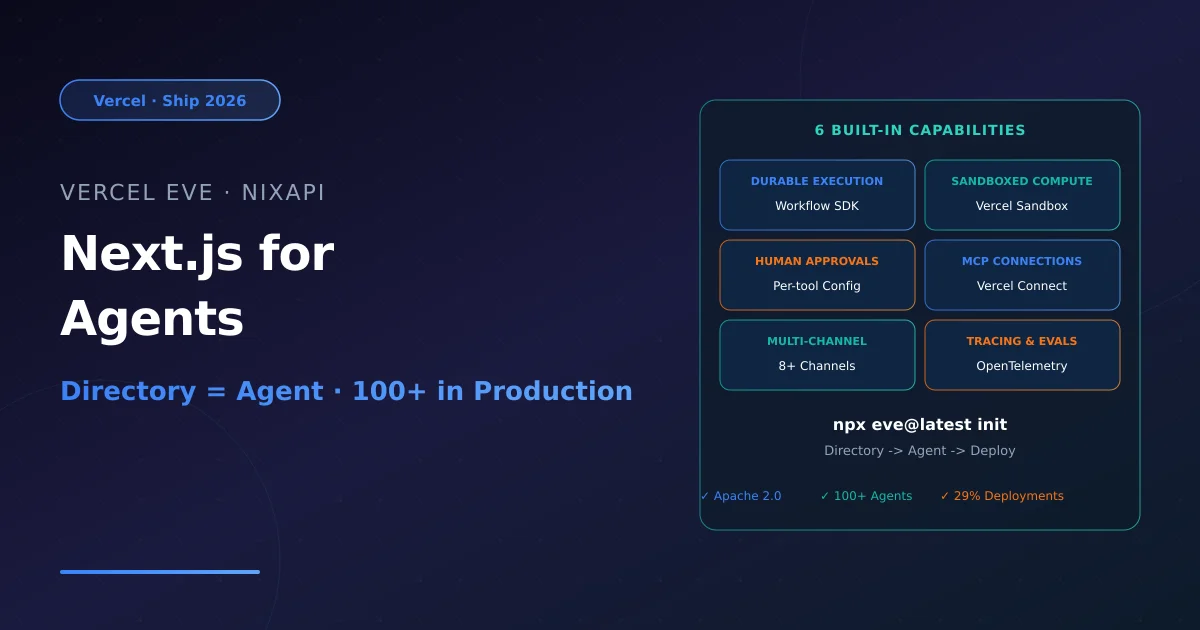
Vercel Eve Deep Dive: Next.js for Agents, Production-Grade Open-Source Agent Framework
TL;DR: Vercel Eve is the first open-source framework treating agents as directories, with six production-grade capabilities built-in: durable execution, sandboxed compute, human approvals, MCP connections, multi-channel support, and tracing. Vercel runs 100+ internal agents on it, triggering ~29% of deployments.
1. Release Context: Vercel’s Agent Infrastructure Strategy
On June 17, 2026, at its annual Ship conference, Vercel launched a suite of agent infrastructure products:
- Vercel Services: Unified frontend/backend deployment engine
- Agent Stack: AI SDK + AI Gateway + Sandbox + Workflow SDK + Chat SDK
- Vercel Connect: Secure MCP server / OpenAPI connections (replacing long-lived credentials)
- Vercel Agent: Proactive AI operations assistant (Beta)
- eve: Open-source agent framework (Apache 2.0)
Eve’s positioning is clear: “Next.js for Agents”—just as Next.js simplified full-stack web development, Eve aims to simplify agent development, deployment, and operations.
2. Core Architecture: Directory as Agent
Eve’s philosophy is filesystem-first. An agent is a directory:
my-agent/
├── model.md          # Model config (one line)
├── instructions.md   # System prompt (Markdown)
├── tools/
│   ├── search.ts     # Tool: filename becomes tool name
│   ├── deploy.ts     # Tool: auto-registered, no config needed
│   └── delete-data.ts # Sensitive tool: markable for approval
├── skills/
│   ├── coding.md     # Skill definition
│   └── analysis.md   # Skill definition
└── connections/
    ├── slack.json    # MCP connection config
    └── github.json   # API connection config
2.1 Six Built-in Capabilities
| Capability | Description | Implementation |
|---|---|---|
| Durable execution | Conversations as workflows, checkpointed per step, pause/resume | Vercel Workflow SDK |
| Sandboxed compute | Agent-generated code treated as untrusted, runs in isolated sandbox | Vercel Sandbox / Docker / microsandbox |
| Human approvals | Any tool can require human approval before execution | Configurable per-tool |
| Secure connections | MCP server / OpenAPI connections, model never sees credentials | Vercel Connect |
| Multi-channel | Same agent serves multiple surfaces | HTTP / Slack / Discord / Teams / Telegram / Twilio / GitHub / Linear |
| Tracing & evals | OpenTelemetry standard traces, export to Braintrust / Honeycomb / Datadog | Built-in eval framework |
3. Comparison with Competing Frameworks
3.1 Eve vs Mastra vs LangGraph
| Dimension | Eve | Mastra | LangGraph |
|---|---|---|---|
| Language | TypeScript | TypeScript | Python-first |
| Deployment | Vercel-native (others “coming soon”) | Any platform | Any platform |
| Durability | ✅ Built-in (Workflow SDK) | ✅ Built-in | ✅ Built-in |
| Sandbox | ✅ Built-in (Vercel Sandbox) | ⚠️ Requires config | ⚠️ Requires config |
| Human approval | ✅ Built-in | ⚠️ Requires config | ⚠️ Requires config |
| MCP support | ✅ Built-in (Vercel Connect) | ✅ Supported | ✅ Supported |
| Multi-channel | ✅ 8+ channels built-in | ⚠️ Requires config | ⚠️ Requires config |
| Tracing | ✅ OpenTelemetry built-in | ⚠️ Requires config | ⚠️ Requires config |
| License | Apache 2.0 | MIT | MIT |
| Production validation | 100+ agents at Vercel | YC-backed, v1.0 released | Most mature LangChain ecosystem |
3.2 Key Differentiators
Eve’s advantages:
- Batteries included: 6 production-grade capabilities zero-config
- Deep Vercel ecosystem integration: Deploy, sandbox, connect, trace—all one-click
- Real production validation: 100+ internal agents, 29% of deployments agent-triggered
Eve’s limitations:
- Platform lock-in (currently): Vercel-only by default, other platforms “coming soon”
- Early ecosystem: Just launched, fewer community plugins and third-party integrations
- TypeScript-only: Non-TS teams need adaptation
4. Quick Start
4.1 Initialize Project
npx eve@latest init my-agent
cd my-agent
4.2 Define Model
# model.md
gpt-4o
Support for provider fallback via Vercel AI Gateway:
# model.md
anthropic/claude-sonnet-4
# fallback: openai/gpt-4o
4.3 Define Tools
// tools/search.ts
export default async function search({ query }: { query: string }) {
  const results = await fetch(`https://api.example.com/search?q=${query}`);
  return results.json();
}
Filename becomes tool name, auto-registered, no decorators or config needed.
4.4 Deploy
vercel deploy
# Same agent directory, zero changes for production deployment
5. Production Features Deep Dive
5.1 Durable Execution: Conversation as Workflow
// Agent sessions automatically persisted
// Recoverable after crashes, recoverable after deployments
// Recoverable after human approvals
Each conversation is a Vercel Workflow SDK durable workflow:
- Automatic checkpointing per step
- Supports pause, resume, retry
- State preserved across deployments
5.2 Sandboxed Compute: Secure Agent Code Execution
// tools/run-code.ts
// Mark as requiring sandbox
export const config = { sandbox: true };

export default async function runCode({ code }: { code: string }) {
  // Executed in isolated sandbox, no host filesystem access
  return executeInSandbox(code);
}
- Local: Docker / microsandbox / bash
- Production: Vercel Sandbox (auto-switch, zero config)
5.3 Human Approvals: Sensitive Operations Under Control
// tools/delete-database.ts
export const config = { requireApproval: true };

export default async function deleteDatabase({ confirm }: { confirm: boolean }) {
  // Pauses before execution, waits for human approval in Vercel Dashboard
  if (!confirm) throw new Error("Approval required");
  return db.delete();
}
5.4 MCP Connections: Secure External Service Integration
// connections/slack.json
{
  "type": "mcp",
  "server": "https://mcp-slack.example.com",
  "auth": "vercel-connect"
}
- Model never sees URL or credentials
- Vercel Connect auto-handles OAuth and token refresh
- Supports Slack, GitHub, Snowflake, Salesforce, Notion, Linear
6. NixAPI Perspective: Unified API Layer + Agent Framework Synergy
For developers using NixAPI, Eve’s MCP connection capability means:
// Through NixAPI MCP server, connect unified API to Eve agent
// connections/nixapi.json
{
  "type": "mcp",
  "server": "https://mcp.nixapi.com",
  "auth": "vercel-connect"
}
Synergy value:
- Model routing: Eve’s AI Gateway fallback + NixAPI’s unified routing = double reliability
- Cost optimization: NixAPI auto-selects lowest-cost model, Eve’s tracing provides transparent billing
- Multi-model agents: One Eve agent can call Claude, GPT, M3, and other models through NixAPI
- Data sovereignty: NixAPI’s private deployment + Eve’s self-hosted sandbox = complete data control
7. Summary and Outlook
| Dimension | Rating | Notes |
|---|---|---|
| Ease of use | ⭐⭐⭐⭐⭐ | Directory-as-agent, zero-config production capabilities |
| Production readiness | ⭐⭐⭐⭐⭐ | Validated by 100+ internal agents at Vercel |
| Ecosystem openness | ⭐⭐⭐ | Currently Vercel-locked, other platform support pending |
| NixAPI relevance | ⭐⭐⭐⭐⭐ | MCP connections + unified API layer natural fit |
Vercel Eve represents a paradigm shift in agent frameworks: from “toolchains requiring heavy configuration” to “batteries-included infrastructure.” For teams already in the Vercel ecosystem, Eve is the most rational choice for agent development.
For non-Vercel users, recommendations:
- Watch progress: Vercel promises “support for other platforms coming soon”
- Evaluate Mastra: If cross-platform deployment is needed, Mastra v1.0 is the more mature TypeScript option
- Try it out: Experience directory-as-agent development via
npx eve@latest init
This article is based on publicly available information from June 17-18, 2026. Eve is currently in public preview—APIs and features may continue to evolve.
Try NixAPI Now
Reliable LLM API relay for OpenAI, Claude, Gemini, DeepSeek, Qwen, and Grok with ¥1 = $1 top-up
Sign Up Free